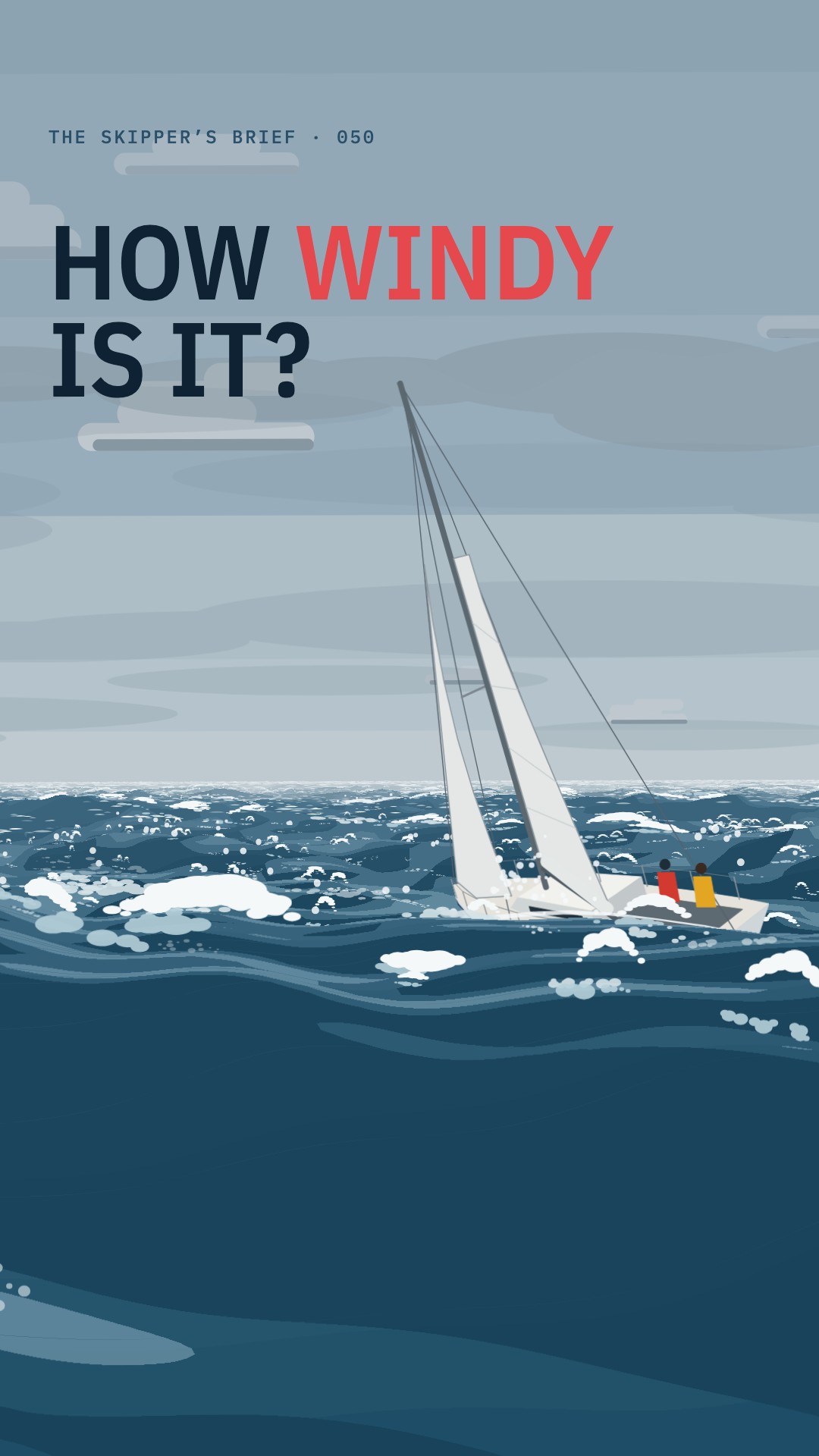
Brief #050 · BEAUFORT
How windy is it? Read the sea
Weather & sea
The Beaufort scale rates the wind from force 0 (a sea like a mirror) to 12 (a hurricane) by how the sea looks: at force 3 (7–10 knots) crests begin to break, at force 4 (11–16 knots) white horses are fairly frequent, at force 6 (22–27 knots) foam crests are everywhere, and at force 8, a gale (34–40 knots), crests break into spindrift and foam blows in streaks. Francis Beaufort's original scale went by how much sail a warship could carry; the sea descriptions came later. Rule of thumb: white horses everywhere means force 5 or more, so in a small boat, reef early or head in.
Descriptions are for the open sea; near land, waves are smaller and steeper. When to reef depends on your boat and crew.
Transcript
How windy is it? Read the sea.
From force 0, a mirror, to 12, a hurricane.
What force is this? Crests begin to break. Force 3: 7 to 10 knots.
Fairly frequent white horses? Force 4: 11 to 16 knots.
Large waves, foam crests everywhere? Force 6: 22 to 27 knots.
Spindrift and streaks of foam? Force 8: 34 to 40 knots.
Beaufort's original scale went by how much sail a warship could carry.
White horses everywhere? That's force 5 or more.
In a small boat, reef early, or head in.
Want to learn more interesting facts like this? Follow the page.
Sources
- Met Office, Beaufort wind force scale: 'an empirical measure of wind intensity based on observed sea conditions'; force 0 calm (<1 kt), force 3 gentle breeze 7–10 kt (probable wave height 0.6 m), force 4 moderate breeze 11–16 kt (1.0 m), force 5 fresh breeze 17–21 kt (2.0 m), force 6 strong breeze 22–27 kt (3.0 m), force 8 gale 34–40 kt (5.5 m), force 12 hurricane 64+ kt; wave heights refer to well-developed wind waves of the open sea
- US National Weather Service (Miami), Beaufort Wind Scale, specifications for use at sea: force 0 'Sea like a mirror'; force 3, 7–10 kt: 'Large wavelets. Crests begin to break. Foam of glassy appearance. Perhaps scattered white horses'; force 4, 11–16 kt: 'Small waves, becoming larger; fairly frequent white horses'; force 5, 17–21 kt: 'many white horses are formed'; force 6, 22–27 kt: 'Large waves begin to form; the white foam crests are more extensive everywhere'; force 8 gale, 34–40 kt: 'edges of crests begin to break into spindrift. The foam is blown in well-marked streaks along the direction of the wind'; force 12 hurricane, 64–71 kt
- Met Office National Meteorological Library and Archive, Fact sheet 6 – The Beaufort Scale (archived 2012): 'Francis Beaufort devised his scale of wind force in 1805, when serving aboard HMS Woolwich'; in 1807 'he added a description of the canvas that could be carried by a fully rigged frigate'; the 1838 Admiralty criteria run from 'royals' at force 5 and 'double-reefs, jib, etc.' at force 7 to force 12, 'To which she could show no canvas'; George Simpson's scale 'based on the sea's appearance' was devised in 1906; force 0 to 12 for all normal purposes; force 12 is 64 knots or more
- NOAA National Centers for Environmental Information, Marine Beaufort Scale: 'originally developed in 1805 by Sir Francis Beaufort as a system for estimating wind strengths without the use of instruments'; force 4 'some white horses', force 5 'many white horses', force 7 'foam blown in streaks downwind', force 8 gale, 34–40 knots, 'crests break into spindrift'
- NOAA JetStream, Wind and Sea Scales: in 1807 Beaufort added criteria to his 0–12 scale showing how much of a British man-of-war's sails would be used at each force; adopted for all Royal Navy log books in December 1838; 'as ship design changed and steam power became widespread, the scale had to be modified'
- Royal Meteorological Society, The Beaufort Wind Scale: devised in 1805 by Francis Beaufort while serving on HMS Woolwich; force 4 (11–16 kt) 'Small waves, fairly frequent white horses'; force 5 (17–21 kt) 'Moderate waves, many white horses'; force 6 (22–27 kt) 'Large waves, extensive foam crests'
- Met Office, Inshore waters forecast guide: 'Strong coastal winds (Strong Breeze force 6 or more) are displayed for the first 24 hours of the inshore waters forecast'
- US National Weather Service, Coastal Warning Display Program: Small Craft Advisory thresholds are set by area, from sustained winds or frequent gusts of 20–25 knots up to 33 knots (e.g. Southern region 20 to 33 knots, Western 21 to 33, Eastern 25 to 33 with 20–25 knot lower thresholds in harbors and bays); 'There is no precise definition of a small craft'
- Yachting Monthly, Reefing: how, when and why do we do it? (James Jermain): 'Most boats are designed to require the first reef in around 18 knots apparent wind when sailing to windward'; 'The time to reef is when you first think of it'; 'you will seldom regret reefing early and you will almost always regret reefing late'