Brief #083 · ISOLATED DANGER
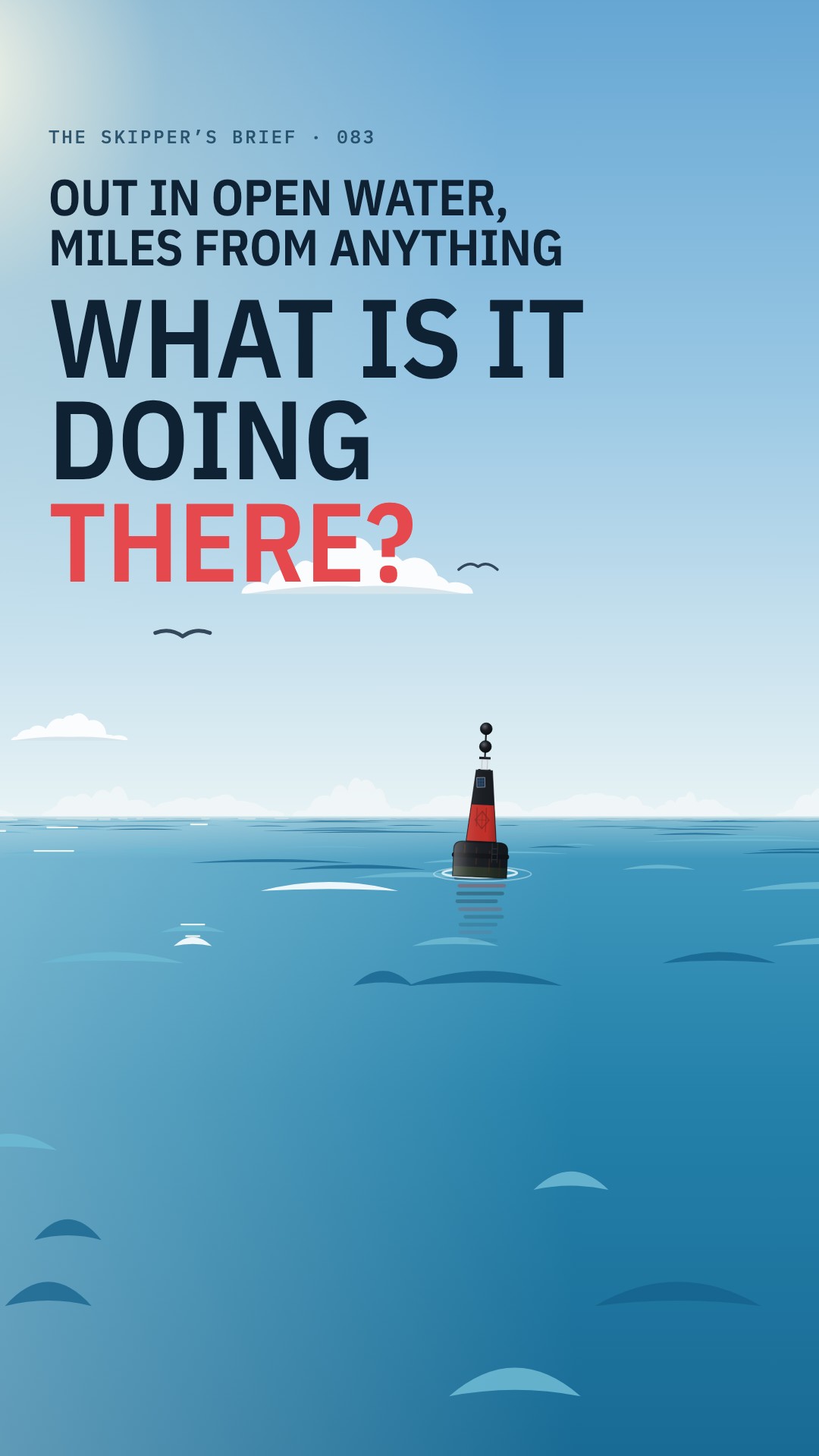
A buoy out in open water, miles from anything. What is it doing there?
Navigation
A black buoy with a broad red band and two black balls on top, alone in open water, is an isolated danger mark. It's moored on or above a danger, a rock or a wreck, that has navigable water all round it. Pass it on any side, but give it a wide berth: the chart shows how far the danger reaches, and it's no place to stop or anchor. A cardinal mark stands beside a danger and tells you which side is safe; this one sits on the danger itself. At night it shows a white light flashing in groups of two. To remember it: two balls, two flashes. It looks the same in both IALA regions, A and B.
IALA Maritime Buoyage System: isolated danger marks are the same in Regions A and B. How far the danger reaches and how far off to pass aren't fixed, so check the chart.
Transcript
This buoy is out in open water, miles from anything. What is it doing there?
It's a real question from the test at theskippersbrief.com.
It's sitting on a danger: a rock or a wreck, right under it.
There's water all round, so pass on any side. But give it a wide berth.
A cardinal mark stands beside a danger. This one sits right on it.
So it's no place to stop or anchor.
By day: black, with a red band, and two black balls on top.
At night, it flashes white, in twos.
Easy to remember: two balls, two flashes.
Take the free test at theskippersbrief.com.
Sources
- IALA Recommendation R1001, The IALA Maritime Buoyage System, Edition 2.0 (June 2023), the same in Regions A and B (copy hosted by Irish Lights). §2.3.1.1: an Isolated Danger mark is 'erected on, or moored on or above, an isolated danger which has navigable water all around it'; §2.3.1: the extent of the danger and the safe passing distance 'cannot be specified for all circumstances', so the mariner consults the charts; Table 7: topmark 'Two black spheres, one above the other', colour 'Black with one or more broad horizontal red bands', pillar or spar preferred, light white, 'Group flashing (2)'; §2.3.2.1: on a buoy the spheres are at least 20 % of its waterline diameter and about half a diameter apart. §2.2.1: 'Cardinal marks indicate where safer water lies in the area, in relation to a point of interest'; 'The type of Cardinal mark indicates which side of the mark it should be passed by'
- US Code of Federal Regulations, 33 CFR 62.29, Isolated danger marks: they 'indicate an isolated danger which may be passed on all sides'; as they are 'erected or moored on or near dangers, they should not be approached closely without special caution'; black with one or more broad horizontal red bands, topmark two black spheres, one above the other
- US Code of Federal Regulations, 33 CFR 62.23(c)(2): mariners passing a buoy close aboard 'risk collision with a yawing buoy, the buoy's mooring, or with the obstruction which the buoy marks'
- Wikipedia, Navigational aid: an isolated danger mark, black with a horizontal red band and two black balls on top, 'indicates a danger (shoal, rock, wreck etc.) which is isolated with safe water all around'; 'A north cardinal mark is placed to the north of a hazard and indicates safe water is to the north of the mark'
- Wikipedia, Isolated danger mark: generally a pillar or spar, black with one or more broad horizontal red bands, a topmark of two black spheres stacked vertically; if lit, a white light 'Fl(2) W', a group of two flashes then a longer dark period
- Canadian Hydrographic Service, Chart 1, section Q, IALA Maritime Buoyage System: 'two international Buoyage Regions - A and B - where lateral marks differ'; of the cardinal and other marks, 'all marks are the same in Regions A and B'; isolated danger marks are 'stationed over dangers with navigable waters around them', body black with red horizontal band, topmark 2 black spheres, white light
- Maritime Safety Victoria (Safe Transport Victoria), boating safety handbook, Isolated danger marks: on, or moored above, an isolated danger with navigable water all around it; red and black horizontal stripes, a topmark of two black spheres, a white light showing a group of two flashes; 'It may help to remember this mark by associating the two flashes with two spheres'; the marks are 'not always positioned centrally over a danger', so refer to a chart and don't pass too close
- US Navy training manual Seaman (NAVEDTRA 14067), p. 5-34, Isolated danger marks: a black double-sphere topmark is by day the most important feature; when lighted, a white light showing a group of two flashes; 'The association of two flashes and two spheres in the topmark may be a help in remembering these characteristics' (free copy at Integrated Publishing)
- The Skipper's Brief, Buoyage course (checked 2026-11-14), module 'Danger, safe water, special and wreck marks'. Question isolated-danger-mark: 'You find this buoy in open water. What is there, and how do you pass it?' Options: safe water, pass close either side; a small danger, pass wide, either side (right); a danger to its south, pass north; a channel edge, keep it to port. Question isolated-danger-anchoring: 'You're looking for a lunch stop. Is the water right by this buoy a good place to anchor?' Answer: no, it stands on a small danger. Every course starts with 3 free questions, no sign-up