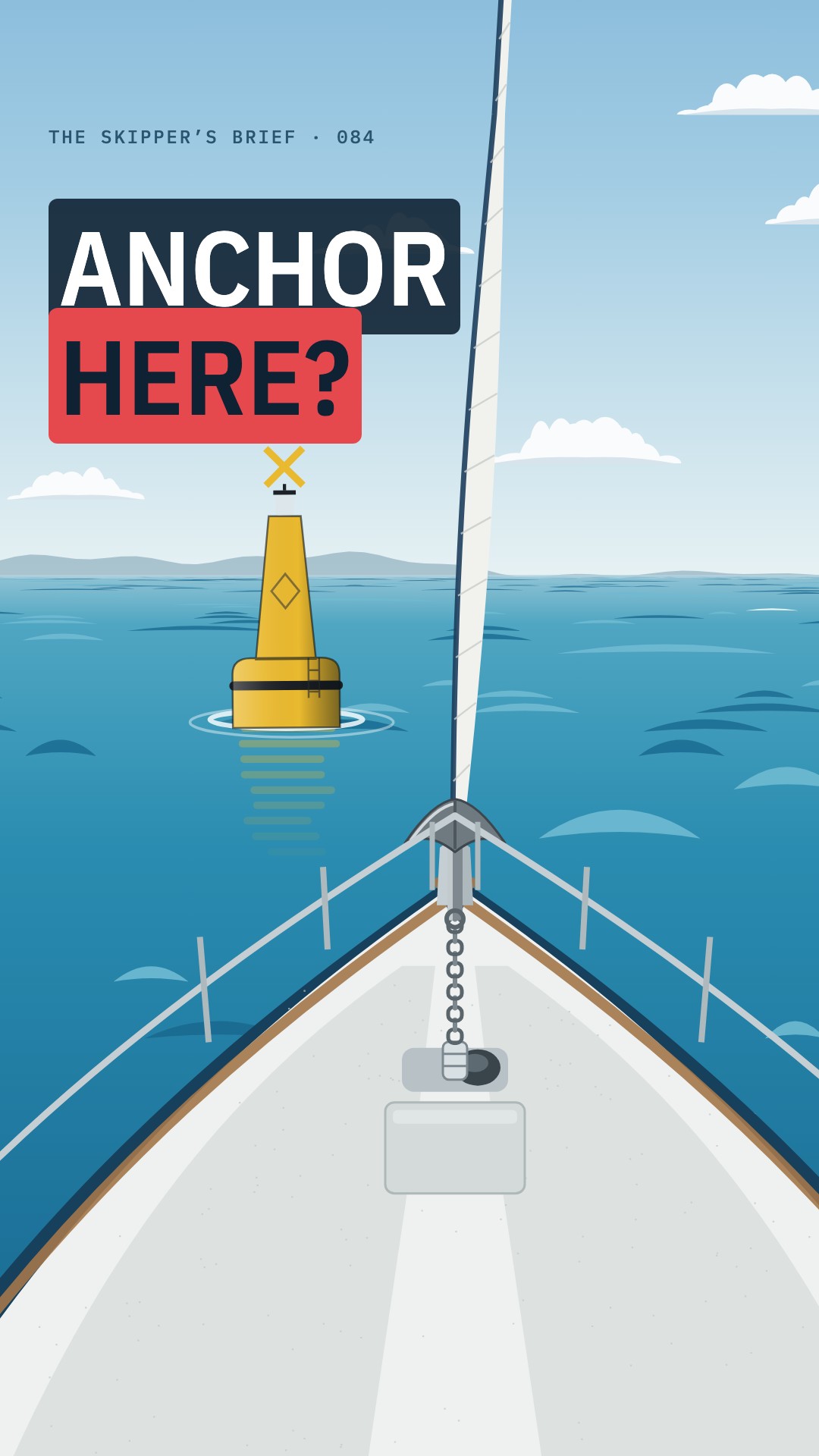
Brief #084 · SPECIAL MARK
Anchor next to this yellow buoy? You could hook a power cable.
Navigation
A yellow buoy with a yellow X on top is a special mark. It isn't mainly there to show you a channel or which side to pass: it marks a special area or feature, and the chart or another nautical publication says what. IALA's examples include a cable or pipeline, a fish farm, a recreation zone such as a swimming area, a military exercise zone, a spoil ground and a data buoy. So before you anchor or fish near one, check the chart: anchors and fishing gear cause most of the damage to undersea cables, and many cables carry voltages that can kill anyone who tries to cut one free. At night a special mark shows a yellow light, in a rhythm that no white light of the buoyage system uses. It looks the same in both IALA regions, A and B.
IALA Maritime Buoyage System: special marks are the same in Regions A and B. Authorities use them for many things, so only the chart, or the local notices it points to, says what a given one marks and whether you may anchor or fish near it.
Transcript
Anchor next to this yellow buoy? You could hook a power cable.
It's a real question from the test at theskippersbrief.com.
Check the chart first. Yellow with an X on top is a special mark.
It's not about which side you pass. It's about what's there.
A cable or a pipeline. A fish farm. A swimming area. A data buoy.
Hook a cable with your anchor, and you can damage it. Try to cut it free, and it could kill you.
At night, its light is yellow, in a rhythm no white light uses.
Think of it as X marks the spot: the chart says what's there.
Take the free test at theskippersbrief.com.
Sources
- IALA Recommendation R1001, The IALA Maritime Buoyage System, Edition 2.0 (June 2023). §2.5.1 Special marks: they 'are used to indicate a special area or feature whose nature may be apparent from reference to a chart or other nautical publication. They are not generally intended to mark channels or obstructions where the MBS provides suitable alternatives.' §2.5.2.1 topmark: a single 3-D yellow diagonal cross ('X'), its arms within a square about 33 % of the buoy's waterline diameter. §2.5.2.2: 'Special marks are yellow'; 'any light used is also yellow'; 'the yellow lights of Special marks do not have any of the rhythms used for white lights'; their shape will not conflict with other marks, so 'a Special mark located on the port hand side of a channel may be cylindrical but will not be conical'. Examples of uses: Ocean Data Acquisition Systems (ODAS) marks; traffic separation marks; spoil ground marks; military exercise zone marks; cable or pipeline marks; recreation zone marks; boundaries of anchorage areas; man-made structures; aquaculture; mooring buoys; moving object or hazard (MAtoN). Table 9: colour yellow; topmark (if any) single yellow 'X'; light yellow, any rhythm 'other than those reserved for Cardinal, Isolated Danger, MAtoN and Safe Water marks'. §2.1.1: the two regions differ only in lateral marks (copy hosted by Irish Lights)
- Canadian Hydrographic Service, Chart 1, section Q, IALA Maritime Buoyage System: 'In the illustrations below, all marks are the same in Regions A and B' except the lateral marks; special marks are 'not primarily to assist navigation but to indicate special features'; topmark (if any) yellow X; light (if any) yellow
- US Code of Federal Regulations, 33 CFR 62.31, Special marks (US aids to navigation): they 'are not primarily intended to assist safe navigation, but to indicate special areas or features referred to in charts or other nautical publications'; they may mark, for example, 'anchorages, cable or pipeline areas, traffic separation schemes, military exercise zones, ocean data acquisition systems'; 'Special marks are colored solid yellow'
- International Cable Protection Committee, 'Charting Submarine Cables Is Critical for Maritime Safety & Infrastructure Protection' (updated 25 June 2025): fishing and anchoring 'already cause more than 70 percent of cable damage to submarine telecommunications cables globally each year'; 'Submarine cables must be clearly marked on charts to help vessels plan safe passage'; mariners should 'avoid fishing or anchoring over submarine cables, where possible'
- KIS-ORCA (Kingfisher Information Service, Offshore Renewable & Cable Awareness), 'The Risks of Fishing near Cables & Renewable Energy Structures': 'Most modern submarine cables carry high voltages which may prove lethal if attempts are made to cut them'; 'Heavily armoured cables are very strong and have high breaking strains'. Its Emergency Procedures page: 'DO NOT endanger your vessel and crew by attempting to recover your gear'
- United Nations Convention on the Law of the Sea, Part VII, Article 113: every State shall make it a punishable offence for its ships or people to break or injure a submarine cable beneath the high seas wilfully or through culpable negligence, 'and similarly the breaking or injury of a submarine pipeline or high-voltage power cable'; Article 115: ship owners who prove they sacrificed an anchor, a net or other fishing gear to avoid injuring a submarine cable or pipeline are to be indemnified by its owner, if they took all reasonable precautions beforehand
- The Skipper's Brief, Buoyage course (checked 2026-11-14): 'Every course starts with 3 free questions, with no sign-up'. Module 'Danger, safe water, special and wreck marks', question: 'You want to anchor near this yellow mark with an X on top. What should you do first?' Options: anchor beside it, yellow means safe; pass north of it, danger to the south; keep it to port, it's a channel mark; check the chart for what it marks (right). Explanation: a special mark is 'not a guide round a danger, but a sign of a special area or feature', and 'The chart says which'