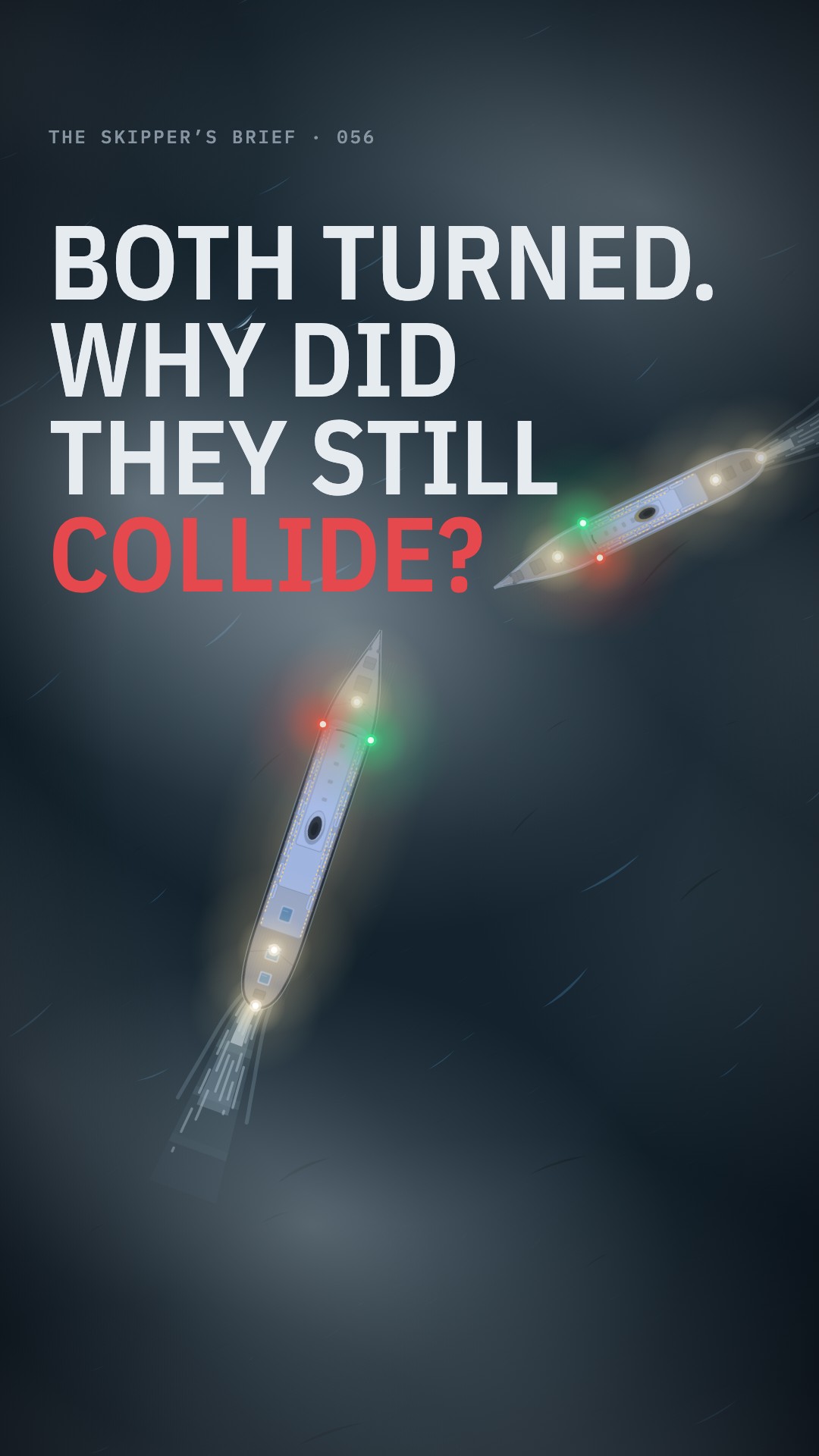
Brief #056 · RULE 19
Both ships saw each other on radar. Why did they still collide?
Rules of the road
In fog off Nantucket in July 1956, the liners Andrea Doria and Stockholm watched each other on radar from miles away, then turned opposite ways, the Andrea Doria to the left and the Stockholm to the right, into each other. 51 people died and the Andrea Doria sank the next morning. Back then no rule said which way to turn for a ship seen only on radar; today's fog rule does: for a ship ahead that you detect by radar alone, avoid turning to port. Turn to starboard, early, and slow down.
International rules (COLREGs), for vessels not in sight of one another in or near restricted visibility. Inland waters can have their own rules.
Transcript
Both ships saw each other on radar. Both turned. Why did they still collide?
Fog off Nantucket, 1956. The Andrea Doria saw the Stockholm 17 miles away.
The Andrea Doria turned left. The Stockholm turned right. Into each other.
51 people died. She sank the next morning.
Back then, no rule said which way to turn on radar alone. Today one does. It's in my Rules of the Road course.
Fog. Your radar shows a ship ahead, coming your way. Which way do you turn?
To the right, early, and slow down. Turn left while she turns right, and you meet. Ship ahead in fog: go right, go slow.
Try three free questions at theskippersbrief.com.
Sources
- Samuel Halpern, 'An Objective Forensic Analysis of the Collision Between Stockholm and Andrea Doria' (foreword by Capt. Les Eadie, Maine Maritime Academy), from the New York pretrial-hearing testimony and both ships' course recorders: the westbound Andrea Doria, in dense fog since 3 p.m. at 21.8 knots, picked up the Stockholm on radar at about 17 miles, about 26 minutes before the collision; the Stockholm, in mostly clear weather at 18.5 knots, picked her up at about 12 miles; the Doria's officers expected a starboard-to-starboard passing and turned 4 degrees to port, then hard to port; the Stockholm's third officer expected port-to-port and turned 24 degrees to starboard, then hard to starboard; collision at 11:11 p.m., 25 July 1956; 46 Andrea Doria passengers and 5 Stockholm crew died, 1,660 rescued; she sank at 10:09 a.m. the next morning; 'described as the world's first major radar assisted collision at sea'
- Professional Mariner, 'The end of a ship, and an era' (Jim Austin, 25 August 2009): the Doria saw 'a radar echo 4° to starboard at 17 miles' and her master ordered a 4° change 'left'; the Stockholm's officer saw 'a radar contact at 12 miles and slightly to port' and ordered 'a 20° course change to starboard'; 'The collision took 51 lives, five aboard Stockholm and 46 aboard Doria'; quoting Farwell, the 1948 conference 'did not make special provisions for vessels equipped with radar', and not until the 1972 COLREGs 'would the role and responsibilities relating to radar be clarified'
- HISTORY.com, 'Ships collide off Nantucket' (This Day in History, 25 July): at 11:10 p.m. on 25 July 1956, in heavy Atlantic fog about 45 miles south of Nantucket, the Andrea Doria and the Stockholm collided; both had radar; 51 people were killed; 1,660 were rescued, 'the greatest civilian maritime rescue in history'; the Ile de France took charge of the rescue; the Andrea Doria sank at 10:09 a.m. on 26 July
- Wikipedia, 'SS Andrea Doria' (cross-check, secondary): collision around 11:10 p.m. on 25 July 1956 off Nantucket; the Andrea Doria steered to her left for a starboard-to-starboard passing, then turned hard to port; the Stockholm turned about 20° to her right for a port-to-port passing, then hard to starboard; the Andrea Doria sank at 10:09 a.m. on 26 July; Ile de France took 753 survivors; 'essentially a radar-assisted collision'
- The Journal of Navigation, Vol. XI No. 2 (1958), Forum 'Radar and the Collision Regulations' and following letters (doi 10.1017/S0373463300038972): navigators debating radar rules after the 1957 Genoa radar conference, with the Andrea Doria case cited; Capt. R. G. Swallow RN: 'there are no steering rules other than Rules 25 and 27 applicable to ships not in sight of one another'; Cdr P. C. H. Clissold proposes that a radar-only alteration of course 'should only be to starboard', noting that 'this prohibition to alter course to port would have avoided collision' in the cases examined; Capt. Oudet: 'When two vessels are not in sight of one another neither has the right of way'
- The 1960 Collision Regulations' Annex, 'Recommendations on the use of radar information as an aid to avoiding collisions at sea', as reproduced by Ancient Mariner (blog, secondary): (5)(c) 'A succession of small alterations of course should be avoided'; (6) 'An alteration to starboard, particularly when vessels are approaching on opposite or nearly opposite courses, is generally preferable to an alteration to port'; (8) 'the most prudent action may be to take all way off'
- IMO, 'IMO and the safety of navigation' (Focus on IMO, January 1998): with radar spreading, the 1960 conference revised the collision rules and put 'recommendations concerning the use of radar' in an Annex; the 1972 COLREGs were adopted on 20 October 1972 and entered into force on 15 July 1977; Part B Section III (Rule 19) covers conduct in restricted visibility
- Proceedings of the Ninth International Conference on Maritime Education and Training (Nippon Foundation library): the Andrea Doria and the Stockholm collided in 1956 'in dense fog although both ships were equipped with radar and were in fact using it'; 'these kinds of accidents came to be known as "radar-assisted collisions"'
- COLREGs Rule 19, Conduct of vessels in restricted visibility: (a) applies to vessels not in sight of one another in or near restricted visibility; (b) every vessel at a safe speed, engines ready; (d) a vessel which detects another by radar alone and finds a close-quarters situation or risk of collision developing 'shall take avoiding action in ample time', and so far as possible avoid '(i) an alteration of course to port for a vessel forward of the beam, other than for a vessel being overtaken; (ii) an alteration of course towards a vessel abeam or abaft the beam'; (e) on hearing a fog signal apparently forward of the beam, or unable to avoid a close-quarters situation with a vessel forward of the beam, 'reduce her speed to the minimum at which she can be kept on her course' (International text, Canada's Collision Regulations, Schedule 1)
- COLREGs Rules 11 and 3(k): the steering rules of Section II (give way, stand on, head-on, crossing) 'apply to vessels in sight of one another', and vessels are in sight of one another 'only when one can be observed visually from the other'; out of sight in fog, Rule 19 applies to both and neither stands on (International text, Canada's Collision Regulations, Schedule 1)
- COLREGs Rule 14(a), Head-on situation (vessels in sight of one another): two power-driven vessels meeting on reciprocal or nearly reciprocal courses 'each shall alter her course to starboard so that each shall pass on the port side of the other' (International text, Canada's Collision Regulations, Schedule 1)
- The Skipper's Brief, Rules of the Road course page: '3 free questions in every course', 'no sign-up'; module 'Restricted visibility' (Rule 19), including a vessel detected by radar alone almost dead ahead (alter to starboard, early, and slow down)