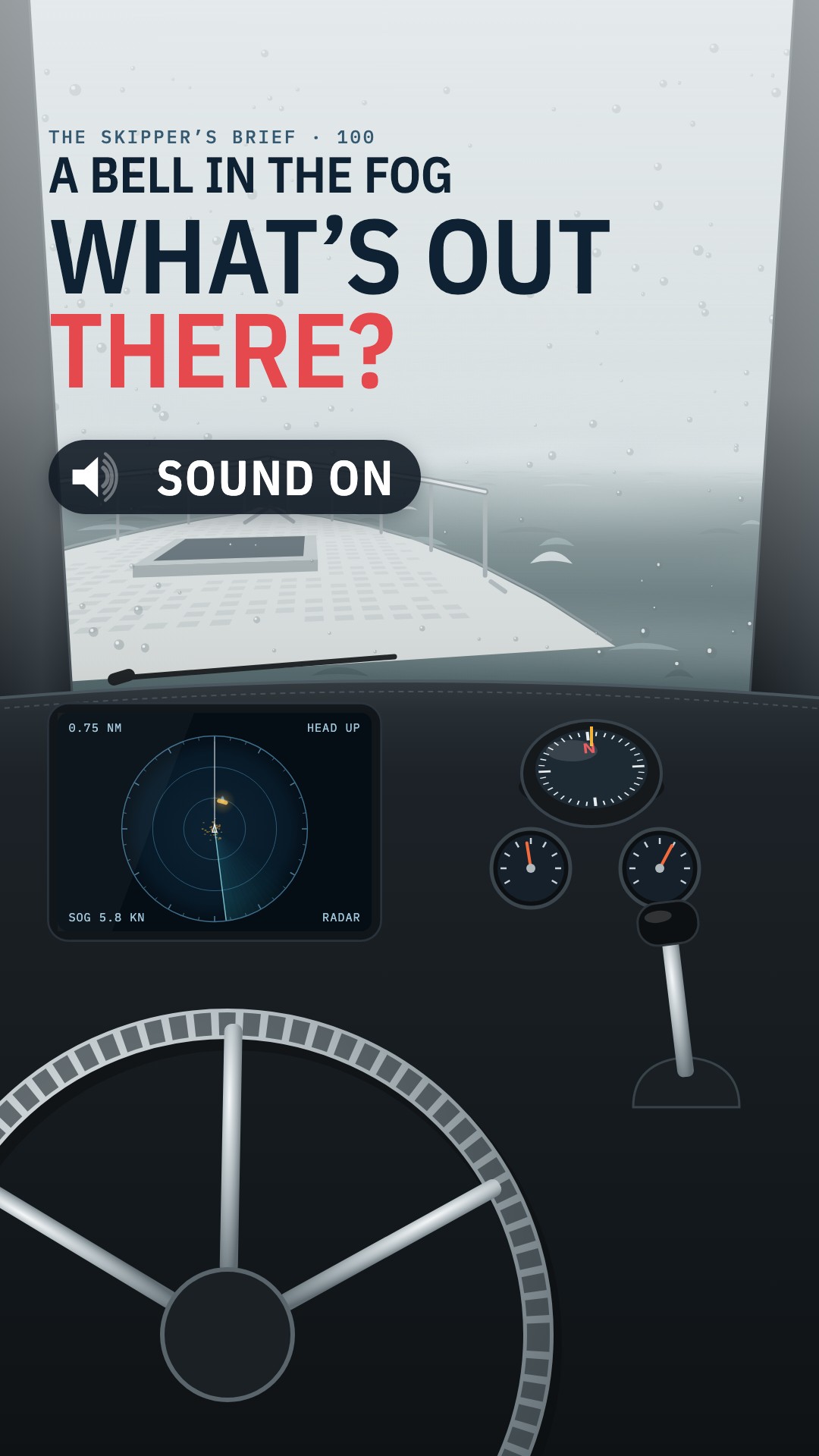
Brief #100 · SOUND ON
Sound on. A bell is ringing in the fog. What's out there?
Rules of the road
A bell rung rapidly for about 5 seconds, again at intervals of not more than a minute, is a vessel at anchor in or near restricted visibility (COLREG Rule 35(g)). A vessel of 100 m or more rings the bell in her fore part and, immediately after it, sounds a gong rapidly for about 5 seconds in her after part. She may also sound one short, one prolonged and one short blast to warn a vessel coming close. A vessel aground gives the same bell signal (and the gong, if she is 100 m or more) with three separate and distinct strokes on the bell immediately before and after the rapid ringing (Rule 35(h)). A vessel of 20 m or more carries a bell, and one of 100 m or more a gong as well (Rule 33); one under 20 m needn't give the bell signals, and one under 12 m needn't give any of these signals, but either must then make some other efficient sound signal at intervals of not more than 2 minutes (Rule 35(i) and (j)). What it means for you: she is stopped, right there in the fog. Hear a fog signal apparently forward of your beam and you slow to the least speed at which you can keep your course, take all your way off if you must, and go with extreme caution until the danger is past (Rule 19(e)). Give her room. One way to remember it: bell, she's stopped; three strokes round it, she's stuck.
International rules (COLREGs). The US Inland Rules (33 CFR 83.35) give the same bell, gong and aground signals; there, a vessel under 20 m, or a barge, canal boat, scow or other nondescript craft, anchored in a special anchorage area designated by the Coast Guard needn't sound the anchor signal. Inland waters can have their own rules.
Transcript
Sound on. A bell is ringing in the fog. What's out there?
Fog signals are in the test at theskippersbrief.com.
A ship at anchor.
Her bell rings fast for about five seconds, at least once a minute.
She's over 100 metres, so right after the bell, a gong sounds aft.
What it means: she's stopped, right there. Slow right down, and give her room.
Three strokes before and after? She's aground. Keep well clear.
To remember it: bell, she's stopped. Three strokes round it, she's stuck.
Take the free test at theskippersbrief.com.
Sources
- COLREGs Rule 35, Sound signals in restricted visibility: 'In or near an area of restricted visibility, whether by day or night'; (g) a vessel at anchor 'shall at intervals of not more than one minute ring the bell rapidly for about five seconds'; in a vessel of 100 m or more 'the bell shall be sounded in the forepart of the vessel and immediately after the ringing of the bell the gong shall be sounded rapidly for about five seconds in the after part'; she 'may in addition sound three blasts in succession, namely one short, one prolonged and one short blast'; (h) a vessel aground gives the bell signal and if required the gong signal, and 'three separate and distinct strokes on the bell immediately before and after the rapid ringing of the bell'; (i) a vessel of 12 m to under 20 m, and (j) one under 12 m, needn't give these signals, but if she doesn't, she makes 'some other efficient sound signal at intervals of not more than 2 minutes'. No Canadian modification to (g) and (h). The reel's ship is 122 m, so she has the gong; the aground ship is 90 m. The memory line ('bell, she's stopped; three strokes round it, she's stuck') is our own, not wording from the rules (International text, Canada's Collision Regulations, Schedule 1)
- COLREGs Rule 33(a): a vessel of 12 m or more has a whistle, 'a vessel of 20 metres or more in length shall be provided with a bell in addition to a whistle, and a vessel of 100 metres or more in length shall, in addition, be provided with a gong, the tone and sound of which cannot be confused with that of the bell'; the bell or gong may be replaced by equipment with the same sound, 'provided that manual sounding of the prescribed signals shall always be possible'. Annex III 2: a bell's mouth is at least 300 mm across on a vessel of 20 m or more, and 'a power-driven bell striker is recommended' (many ships ring the bell from the bridge; the reel shows it rung by hand). The bell and gong in the reel are our own synthesis: inharmonic partials with a long decay for the bell, a lower, washier tone for the gong (International text, Canada's Collision Regulations, Schedule 1 and Annex III)
- COLREGs Rule 19(e): 'every vessel which hears apparently forward of her beam the fog signal of another vessel' (unless it has been determined that a risk of collision does not exist) 'shall reduce her speed to the minimum at which she can be kept on her course. She shall if necessary take all her way off and in any event navigate with extreme caution until danger of collision is over.' Rule 20(c) and 30(a): by day in fog she shows her anchor lights as well as her one black ball forward, as drawn (International text, Canada's Collision Regulations, Schedule 1)
- US Code of Federal Regulations, 33 CFR 83.35 (Inland Rule 35): the same anchor signal in (g) ('ring the bell rapidly for about 5 seconds', at intervals of not more than 1 minute, the gong aft on a vessel of 100 meters or more) and the same aground signal in (h) ('three separate and distinct strokes on the bell immediately before and after the rapid ringing'); (l) a vessel under 20 meters, or a barge, canal boat, scow or other nondescript craft, anchored in a special anchorage area designated by the Coast Guard isn't required to sound the anchor signal (Cornell LII mirror of the eCFR)
- The Skipper's Brief, Lights and Signals course (paid part; every course starts with 3 free questions, with no sign-up; checked 2026-11-14). Fog signals are in module 'Sound signals' (questions fog-prolonged-two-short, fog-two-prolonged, fog-motor-sailing) and in the free question pilot-boat-in-fog; fog-two-prolonged's explanation says 'A vessel at anchor rings a bell'. No question asks about the bell or gong itself, so the reel's options are our own and the narration doesn't call it a course question. Module 'Pilot boats, at anchor and aground', question aground-lights: 'Aground means shallow water nearby: keep well clear of her'