Brief #086 · RULE 10
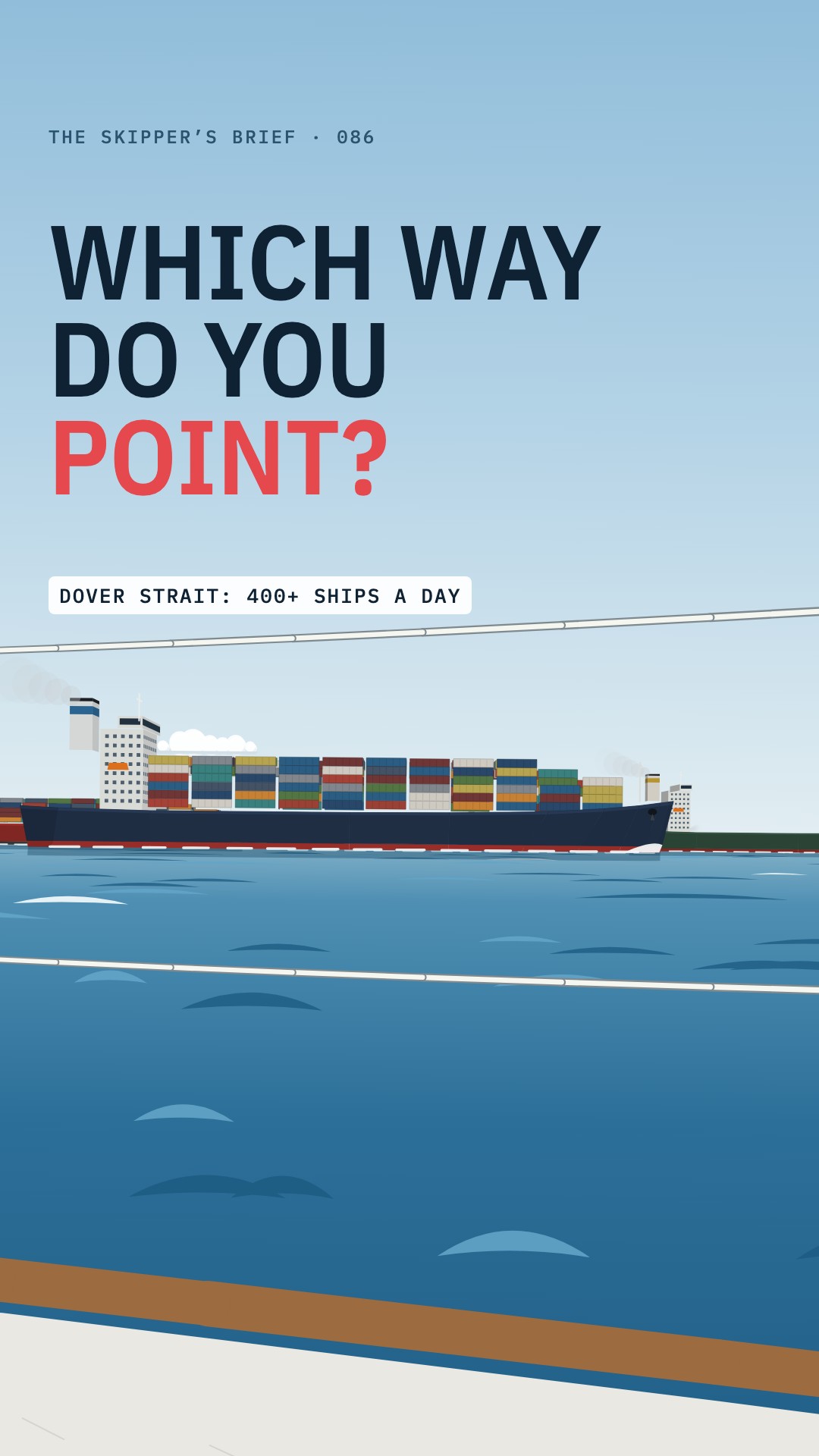
You have to cross a shipping lane. Which way do you point?
Rules of the road
Crossing a traffic separation scheme: avoid crossing the lanes if you can, and if you must, cross on a heading as nearly as you can at right angles to the general direction of the traffic. It's your heading that counts, not your track: when the tide sets you sideways, keep your bow pointing straight across and let your track slant. A ship following the lane then sees you side on and knows at once that you're crossing. Pointing into the tide to make a square track leaves your bow at an angle to the lane, and your intention is harder for the ships to read. Under sail, or under 20 metres, you must not impede a power-driven vessel following the lane.
International rules (COLREGs), Rule 10: traffic separation schemes adopted by the IMO. Inland waters can have their own rules.
Transcript
You have to cross a shipping lane, and the tide is pushing you sideways. Which way do you point?
It's a real question from the test at theskippersbrief.com.
Point straight across, at right angles to the lanes.
Let the tide set you sideways. Your track slants. The rule counts your heading, not your track.
A ship sees your side, and knows at once you're crossing.
Point into the tide instead, and you're harder to read.
Under sail, or under 20 metres, don't impede ships following the lane.
Easy to remember: bow across, whatever the tide.
Take the free test at theskippersbrief.com.
Sources
- COLREGs Rule 10(c): 'A vessel shall, so far as practicable, avoid crossing traffic lanes but, if obliged to do so, shall cross on a heading as nearly as practicable at right angles to the general direction of traffic flow.' Rule 10(a): the Rule applies to traffic separation schemes adopted by the IMO and does not relieve any vessel of her obligation under any other rule (International text, Canada's Collision Regulations, Schedule 1)
- COLREGs Rule 10(j): 'A vessel of less than 20 metres in length or a sailing vessel shall not impede the safe passage of a power-driven vessel following a traffic lane.' (International text, Canada's Collision Regulations, Schedule 1)
- COLREGs Rule 8(f)(i), why the reel says keep clear early: 'A vessel which, by any of these Rules, is required not to impede the passage or safe passage of another vessel shall, when required by the circumstances of the case, take early action to allow sufficient sea room for the safe passage of the other vessel.' (International text, Canada's Collision Regulations, Schedule 1)
- UK Maritime and Coastguard Agency, MGN 364 (M+F) Amendment 2 (3 December 2024), Traffic separation schemes: application of Rule 10. §2.4: 'Vessels crossing a TSS must do so on a heading as nearly as practicable at right angles to the direction of traffic flow'; this 'should lead to a clear encounter situation with vessels passing through the main traffic lanes'. §2.5: 'the rule clearly defines heading rather than course over ground'. §2.17: the UK reads impeding the safe passage as causing that vessel 'to be forced into deviating from its course or speed'
- Wikipedia, Traffic separation scheme, section Crossing: a crossing ship keeps 'a right angle between the lane direction and the keel direction', even when a current carries her off at some other angle over the ground
- Maritime and Coastguard Agency, Dover Strait crossings: Channel Navigation Information Service: 'Over 400 commercial vessels use the Dover Strait every day' (the hook's on-screen number)
- The Skipper's Brief, Rules of the Road course, module 'Narrow channels and traffic lanes' (Rules 9 and 10): 'Crossing these lanes, you find the tide is setting you south. How do you steer?' Options: keep your heading at right angles to the lanes (right); point into the tide so your track is square; steer for your destination, whatever the angle; wait in the separation zone for slack water. 'Every course starts with 3 free questions, with no sign-up'