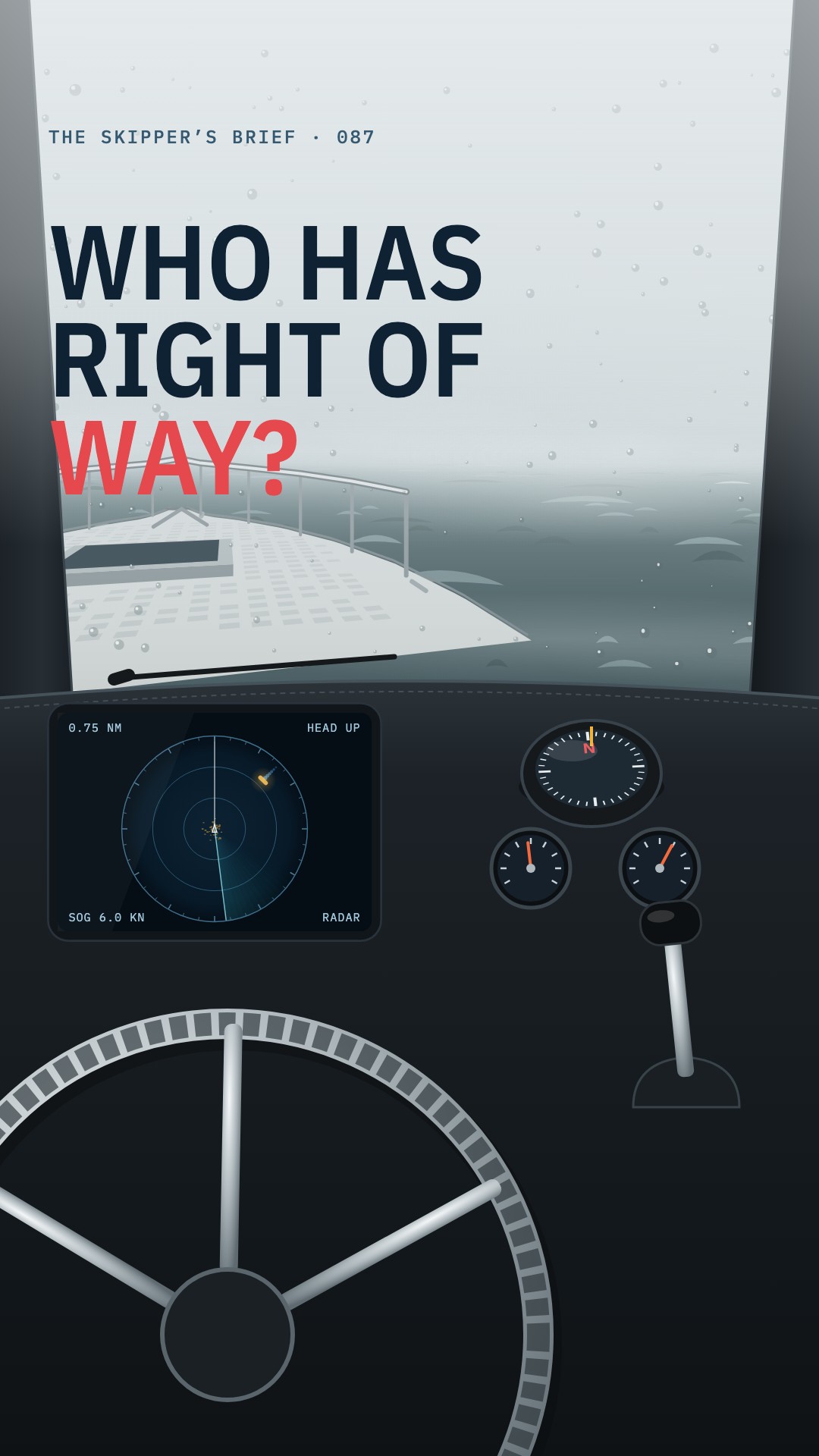
Brief #087 · RULE 19
Thick fog, a ship on your radar. Who has right of way?
Rules of the road
In fog, nobody has right of way. The steering rules (stand-on and give-way, head-on, crossing) only apply to vessels in sight of one another, and in sight means seen by eye: an echo on the radar or a horn in the fog doesn't count. Out of sight, the restricted-visibility rule, Rule 19, applies to every vessel. Each goes at a safe speed, and each that detects another by radar and finds a close-quarters situation or a risk of collision developing must act in ample time. For a vessel forward of the beam, avoid altering to port (unless you are overtaking her): she may turn to starboard, into you. Alter to starboard, early and by a lot, or slow down. For a vessel abeam or abaft the beam, avoid altering towards her. Hear a fog signal apparently forward of the beam and you slow to the least speed you can steer at, and stop if you must. Once the two of you see each other, the normal rules are back: here she is crossing from your right, so you give way.
International rules (COLREGs); the US Inland Rules say the same (Rules 11 and 19). Inland waters can have their own rules.
Transcript
Who has right of way in thick fog? A ship on your radar is crossing from your right.
It's a real question from the test at theskippersbrief.com.
Nobody. Out of sight, there's no stand-on vessel.
Right of way only counts once you can see each other, by eye. Radar and horns don't count.
So both of you must act, and early.
Ship ahead of your beam? Don't turn to port. Turn to starboard, or slow down.
Hear her horn ahead? Slow right down.
The moment you see her, the normal rules are back. She's on your right, so now you give way.
One way to remember it: no eyes, no right of way.
Take the free test at theskippersbrief.com.
Sources
- COLREGs Rule 11: 'Rules in this Section apply to vessels in sight of one another' (Section II, the steering rules: stand-on, give-way, head-on, crossing); Rule 3(k): 'Vessels shall be deemed to be in sight of one another only when one can be observed visually from the other.' Out of sight in fog, Rule 19 applies to both and neither stands on. No Canadian modification. The memory line in the close ('no eyes, no right of way') is our own summary of these rules, not a traditional saying (International text, Canada's Collision Regulations, Schedule 1)
- COLREGs Rule 19, Conduct of vessels in restricted visibility: (a) applies to vessels not in sight of one another in or near an area of restricted visibility; (b) 'Every vessel shall proceed at a safe speed adapted to the prevailing circumstances and conditions of restricted visibility', a power-driven vessel with her engines ready for immediate manoeuvre; (d) 'A vessel which detects by radar alone the presence of another vessel shall determine if a close-quarters situation is developing and/or risk of collision exists. If so, she shall take avoiding action in ample time', and so far as possible avoid '(i) an alteration of course to port for a vessel forward of the beam, other than for a vessel being overtaken; (ii) an alteration of course towards a vessel abeam or abaft the beam'; (e) except where it has been determined that a risk of collision does not exist, every vessel which 'hears apparently forward of her beam the fog signal of another vessel' shall 'reduce her speed to the minimum at which she can be kept on her course', and 'if necessary take all her way off'. No Canadian modification (International text, Canada's Collision Regulations, Schedule 1)
- COLREGs Rule 15(a), Crossing situation: 'When two power-driven vessels are crossing so as to involve risk of collision, the vessel which has the other on her own starboard side shall keep out of the way and shall, if the circumstances of the case admit, avoid crossing ahead of the other vessel.' A Section II rule, so it applies once the vessels are in sight of one another (Rule 11). Canada adds only a river-crossing paragraph (b) for Canadian waters (International text, Canada's Collision Regulations, Schedule 1)
- COLREGs Rule 35(a): in or near restricted visibility 'A power-driven vessel making way through the water shall sound at intervals of not more than two minutes one prolonged blast'; Rule 32(c): 'The term prolonged blast means a blast of from four to six seconds' duration'; Annex III 1(b)(ii): a whistle's fundamental frequency is '130-350 Hz, for a vessel 75 metres but less than 200 metres in length' (the reel's ship is 90 m; her horn is synthesised at about 165 Hz). Rule 20(c): her navigation lights 'shall, if carried, also be exhibited from sunrise to sunset in restricted visibility', so they show in the reel's daytime fog (International text, Canada's Collision Regulations, Schedule 1)
- US Code of Federal Regulations, 33 CFR 83.19, Conduct of vessels in restricted visibility (Rule 19) of the Inland Navigation Rules: the same paragraphs (a) to (e) as the International Rule, including avoiding 'An alteration of course to port for a vessel forward of the beam, other than for a vessel being overtaken'; Inland Rule 11 (83.11) likewise applies the steering rules to vessels in sight of one another (Cornell LII mirror of the eCFR)
- The Skipper's Brief, Rules of the Road course, module 'Restricted visibility' (paid part; every course starts with 3 free questions, with no sign-up). Question fog-no-stand-on: 'In thick fog, radar shows a vessel crossing from your right. Neither can see the other. Who is stand-on?' Answer: 'Neither: in fog, nobody stands on'. Question fog-radar-ahead and fog-radar-port-bow: with a vessel detected by radar alone forward of the beam, don't turn to port; turn to starboard early, or slow down. Question fog-in-sight-crossing: once the vessels see each other, even in fog, the usual steering rules apply again