Brief #058 · RULE 7
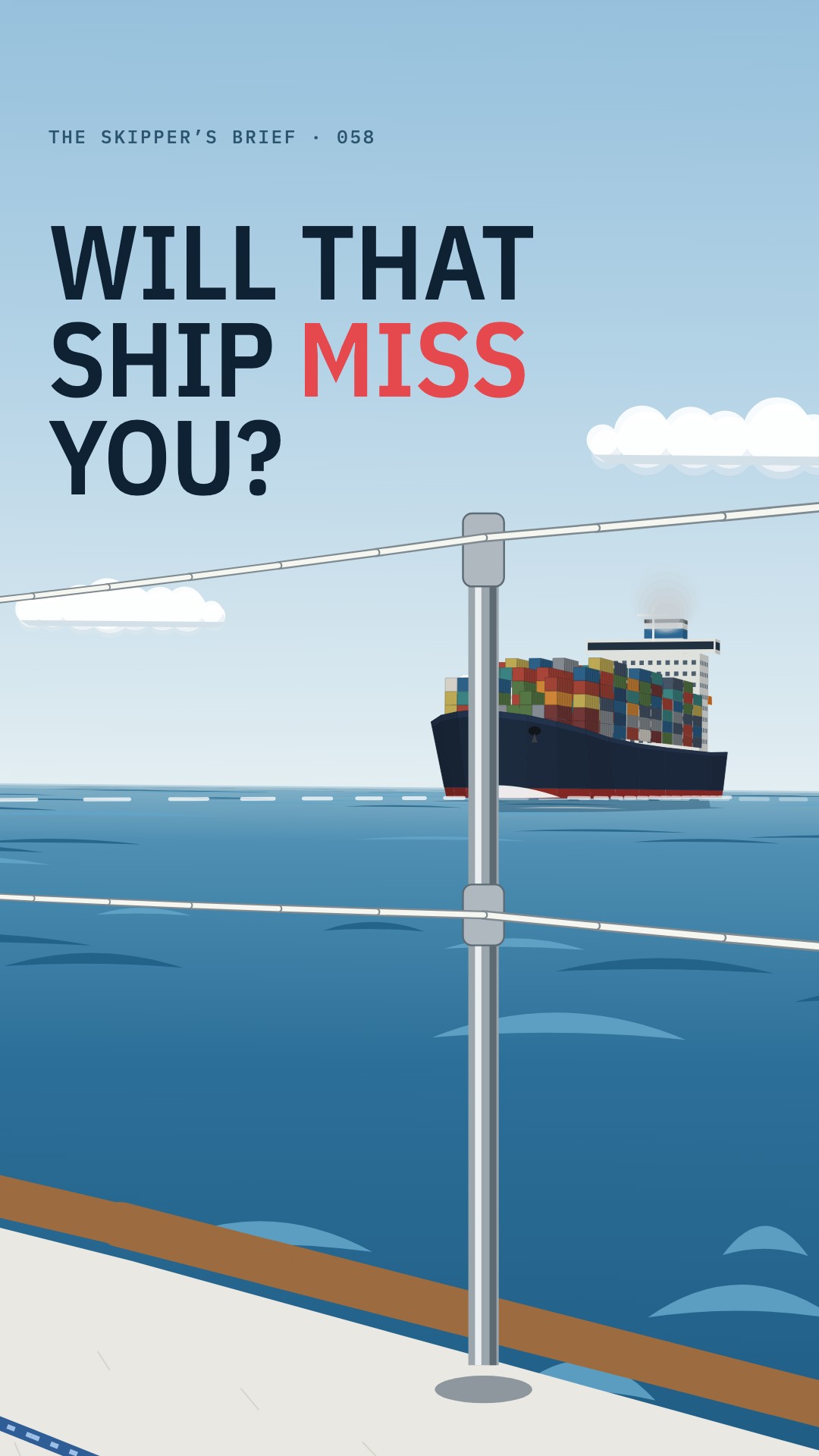
That ship looks like it will miss you. Will it?
Rules of the road
A ship on your bow can look as if she will pass ahead and still hit you. If her compass bearing doesn't change as she gets closer, you're on a collision course. Dragonflies catch their prey with the same geometry: a dragonfly keeps the prey still in its eye and flies straight to where they will meet, and guided missiles are built to steer the same way. The quick check on deck: line her up with a stanchion and hold your course; if she stays on it as she grows, that's a collision course. A hand-bearing compass is the proper tool, and with a big ship, a tow or anything close, even a slowly changing bearing can still mean danger.
International rules (COLREGs). Inland waters can have their own rules.
Transcript
That ship looks like it'll miss you. Will it?
Watch her bearing. If it doesn't change as she gets closer, you're on a collision course.
A dragonfly hunts this way. It keeps the fly still in its eye, and flies straight to where they'll meet. So do guided missiles.
Line her up with a stanchion, and hold your course. If she stays on it as she grows, that's a collision course.
Spotting one early is in my Rules of the Road course.
Which of these two will hit you?
The one that stays put. The other moves forward, and passes ahead of you. Still and growing? You're the fly.
Try three free questions at theskippersbrief.com.
Sources
- COLREGs Rule 7, Risk of collision: (a) every vessel shall use all available means to determine if risk of collision exists; 'If there is any doubt such risk shall be deemed to exist.' (d)(i) 'such risk shall be deemed to exist if the compass bearing of an approaching vessel does not appreciably change'; (d)(ii) 'such risk may sometimes exist even when an appreciable bearing change is evident, particularly when approaching a very large vessel or a tow or when approaching a vessel at close range' (International text, Canada's Collision Regulations, Schedule 1)
- COLREGs Rule 8(a) and (b), Action to avoid collision: action shall 'be positive, made in ample time'; an alteration of course and/or speed shall 'be large enough to be readily apparent to another vessel observing visually or by radar'; Rule 16: the give-way vessel 'shall, so far as possible, take early and substantial action to keep well clear' (International text, Canada's Collision Regulations, Schedule 1)
- Brighton, Thomas and Taylor (2017), 'Terminal attack trajectories of peregrine falcons are described by the proportional navigation guidance law of missiles', PNAS 114(51). Introduction: under parallel navigation 'the pursuer keeps its target on a constant compass bearing', a geometry seen in dragonflies, robber flies, falcons, hawks and bats; missile engineers designed guidance laws to achieve these geometries; the success of an aerial predator hinges on steering a collision course to its prey. Peregrines' attacks follow proportional navigation, 'the same feedback law used by visually guided missiles'
- Olberg, Worthington and Venator (2000), 'Prey pursuit and interception in dragonflies', J Comp Physiol A 186:155–162 (36 filmed prey-capture flights): 'dragonflies fly directly toward the point of prey interception', 'steering to minimize the movement of the prey's image on the retina' (abstract, AGRIS record)
- Mischiati, Lin, Herold, Imler, Olberg and Leonardo (2015), 'Internal models direct dragonfly interception steering', Nature 517:333–338: 'Predictive rotations of the dragonfly's head continuously track the prey's angular position'; the body then turns to align with the prey's flight path, driven mostly by internal models, with vision for unexpected prey movements (abstract)
- HHMI Janelia on Mischiati et al. (phys.org, Dec 2014): dragonflies chasing a fruit fly (or a bead on a pulley) keep 'the image of the prey fixed in the crosshairs' of their eyes, the head 'rotated continuously to hold the prey steady on the eye'; Leonardo on the older view that the dragonfly 'tries to hold this angle constant': 'This is the way guided missiles work'
- YACHT magazine, 'Standing bearing: when there is a risk of collision and how to react correctly' (Christian Tiedt): 'take a bearing of the approaching vessel via the frame of a window pane or one of the shrouds'; repeat it some time later; if it hasn't moved, 'You are on a collision course with the sighted vessel and must take action'; a vessel passing ahead or astern moves out of the bearing
- Mark King, 'Let's Not Meet By Accident', Powerboating.com (2024): the other vessel 'lines up with the second bow rail stanchion'; 'If another quick check shows the other vessel is still in the same line of position, lined up with your second bow rail stanchion, you are on a collision course'; beware 'changes in the apparent position caused by pitching and yawing'
- Cal Sailing Club, 'Ranging, part 5' (John Bongiovanni, 2024), on David Burch (Starpath School of Navigation): to tell a collision course 'we need a good bearing compass for that', or 'a steady heading and don't move the eye and watch the vessel relative to the rigging'; lining the target up with a landmark behind it doesn't work
- eOceanic, 'How to tell if you are on a collision course with another vessel': 'keep their head still and look where the vessel in question is relative to a fixed reference on your vessel' (a stanchion or shroud), 'Then continually observe it to see if it remains in place'; constant bearing and decreasing range means collision, provided both vessels keep their course and speed
- The Skipper's Brief, Rules of the Road course (live 2026-10-29): module 2 'Lookout, safe speed and risk of collision' (Rules 5 to 8) includes steady-bearing situations (a boat on a collision course keeps the same bearing; a big ship's slowly changing bearing); 'Every course starts with 3 free questions, with no sign-up'; €15