Brief #081 · DAY SHAPES
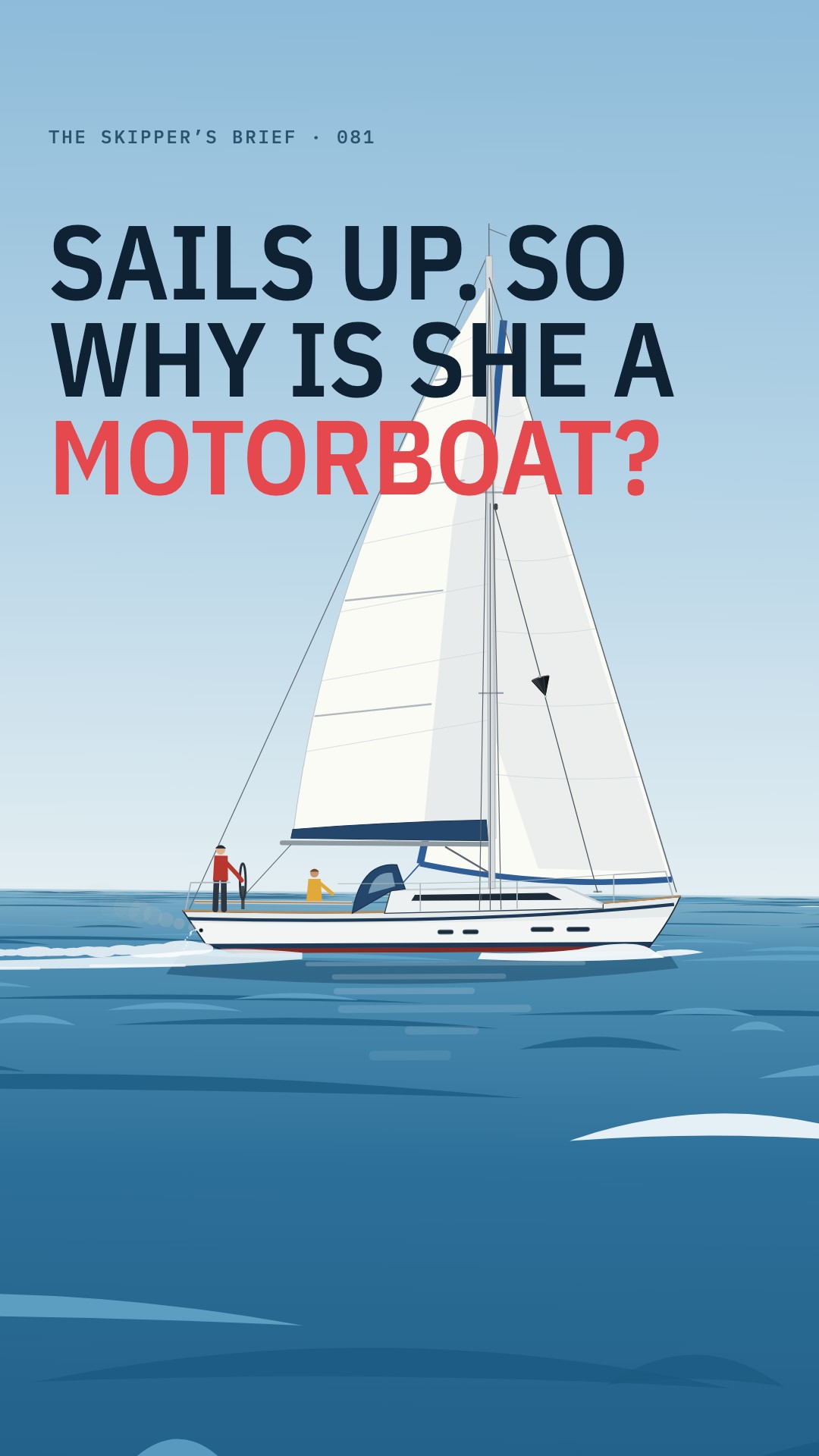
Her sails are up. So why does she have to give way like a motorboat?
Rules of the road
A yacht with her sails up and her engine running counts as a power-driven vessel under the rules, not a sailing vessel. By day she must show a black cone, point down, forward where it can best be seen. So, like any motorboat, she keeps out of the way of yachts under sail alone, of boats fishing, and of vessels not under command or restricted in their ability to manoeuvre; meeting another power-driven vessel, the ordinary crossing and head-on rules apply. Her sails give her no priority at all. The cone matters because from a distance you can't hear whether a yacht's engine is running. One way to remember it: the cone points down, to the engine below.
International rules (COLREGs). In US inland waters (33 CFR 83.25(e)) and in Canada's inland waters a vessel under 12 m needn't show the cone, but may; with her engine driving her she still counts as a power-driven vessel. Other inland waters can have their own rules.
Transcript
This yacht has her sails up. So why does she have to give way like a motorboat?
It's a real question from the test at theskippersbrief.com.
That cone says her engine is on.
Sails and engine together: the rules count her as a power-driven vessel.
So, like any motorboat, she keeps clear of yachts under sail alone, and of boats fishing with nets. Her sails buy her nothing.
From a distance, you can't hear her engine. But you can see the cone.
One way to remember it: the cone points down, to the engine below.
Take the free test at theskippersbrief.com.
Sources
- COLREGs Rule 3(b): 'The term power-driven vessel means any vessel propelled by machinery.' Rule 3(c): 'The term sailing vessel means any vessel under sail provided that propelling machinery, if fitted, is not being used.' (International text, Canada's Collision Regulations, Schedule 1)
- COLREGs Rule 18(a): 'Except where Rules 9, 10 and 13 otherwise require', a power-driven vessel underway shall keep out of the way of a vessel not under command, a vessel restricted in her ability to manoeuvre, a vessel engaged in fishing and 'a sailing vessel'. Rule 3(d): a vessel engaged in fishing is one fishing with nets, lines, trawls or other gear that restricts her manoeuvrability (not trolling lines). Between two power-driven vessels the head-on and crossing rules (14 and 15) apply as usual (International text, Canada's Collision Regulations, Schedule 1)
- COLREGs Rule 25(e): 'A vessel proceeding under sail when also being propelled by machinery shall exhibit forward where it can best be seen a conical shape, apex downwards.' Canada's own Rule 25(f): in the Canadian waters of a roadstead, harbour, river, lake or inland waterway, a vessel under 12 m doing so is not required to show the cone, 'but may do so' (International text and Canadian modification, Canada's Collision Regulations, Schedule 1)
- COLREGs Annex I, section 6: shapes are black; a cone has a base diameter of at least 0.6 m and a height equal to its diameter; a vessel under 20 m may use smaller shapes to suit her size (International text, Canada's Collision Regulations, Schedule 1)
- COLREGs Rule 23(a): a power-driven vessel underway shows a masthead light forward, sidelights and a sternlight; 23(d): one under 12 m may show an all-round white light and sidelights instead. Rule 25(b): the combined three-colour lantern at the masthead is for a sailing vessel under 20 m (International text, Canada's Collision Regulations, Schedule 1)
- US Inland Navigation Rules, 33 CFR 83.25(e): a vessel under sail also propelled by machinery shows forward a conical shape, apex downward; 'A vessel of less than 12 meters in length is not required to exhibit this shape, but may do so.' 33 CFR 83.03(b) and (c) define a power-driven and a sailing vessel in the same words as the International rules, and 83.18(a)(iv) has a power-driven vessel keep out of the way of a sailing vessel
- Wikipedia, Day shape: day shapes are mariner signals that show a vessel's status by day; they are black, sized by the COLREGs; a vessel under sail and power shows a 'Cone, apex down'; a vessel under 20 m may use smaller shapes
- The Skipper's Brief, Lights and Signals course, module 'Sailing and small boats' (checked 2026-11-14): 'By day, a yacht with her sails up shows this black cone, point down. What does it tell you?' Options: her engine is on, she counts as power (right); she is racing, keep clear of her; she is lying at anchor; she is fishing with lines. The explanation cites COLREG Rule 25(e) and notes the US inland exception under 12 m. 'Every course starts with 3 free questions, with no sign-up'