Brief #099 · SOUND ON
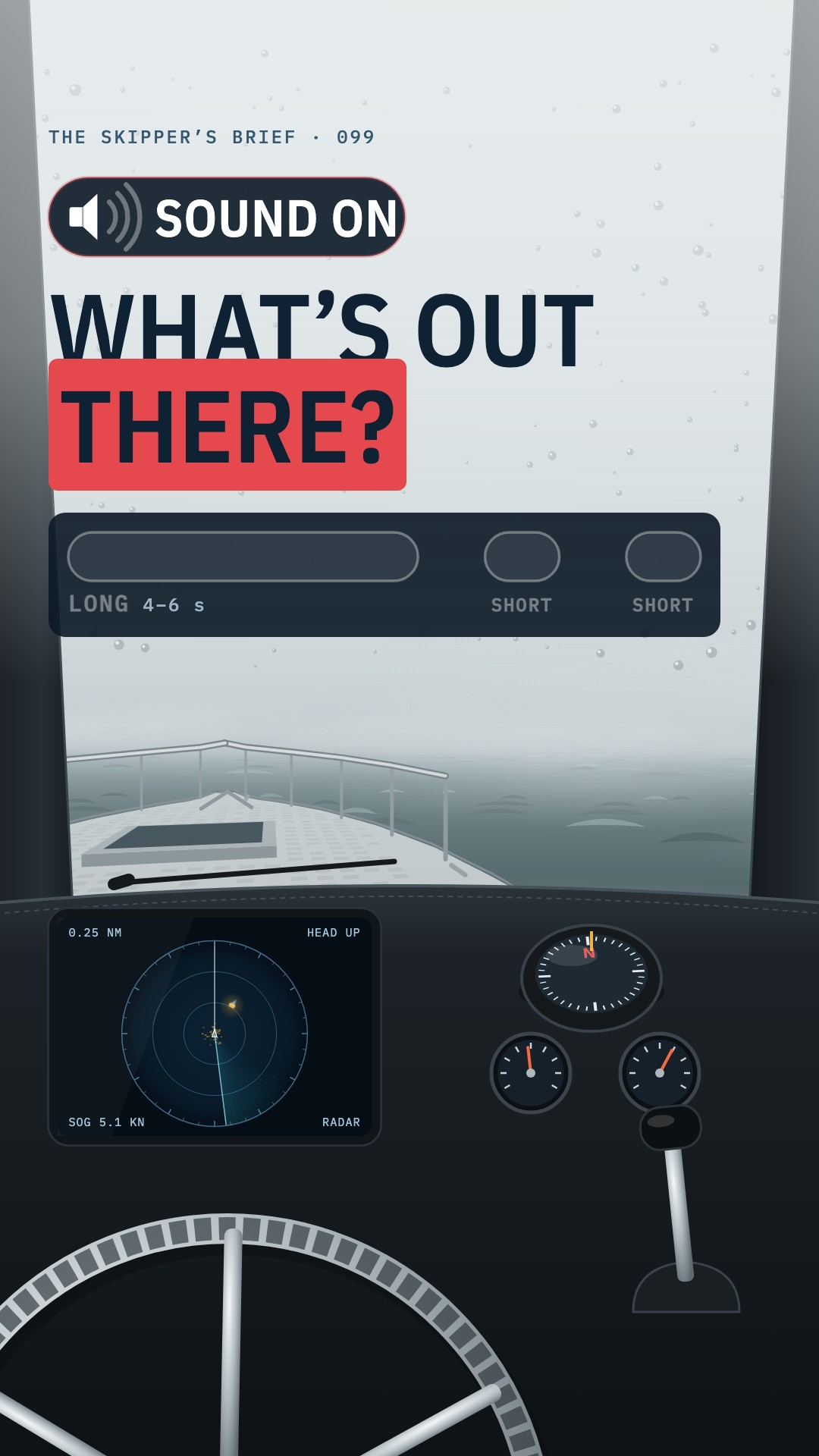
Sound on. One long, two short, in fog. What's out there?
Rules of the road
In or near restricted visibility, one prolonged blast followed by two short blasts, sounded at intervals of not more than two minutes, is the fog signal of COLREG Rule 35(c). A short blast lasts about a second and a prolonged one four to six seconds (Rule 32). It isn't one kind of vessel: a sailing vessel sounds it, and so do a vessel engaged in fishing, one towing or pushing another, one not under command, one restricted in her ability to manoeuvre and one constrained by her draught. A power-driven vessel making way sounds one prolonged blast instead, and two if she is stopped. So the sound can't tell you which of them she is, only that she may not get out of your way easily: each of the others is defined by how little she can manoeuvre, and a sailing vessel depends on the wind. Whatever she is, if you hear her fog signal apparently forward of your beam, slow to the least speed at which you can keep your course, take all way off if you must, and go with extreme caution until the danger of collision is over (Rule 19(e)), unless you have made sure there is no risk of collision. One way to remember it: long, short, short, she can't easily dodge.
International rules (COLREGs). The US Inland Rules give the same signal (33 CFR 83.35(c)), except that they have no vessel constrained by her draft. A vessel fishing, or restricted while working at anchor, gives it at anchor too (Rule 35(d)). A vessel under 12 m may give another efficient sound signal instead (Rule 35(j)). Inland waters can have their own rules.
Transcript
Sound on. You hear this in thick fog. What's out there?
It's a real question from the test at theskippersbrief.com.
A sailing yacht. Under sail, that's her fog signal.
Boats fishing or towing sound it too, and ships that can hardly manoeuvre.
So you can't tell which one she is.
Hear it ahead of your beam? Slow right down. Stop if you must.
One way to remember it: long, short, short, she can't easily dodge.
Take the free test at theskippersbrief.com.
Sources
- COLREGs Rule 35, Sound signals in restricted visibility, 'in or near an area of restricted visibility, whether by day or night': (a) a power-driven vessel making way sounds one prolonged blast at intervals of not more than two minutes; (b) stopped and making no way, two prolonged blasts; (c) a vessel not under command, a vessel restricted in her ability to manoeuvre, a vessel constrained by her draught, a sailing vessel, a vessel engaged in fishing and a vessel engaged in towing or pushing another vessel instead sound, at intervals of not more than two minutes, 'one prolonged followed by two short blasts'; (d) a vessel fishing at anchor, and one restricted while working at anchor, give the same signal; (e) a manned vessel being towed sounds one prolonged and three short; (j) a vessel of less than 12 metres need not give these signals but must then make some other efficient sound signal at intervals of not more than 2 minutes. The memory line in the close ('long, short, short, she can't easily dodge') is our own summary, not wording from the rules (International text, Canada's Collision Regulations, Schedule 1)
- COLREGs Rule 32, Definitions: a short blast is 'a blast of about one second's duration' and a prolonged blast 'a blast of from four to six seconds' duration'. The reel's signal: a 4.7 s prolonged blast and two 1.0 s short ones, 0.9 s apart. Annex III 1(b)(iii): a whistle's fundamental frequency lies between 250 and 700 Hz for a vessel less than 75 metres in length; the reel's 12 m yacht's whistle is our own synthesis at 310 Hz. Rule 33(a): a vessel of 12 metres or more in length shall be provided with a whistle (International text, Canada's Collision Regulations, Schedule 1)
- COLREGs Rule 3, General definitions: (c) a sailing vessel is any vessel under sail provided that propelling machinery, if fitted, is not being used; (d) engaged in fishing means fishing with nets, lines, trawls or other fishing apparatus which restrict manoeuvrability (not trolling lines); (f) not under command: a vessel which through some exceptional circumstance is unable to manoeuvre as required by the Rules; (g) restricted in her ability to manoeuvre: a vessel which from the nature of her work cannot keep out of the way, for example laying, servicing or picking up a navigation mark, submarine cable or pipeline; (h) constrained by her draught: a power-driven vessel severely restricted, by her draught against the depth and width of the water, in her ability to deviate from her course. That such a vessel 'may not get out of your way easily' (summary and posts) and 'can't easily dodge' (the close) is our own summary of these definitions (a sailing vessel depends on the wind); in fog no vessel stands on, and every vessel follows Rule 19 (International text, Canada's Collision Regulations, Schedule 1)
- COLREGs Rule 19(e), Conduct of vessels in restricted visibility: except where it has been determined that a risk of collision does not exist, every vessel which 'hears apparently forward of her beam the fog signal of another vessel' shall reduce her speed 'to the minimum at which she can be kept on her course', shall if necessary take all her way off, and 'in any event navigate with extreme caution until danger of collision is over'. Rule 19(a): it applies to vessels not in sight of one another in or near an area of restricted visibility (International text, Canada's Collision Regulations, Schedule 1)
- COLREGs, the day shapes drawn on the reel's cards (each vessel also shows her lights in fog by day, Rule 20(c)): Rule 26(b), a vessel trawling, two cones with their apexes together, one above the other; Rule 27(a), not under command, two balls (and two all-round red lights) in a vertical line; Rule 27(b), restricted in her ability to manoeuvre, a ball, a diamond and a ball in a vertical line; Rule 28, constrained by her draught, a cylinder (and three all-round red lights); Rule 24(a)(v), a towing vessel shows a diamond only when the tow is longer than 200 m (the reel's is shorter); Annex I 6, shapes of at least 0.6 m with at least 1.5 m between them (International text, Canada's Collision Regulations, Schedule 1)
- US Code of Federal Regulations, 33 CFR 83.35 (Inland Rule 35): (c) 'a vessel not under command; a vessel restricted in her ability to maneuver, whether underway or at anchor; a sailing vessel; a vessel engaged in fishing, whether underway or at anchor; and a vessel engaged in towing or pushing another vessel' sound 'one prolonged followed by two short blasts' at intervals of not more than 2 minutes; there is no vessel constrained by her draft in the Inland Rules (83.28 is reserved). 33 CFR 83.19(e), Inland Rule 19, has the same slow-down rule as the International text (Cornell LII mirror of the eCFR)
- The Skipper's Brief, Lights and Signals course (checked 2026-11-14): every course starts with 3 free questions, with no sign-up. Module 'Sound signals', question fog-prolonged-two-short: 'In fog you hear this about every two minutes. Which vessel could it be?' (the sound: one prolonged, two short). Options: a motorboat making way; a motorboat stopped in the water; a vessel being towed; a sailing yacht (right). Its explanation: the signal is a sailing vessel's, and also that of vessels fishing, towing, not under command, restricted or constrained; a motorboat making way sounds one prolonged, stopped two. Also the Rules of the Road course, module 'Restricted visibility', question fog-own-signal-sail: under sail in fog you sound one prolonged and two short