Brief #096 · SPOT THE MISTAKE
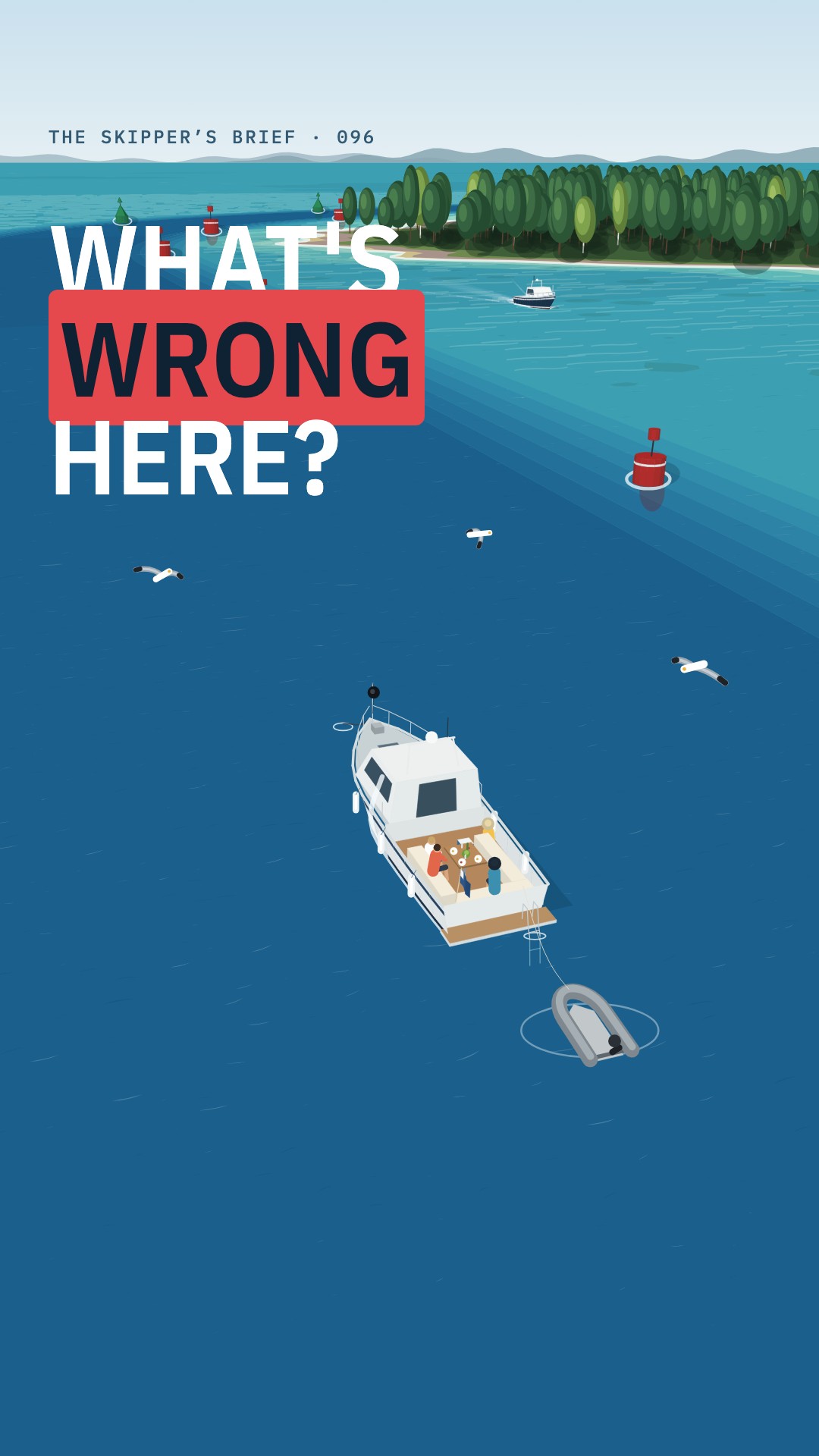
This boat stopped for lunch. What did they get wrong?
Rules of the road
A motorboat has stopped for lunch at anchor in the middle of a narrow buoyed channel. That's the mistake: any vessel shall, if the circumstances of the case admit, avoid anchoring in a narrow channel (COLREG Rule 9(g); the same words in the US Inland Rules, 33 CFR 83.09(g)). A ship that can only navigate inside the channel can't go round her, and a boat under 20 m must not impede her (Rule 9(b)). The black ball forward is right: it says she's at anchor (Rule 30(a)), and in or near a narrow channel even a boat under 7 m must show it (Rule 30(e)). But it doesn't make anchoring there all right. The fenders, the swim ladder (nobody swimming), the flag at the stern, the dinghy astern and lunch in the cockpit are all fine. The fix: anchor outside the channel, in the shallows clear of the fairway, where there's enough water for her and too little for the ship. One way to remember it: a channel is a road, not a picnic spot.
International rules (COLREGs); the US Inland Rules say the same (33 CFR 83.09(g), 83.09(b), 83.30). Rule 9(g) says 'if the circumstances of the case admit': in an emergency, anchoring may be the right thing. The channel, the buoys (IALA Region A, direction of buoyage southward), the depths and the boats are an example, not a real place.
Transcript
This boat stopped for lunch. One thing here is wrong. Can you spot it?
Take a good look. Comment where it is. Three. Two. One.
Here it is: she's anchored in the channel.
That ship can only use the channel. She can't go round you.
The rules say: don't anchor in a narrow channel if you can help it.
The ball, the fenders, the ladder and the flag are all fine. But the ball doesn't make it OK.
Stop outside the channel instead. Three metres here: enough for you, too shallow for her.
One way to remember it: a channel is a road, not a picnic spot.
It's a real question from the test at theskippersbrief.com.
Take the free test at theskippersbrief.com.
Sources
- COLREGs Rule 9(g), Narrow channels: 'Any vessel shall, if the circumstances of the case admit, avoid anchoring in a narrow channel.' (International text, Canada's Collision Regulations, Schedule 1; Canada's modifications to Rule 9 are (h) to (k) and leave (g) as it is)
- US Inland Rules, 33 CFR § 83.09 (Rule 9), Narrow channels: (g) 'Any vessel shall, if the circumstances of the case admit, avoid anchoring in a narrow channel', the same words as the International rule; (b) a vessel of less than 20 meters or a sailing vessel shall not impede the passage of a vessel that can safely navigate only within a narrow channel or fairway (Cornell LII)
- COLREGs Rule 9, Narrow channels: (a) a vessel proceeding along a narrow channel keeps as near to its starboard-hand outer limit as is safe and practicable; (b) 'A vessel of less than 20 metres in length or a sailing vessel shall not impede the passage of a vessel which can safely navigate only within a narrow channel or fairway'; (f) a vessel nearing a bend where other vessels may be hidden by an obstruction navigates with particular alertness and caution and sounds the signal of Rule 34(e), one prolonged blast (the reel's ship sounds it as she comes round the bend; Rule 32(c): a prolonged blast lasts 4 to 6 seconds) (International text, Canada's Collision Regulations, Schedule 1)
- COLREGs Rule 30, Anchored vessels: (a) 'A vessel at anchor shall exhibit where it can best be seen: (i) in the fore part, an all-round white light or one ball'; (e) a vessel of less than seven metres, at anchor 'not in or near a narrow channel, fairway or anchorage, or where other vessels normally navigate', need not show them, so in or near a channel every anchored boat shows the ball. The ball is the signal for being at anchor; nothing in Rule 30 allows anchoring anywhere. US Inland: the same, 33 CFR 83.30(a) and (e) (International text, Canada's Collision Regulations, Schedule 1)
- COLREGs Annex I, 6 Shapes: (a) shapes shall be black, 'a ball shall have a diameter of not less than 0.6 metre'; (c) 'In a vessel of less than 20 metres in length shapes of lesser dimensions but commensurate with the size of the vessel may be used'. The reel's 11.5 m motorboat shows a 0.45 m ball on a staff at her bow (International text, Canada's Collision Regulations, Schedule 1)
- COLREGs Parts B and C (steering and sailing rules; lights and shapes), read in full: no rule deals with fenders, a swim ladder, a dinghy lying astern on its painter or eating on deck (International text, Canada's Collision Regulations, Schedule 1)
- Wikipedia, Ensign (flag): 'a maritime flag that is used for the national identification of a ship'; it 'is generally flown at the stern (rear) of the ship while in port', from the stern flagstaff. The reel's flag is a made-up one, not any country's
- Wikipedia, Draft (hull): the draught is the depth of the vessel below the waterline to her lowest point; it 'is used in under keel clearance calculations, where the draft is calculated with the available depth of water ... to ensure the ship can navigate safely, without grounding'
- The reel's channel is an example, not a real place, and its depths are labelled so: dredged to 7 m between the buoys, 3 m on the shelf outside them, shoaling to the shores. The ship is a generic 90 m general cargo ship drawing about 5 m, so only the channel is deep enough for her; the motorboat draws about 1 m. Buoyage IALA Region A, direction of buoyage southward: red cans to port on the east side, green cones to starboard on the west. IALA R1001: port-hand lateral marks are red and cylindrical (can), starboard-hand marks green and conical, in Region A (copy hosted by Irish Lights)
- The Skipper's Brief, Rules of the Road course, module 'Narrow channels and traffic lanes' (checked 2026-11-14; every course starts with 3 free questions, with no sign-up). Question anchor-in-channel: 'You want to stop for lunch. Can you anchor here, in the narrow channel?' Options: yes, close to its starboard edge; yes, if you hoist an anchor ball; yes, in the middle where it is deep; no: avoid anchoring in the channel (right). Its explanation: an anchored boat blocks the fairway for vessels that can't go round her; find a spot outside the channel, clear of the traffic (COLREG Rule 9(g))