Brief #095 · SPOT THE MISTAKE
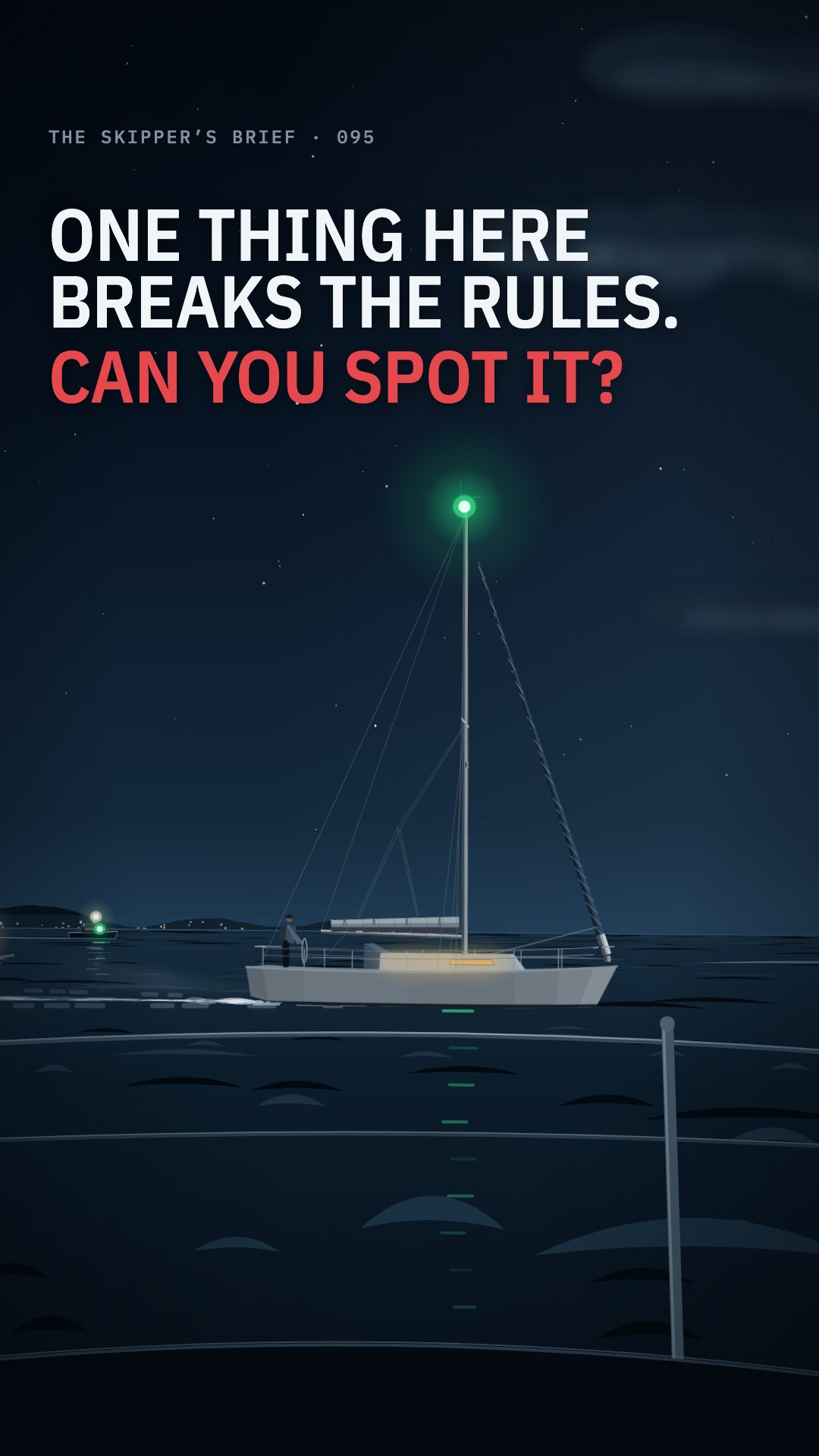
One thing on this yacht breaks the rules. Can you spot it?
Rules of the road
At night a yacht motors past with her sails furled and her engine driving her, showing only her masthead tricolour. That is the mistake. A tricolour (red, green and white sectors in one lantern at the top of the mast) is allowed only on a sailing vessel under 20 m. With her engine driving her she counts as a power-driven vessel, sails up or not, and must show a motorboat's lights: a white masthead light (the steaming light, on the front of her mast), sidelights and a sternlight. Under 12 m she may show an all-round white light and sidelights instead. Her tricolour tells everyone she's under sail: from ahead she looks just like a yacht sailing, and others will treat her as one. Everything else in the scene is correct: the yacht at anchor with one all-round white light (a vessel under 50 m), the motor cruiser with her white masthead light and green sidelight, the small motorboat with a red-and-green bow light and an all-round white light above it (allowed under 12 m), and the yacht's lit cabin windows (other lights are allowed if they can't be mistaken for navigation lights). One way to remember it: engine on, tricolour off.
International rules (COLREGs). The US Inland Rules say the same (33 CFR 83.03, 83.23 and 83.25). Other inland waters can have their own rules.
Transcript
One thing on this yacht breaks the rules. Can you spot it?
Check her lights, her sails, and the boats around her.
Comment where it is.
Here it is. She's showing a tricolour, but she's motoring.
Sails furled, engine driving her: she counts as a motorboat. A tricolour is for sailing only.
From ahead, she looks just like a yacht under sail. So others will treat her as one.
Under engine, she needs a motorboat's lights: a masthead light, sidelights and a sternlight.
One way to remember it: engine on, tricolour off.
It's a real question from the test at theskippersbrief.com.
Take the free test at theskippersbrief.com.
Sources
- COLREGs Rule 25(a): 'A sailing vessel underway shall exhibit: (i) sidelights, (ii) a sternlight.' Rule 25(b): 'In a sailing vessel of less than 20 metres in length the lights prescribed in paragraph (a) of this Rule may be combined in one lantern carried at or near the top of the mast where it can best be seen.' Rule 25(c): the optional red-over-green all-round lights 'shall not be exhibited in conjunction with the combined lantern' (International text, Canada's Collision Regulations, Schedule 1)
- COLREGs Rule 3(b): 'The term power-driven vessel means any vessel propelled by machinery.' Rule 3(c): 'The term sailing vessel means any vessel under sail provided that propelling machinery, if fitted, is not being used.' (International text, Canada's Collision Regulations, Schedule 1)
- COLREGs Rule 23(a): 'A power-driven vessel underway shall exhibit: (i) a masthead light forward', (ii) a second masthead light, which a vessel under 50 m 'shall not be obliged to exhibit', '(iii) sidelights, (iv) a sternlight.' Rule 23(d)(i): 'A power-driven vessel of less than 12 metres in length may in lieu of the lights prescribed in paragraph (a) of this Rule exhibit an all-round white light and sidelights.' No rule lets a power-driven vessel use the sailing vessel's combined lantern of Rule 25(b) (International text, Canada's Collision Regulations, Schedule 1)
- COLREGs Rule 21: the masthead light is white, over the centreline, showing 'from right ahead to 22.5 degrees abaft the beam on either side' (225°); sidelights are green to starboard and red to port, 112.5° each, 'from right ahead to 22.5 degrees abaft the beam'; 'In a vessel of less than 20 metres in length the sidelights may be combined in one lantern carried on the fore and aft centreline'; the sternlight is white, 135°, '67.5 degrees from right aft on each side'. So from ahead a sailing vessel shows red and green, and a power-driven vessel shows a white light above them (International text, Canada's Collision Regulations, Schedule 1)
- COLREGs Annex I, section 2: (c) the masthead light of a power-driven vessel of 12 m but less than 20 m is placed 'at a height above the gunwale of not less than 2.5 metres'; (d.1) an all-round light carried with sidelights under Rule 23(d)(i) 'shall be carried at least one metre higher than the sidelights'; (g) a power-driven vessel's sidelights sit 'at a height above the hull not greater than three-quarters of that of the forward masthead light' (International text, Canada's Collision Regulations, Schedule 1)
- COLREGs Rule 18(a): a power-driven vessel underway 'shall keep out of the way of' a vessel not under command, a vessel restricted in her ability to manoeuvre, a vessel engaged in fishing and 'a sailing vessel' (International text, Canada's Collision Regulations, Schedule 1)
- COLREGs Rule 30(a): a vessel at anchor shows an all-round white light in the fore part and a lower one at or near the stern; Rule 30(b): 'A vessel of less than 50 metres in length may exhibit an all-round white light where it can best be seen instead of the lights prescribed in paragraph (a)' (the anchored yacht in the scene; International text, Canada's Collision Regulations, Schedule 1)
- COLREGs Rule 20(b): from sunset to sunrise 'no other lights shall be exhibited, except such lights as cannot be mistaken for the lights specified in these Rules or do not impair their visibility or distinctive character, or interfere with the keeping of a proper look-out' (the lit cabin windows in the scene; International text, Canada's Collision Regulations, Schedule 1)
- US Inland Navigation Rules, 33 CFR 83.25(b): 'In a sailing vessel of less than 20 meters in length the lights prescribed in paragraph (a) of this Rule may be combined in one lantern carried at or near the top of the mast where it can best be seen', as in the International rules (Cornell LII)
- US Inland Navigation Rules, 33 CFR 83.23(a): a power-driven vessel underway shows a masthead light forward, sidelights and a sternlight; 83.23(d): one under 12 m may instead show 'an all-round white light and sidelights'. 33 CFR 83.03(b) and (c) define a power-driven vessel ('any vessel propelled by machinery') and a sailing vessel as the International rules do (Cornell LII)
- US Inland Navigation Rules, 33 CFR 83.30(b): 'A vessel of less than 50 meters in length may exhibit an all-round white light where it can best be seen' instead of the two anchor lights (Cornell LII)
- BoatUS Foundation, Navigation Lights: 'Sailboats are considered powerboats when they are being propelled by a motor – even if the sails are up'; 'A sailboat with motor running is defined as a motor boat'; power-driven vessels underway 'shall exhibit a masthead light forward, sidelights and a stern light'
- The Skipper's Brief, Lights and Signals course, module 'Sailing and small boats' (paid part; every course starts with 3 free questions, with no sign-up; checked 2026-11-14). Question tricolour-engine-on: 'Your 10 m yacht shows a tricolour like this. You start the engine to motor-sail. Which lights do you switch to?' Options: the tricolour, as before; the tricolour and an all-round white; one all-round white light; masthead light, sidelights, sternlight (right). Its explanation: with the engine driving her she is a power-driven vessel, even with her sails up; 'The tricolour is for sailing only: switch to the masthead (steaming) light, sidelights and sternlight.' The memory line 'engine on, tricolour off' is our own