Brief #067 · RULE 18
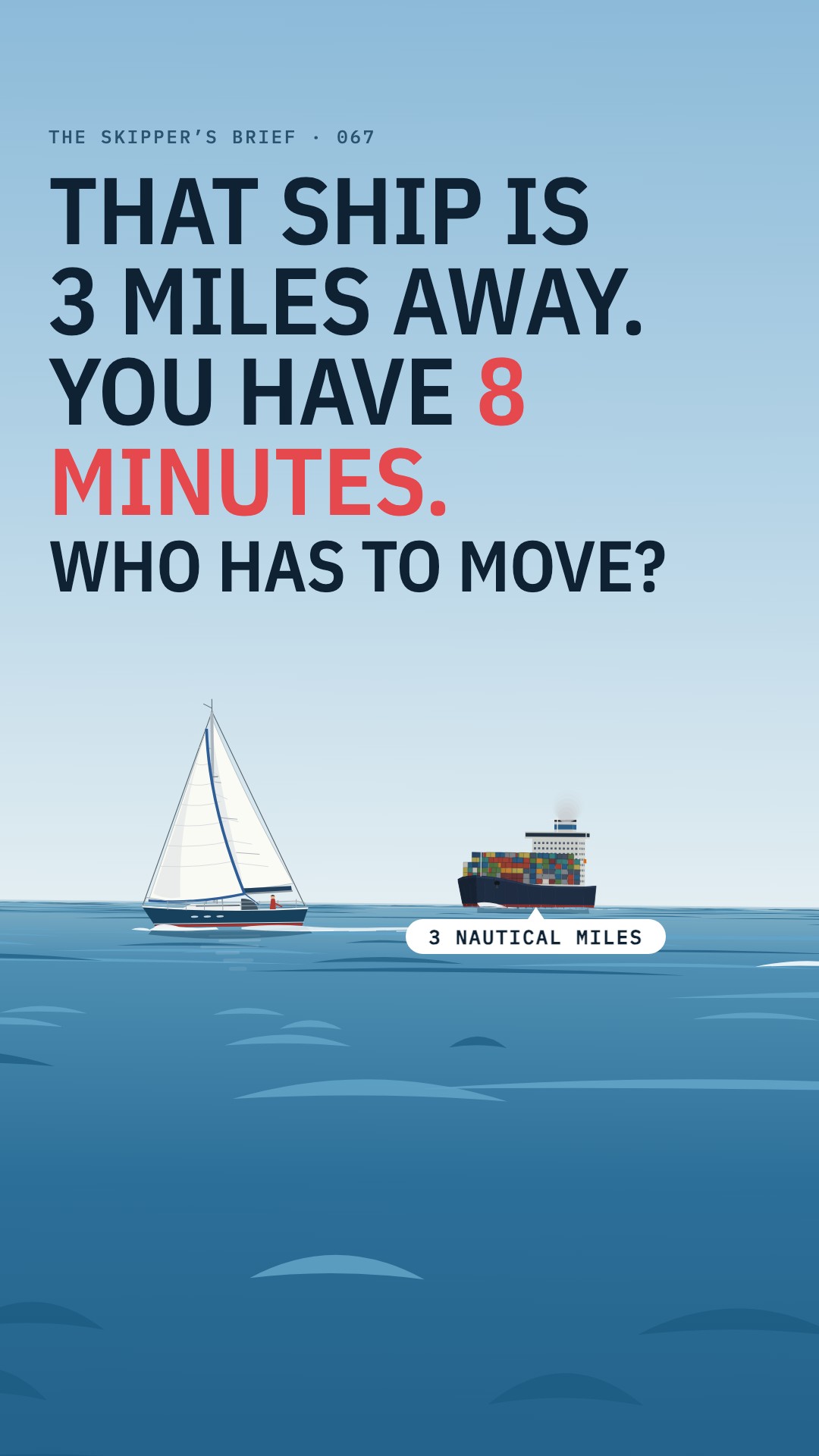
That ship is 3 miles away. You have 8 minutes. Who has to move?
Rules of the road
You're under sail with the engine off, in open water, and a big ship is crossing from your right. She has to keep out of your way, however big she is, and you hold your course and speed. At 22 knots, 3 nautical miles takes about 8 minutes. But the rules don't let you sit there: as soon as it's clear she isn't acting you may act, and once she can't avoid you on her own you must. She may not have seen you, and the international standard allows a 300 m ship up to 15 lengths, 4.5 km, to stop. In a narrow channel or a traffic lane it's different: there you must not impede her.
International rules (COLREGs), vessels in sight of one another. Inland waters can have their own rules.
Transcript
That ship is 3 miles away. You have 8 minutes. Who has to move?
It's a real question from the test at theskippersbrief.com.
The ship. You're under sail, engine off, in open water. However big she is, she has to keep clear.
So you hold your course and speed. At 22 knots, those 3 nautical miles take 8 minutes. But if she doesn't act in time, you must.
She may not have seen you. And she can't stop quickly. The standard allows a 300-metre ship 15 lengths: most of those 3 miles.
She has to move first. If it's clear she won't, you move.
Try three free questions at theskippersbrief.com.
Sources
- COLREGs Rule 18: 'Except where Rules 9, 10 and 13 otherwise require: (a) A power-driven vessel underway shall keep out of the way of: ... (iv) a sailing vessel.' Nothing in it depends on size (International text, Canada's Collision Regulations, Schedule 1)
- COLREGs Rule 3(c): 'The term sailing vessel means any vessel under sail provided that propelling machinery, if fitted, is not being used.' (International text, Canada's Collision Regulations, Schedule 1)
- COLREGs Rule 9(b), why the reel says open water: 'A vessel of less than 20 metres in length or a sailing vessel shall not impede the passage of a vessel which can safely navigate only within a narrow channel or fairway.' (International text, Canada's Collision Regulations, Schedule 1)
- COLREGs Rule 10(j), why the reel says open water: 'A vessel of less than 20 metres in length or a sailing vessel shall not impede the safe passage of a power-driven vessel following a traffic lane.' (International text, Canada's Collision Regulations, Schedule 1)
- COLREGs Rule 16: 'Every vessel which is directed to keep out of the way of another vessel shall, so far as possible, take early and substantial action to keep well clear.' (International text, Canada's Collision Regulations, Schedule 1)
- COLREGs Rule 17: (a)(i) 'Where one of two vessels is to keep out of the way, the other shall keep her course and speed.' (a)(ii) 'The latter vessel may however take action to avoid collision by her manoeuvre alone, as soon as it becomes apparent to her that the vessel required to keep out of the way is not taking appropriate action in compliance with these Rules.' (b) 'When, from any cause, the vessel required to keep her course and speed finds herself so close that collision cannot be avoided by the action of the give-way vessel alone, she shall take such action as will best aid to avoid collision.' (d) 'This Rule does not relieve the give-way vessel of her obligation to keep out of the way.' (International text, Canada's Collision Regulations, Schedule 1)
- Rodrigue, The Geography of Transport Systems (6th ed., 2024): 'Most containerships are designed to travel at speeds around 24 knots'; normal speed class 20 to 25 knots, the cruising speed ship and engine were designed for; slow steaming 18 to 20 knots; extra slow 15 to 18. The 8 minutes is our arithmetic on a stated assumption: 3 nautical miles at 22 knots is 8.2 minutes (7.9 with you closing at 6 knots on a right-angled crossing). A slow-steaming ship takes longer
- Notteboom, Pallis and Rodrigue, Port Economics, Management and Policy, 'Slow steaming in container shipping': lines began 'reducing their vessels' commercial speed from 22-23 knots to 18 knots'
- IMO Standards for Ship Manoeuvrability, via Wärtsilä Encyclopedia of Ship Technology: 'The track reach in the full astern stopping test should not exceed 15 ship lengths', which an Administration may raise for ships of large displacement, 'but should in no case exceed 20 ship lengths'. 15 × 300 m = 4.5 km; 3 nautical miles = 5.56 km
- Wärtsilä Encyclopedia of Ship Technology, manoeuvring characteristics: stopping ability is measured by 'track reach' and 'time to dead in water', in a stop using full astern power after a steady approach at full test speed
- Australian Transport Safety Bureau, investigation 311-MO-2014-006, container ship Kota Wajar and yacht Blazing Keel, Moreton Bay, 6 July 2014, about 0419 in clear visibility: 'no one on board either Kota Wajar or Blazing Keel saw or otherwise detected the other vessel before the collision'; the ship's procedures required a dedicated lookout but one was not posted, and radar was not appropriately used. The yacht's own lookout was also ineffective, and she was motoring across a shipping channel at night
- Sail-World, reporting the ATSB's findings on Kota Wajar and Blazing Keel: 'no one on board either Kota Wajar or Blazing Keel saw or otherwise detected the other vessel before the collision'; 'a lookout was not posted'; the yacht's two crew were uninjured and she kept her watertight integrity
- The Skipper's Brief, Rules of the Road course: 'Free question 1 of 3' is 'You're sailing a small yacht in open water. A big ship crosses from your right. Tap the one that must keep clear.' Its answer: the ship, unless she can only navigate safely inside a narrow channel or is following a traffic lane, and 'if she doesn't act in time, you must'. 'Every course starts with 3 free questions, with no sign-up'