Brief #071 · TOWING
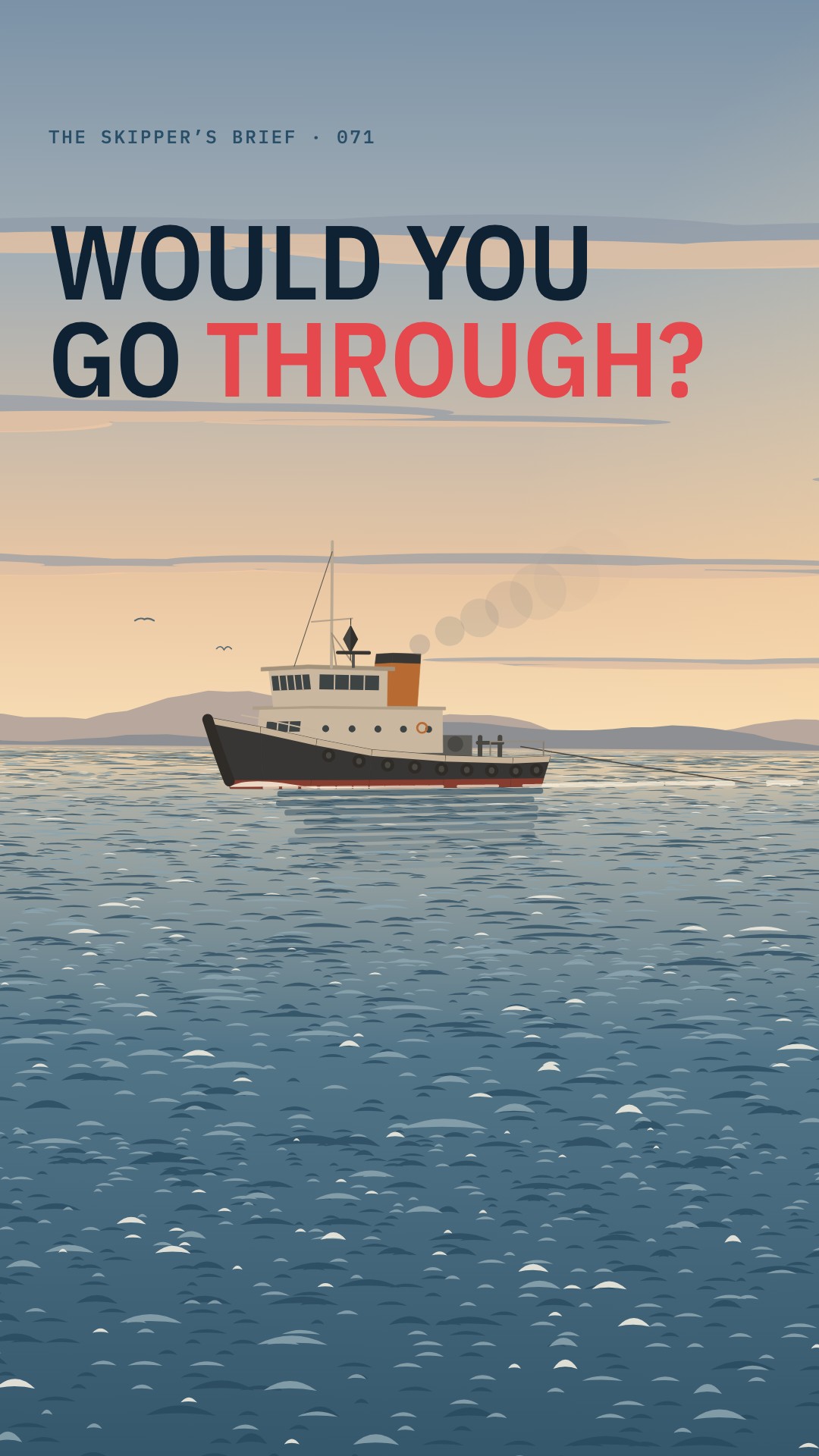
That gap between tug and barge looks clear. Would you go through?
Rules of the road
Never go between a tug and her tow. A towline joins them, and it can be just under the surface, hundreds of metres of it, with open water on top. It isn't always hidden: a wire towline sags under its own weight, shows near the tug's stern and the barge's bow, and hangs deeper with more scope or less speed, so you can't judge it by eye. In Vancouver in 1999 a pleasure boat, not recognising a tug and barge at night, steered between them; the barge was 274 m astern. Her propellers fouled in the towline, the barge struck her and she capsized, and five of the fourteen aboard lost their lives. The investigators also found the barge's sidelight far below the required range and the tug's wheelhouse left unattended. By day, a tow over 200 m shows a black diamond on the tug and on the tow; at night the tug shows three masthead lights in a vertical line. Shorter tows show two lights and no diamond. Pass well astern of the tow.
International rules (COLREGs). Inland waters can have their own rules.
Transcript
The gap between that tug and that barge looks clear. Would you go through?
It's a real question from the test at theskippersbrief.com.
Never. A towline joins them, and it can be just under the surface.
That line can be hundreds of metres long, and all you see is open water.
Vancouver, 1999. At night, a pleasure boat steered through. The towline caught her propellers, and the barge struck her. Five of the fourteen aboard lost their lives.
By day, a black diamond on both means a long tow. At night, three white lights in a line.
That gap isn't a gap. It's one long ship, with its middle under water.
Try three free questions at theskippersbrief.com.
Sources
- Transportation Safety Board of Canada, Marine Investigation Report M99W0133, collision between the pleasure craft Sunboy and the tug Jose Narvaez towing the barge Texada B.C., Vancouver Harbour, 7 August 1999. 'At about 2142, having not recognized the tug/barge combination, the operator of the Sunboy steered his vessel between the tug Jose Narvaez and the barge Texada B.C. being towed 274 m astern.' 'The propellers of the Sunboy became fouled in the towline, and the pleasure craft was struck by the on-coming barge, and capsized.' 'Of the 14 people who had been on board the Sunboy, nine were rescued and survived, four drowned and one remains missing and is presumed drowned'; finding: 'the loss of five lives'. 2.2.3: 'the cable connecting them lies hidden a short distance below the surface of the water and there is no visible link between the two'. 2.7.1: 'A tow line can vary substantially in length and, as it is under water, it is not visible.' 1.1.1: 790 m of 45 mm steel wire towline on the winch; 1.2.2: lengthened from about 60 m to 274 m; 5,200 tonnes of coal. Also causes: the tug's wheelhouse left unattended, and a temporary lantern as the barge's starboard sidelight, tested at under 0.4 nm against the 3 nm required
- Canadian Coast Guard, Safe Boating Guide (2001 edition), as quoted in TSB report M99W0133, 4.1.4: 'Often, the length of the tow is so great that the towline hangs below the surface of the water and is virtually invisible. If a small vessel strikes the submerged towline it could capsize and then be run down by the barge. Never pass between a tug and its tow'
- US Coast Guard, Marine Safety Alert 06-96, 'Tug and Barge Advisory' (8 August 1996): summer 1995, a tug towing a barge at night on a single tow wire, departing Portland, Maine. 'The recreational boat saw the tug, but did not realize it was towing a barge. The recreational boat waited for the tug to pass, and then, at a slow speed, tried to pass immediately behind the tug. It then struck the towing cable, was immediately pulled down by the stern, and was swamped. Accidents of this type are often fatal.' 'Tug and Barge systems can easily exceed 800' in length, even in restricted harbor waters' (diagram: 75 ft tug, 600 ft wire, 200 ft barge)
- COLREGs Rule 24, Towing and pushing: (a)(i) the towing vessel shows 'two masthead lights in a vertical line. When the length of the tow, measuring from the stern of the towing vessel to the after end of the tow exceeds 200 metres, three such lights in a vertical line'; (a)(iv) 'a towing light in a vertical line above the sternlight'; (a)(v) 'when the length of the tow exceeds 200 metres, a diamond shape where it can best be seen'; (e)(iii) the vessel towed: 'when the length of the tow exceeds 200 metres, a diamond shape where it can best be seen' (International text, Canada's Collision Regulations, Schedule 1)
- U.S. Navy Towing Manual, SL740-AA-MAN-010, Revision 4 (1 November 2022), 3-4.2: 'The weight of a wire rope towing hawser ... causes a catenary, or sag, in the towline between the tug and the tow'; 'To decrease catenary, towline scope may be shortened or the towing speed increased.' Example, 2-inch hawser, 1,500 ft of scope: more tension takes the catenary from about 100 ft to about 65 ft; slowing down almost doubles it to about 190 ft. Aramid fibre line 'provides no catenary'. How a towline hangs depends on the tow and the speed: 'can be' just under the surface, not always
- Jim Hendricks, 'Navigating Safely Around a Boat Being Towed', Boating magazine (January 2025): 'Navigate well astern of the tow'; on cutting between a towing vessel and its tow: 'This has happened, and the results are almost always tragic'; a towing vessel with a line under 200 m 'does not need to display a day shape'
- The Skipper's Brief, Lights and Signals course, module Towing (Rule 24). Question long-tow-on-starboard-bow: 'Three masthead lights in a line mean she's towing, with more than 200 m from her stern to the end of the tow ... pass well behind the end of the tow, never between her and it.' Question tow-diamond: 'A diamond means a tow longer than 200 m ... the vessel being towed shows one too ... don't cross the line between them.' Rules of the Road course, question long-tow-diamond: 'never pass between a tug and her tow: the towline can be just under the surface.' Every course starts with 3 free questions, no sign-up