Brief #061 · RULE 2
Which rule lets you break all the others?
Rules of the road
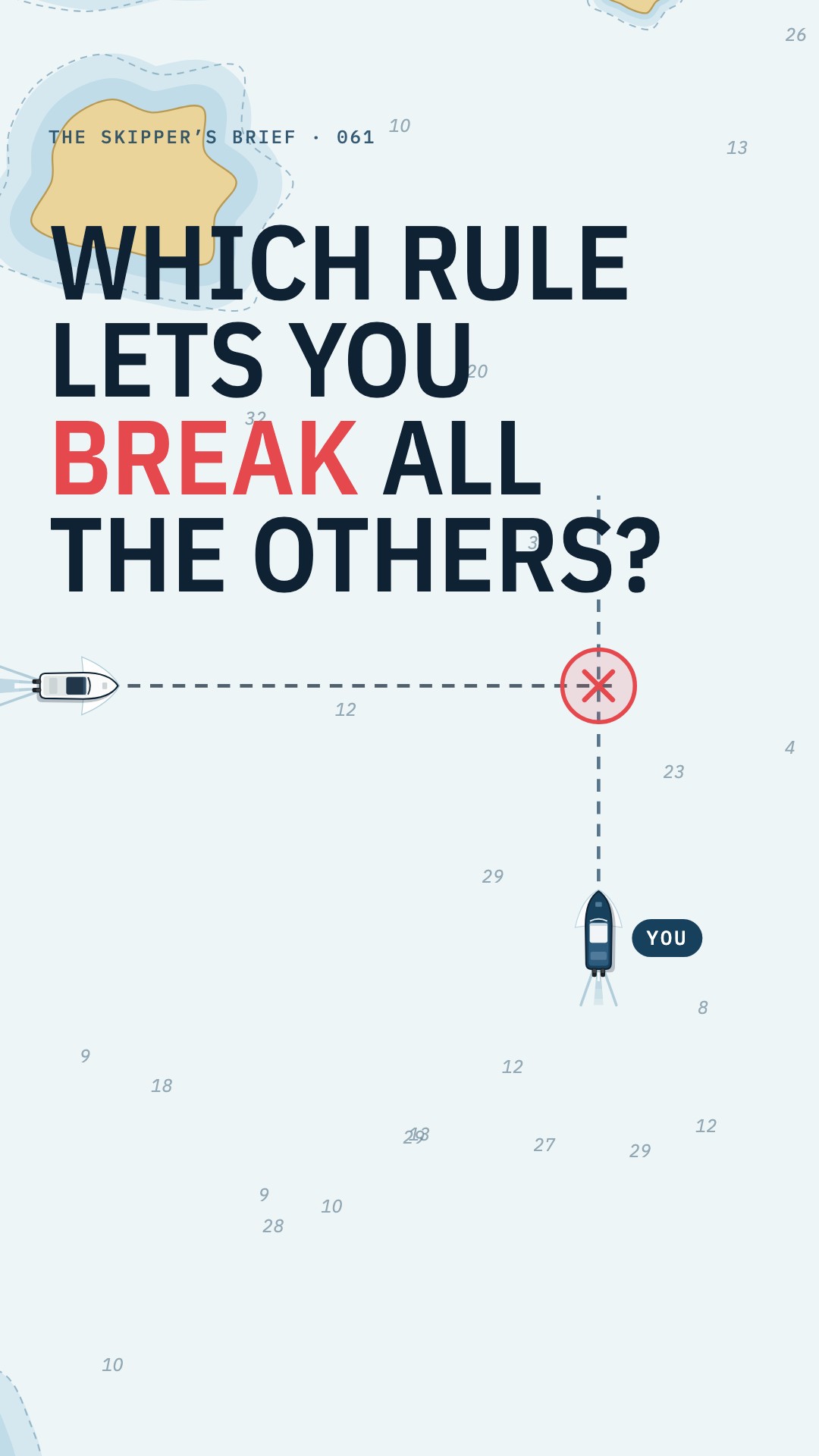
The responsibility rule: nothing in the international collision rules excuses neglecting good seamanship, and to avoid immediate danger you may depart from any of the other rules. The international rules never even say "right of way": one boat keeps out of the way, the other stands on. If the give-way boat keeps coming, the stand-on boat acts: five or more short blasts, then a turn to starboard or a cut in speed, not a turn to port for a boat on its port side. As the old sailors' rhyme of Michael O'Day says, being right won't save you.
International rules (COLREGs), two power-driven boats crossing. Inland waters can have their own rules: the US Inland Rules, for one, give a downbound vessel on the Great Lakes and Western Rivers the "right-of-way".
Transcript
One rule at sea lets you break all the others. Which one?
The responsibility rule. To avoid immediate danger, you may break any of the others.
And the international rules never say right of way. One boat keeps clear, the other stands on.
Here's one from my Rules of the Road course.
She should give way, but she keeps coming. What do you do?
You act. Five short blasts, then turn to starboard or slow down. Not to port: she may turn into you.
Here lies the body of Michael O'Day, who died maintaining his right of way. He was right, dead right, as he sailed along, but he's just as dead as if he'd been wrong.
Try three free questions at theskippersbrief.com.
Sources
- COLREGs Rule 2, Responsibility (international text, Canada's Collision Regulations, Schedule 1): (a) 'Nothing in these Rules shall exonerate any vessel, or the owner, master or crew thereof, from the consequences of any neglect to comply with these Rules or of the neglect of any precaution which may be required by the ordinary practice of seamen, or by the special circumstances of the case.' (b) 'due regard shall be had to all dangers of navigation and collision and to any special circumstances ... which may make a departure from these Rules necessary to avoid immediate danger.'
- COLREGs Rule 15, Crossing situation: 'When two power-driven vessels are crossing so as to involve risk of collision, the vessel which has the other on her own starboard side shall keep out of the way' and avoid crossing ahead of her (so a boat crossing from your left gives way to you)
- COLREGs Rule 16, Action by give-way vessel: 'Every vessel which is directed to keep out of the way of another vessel shall, so far as possible, take early and substantial action to keep well clear.'
- COLREGs Rule 17, Action by stand-on vessel: (a)(i) the other 'shall keep her course and speed'; (a)(ii) she 'may however take action to avoid collision by her manoeuvre alone, as soon as it becomes apparent to her that the vessel required to keep out of the way is not taking appropriate action'; (b) when 'collision cannot be avoided by the action of the give-way vessel alone, she shall take such action as will best aid to avoid collision'; (c) a power-driven vessel acting under (a)(ii) for another power-driven vessel in a crossing situation 'shall, if the circumstances of the case admit, not alter course to port for a vessel on her own port side'; (d) the give-way vessel is not relieved of her obligation
- COLREGs Rule 8(e), Action to avoid collision: 'If necessary to avoid collision or allow more time to assess the situation, a vessel shall slacken her speed or take all way off by stopping or reversing her means of propulsion.'
- COLREGs Rule 34(d), Warning signals: when vessels in sight of one another are approaching and either 'is in doubt whether sufficient action is being taken by the other to avoid collision, the vessel in doubt shall immediately indicate such doubt by giving at least five short and rapid blasts on the whistle'; 34(a): one short blast means 'I am altering my course to starboard'
- The phrase 'right of way' appears nowhere in the international rules: a full-text search of Canada's Collision Regulations (Schedule 1, the international rules with annexes) finds no 'right of way' or 'right-of-way'; the rules speak of the vessel that shall 'keep out of the way' (18 times) and the 'stand-on vessel' (Rule 17) (searched 2026-10-29)
- UK Maritime and Coastguard Agency, MSN 1781 (M+F), the Merchant Shipping (Distress Signals and Prevention of Collisions) Regulations 1996: the full COLREG 1972 text as amended, Rules 1 to 38 and Annexes I to IV; a full-text search finds no 'right of way' (searched 2026-10-29) – a second, independent official copy
- US Inland Navigation Rules, 33 CFR 83.09(a)(ii): on the Great Lakes, Western Rivers or waters specified by the Secretary, a power-driven vessel 'proceeding downbound with a following current shall have the right-of-way over an upbound vessel' – so only the international rules can be said never to use the phrase
- Peter Kemp (ed.), The Oxford Companion to Ships and the Sea (Oxford University Press, 1976), entry 'Rule of the Road': '...both vessels must take avoiding action even if such action involves a departure from the Rule of the Road on the part of one of them. This requirement is perhaps best summed up by the little verse which most seamen learn during the early years of their career: "Here lies the body of Michael O'Day / Who died maintaining the right of way; / He was right, dead right, as he sailed along, / But he's just as dead as if he'd been wrong"' (Kemp prints 'the right of way'; most boating books print 'his')
- Angus Konstam, Naval Miscellany (Osprey, 2010), prints the verse word for word as spoken: 'Here lies the body of Michael O'Day, / Who died maintaining his right of way, / He was right, dead right, as he sailed along, / But he's just as dead as if he'd been wrong.'
- Charlie Wing, Boating Magazine's One Minute Guide to the Nautical Rules of the Road (International Marine, 1998), a rules-of-the-road handbook, prints the same verse: 'Here lies the body of Michael O'Day / Who died maintaining his Right of Way...'
- The Skipper's Brief, Rules of the Road course (live 2026-10-29): module 'Overtaking, head-on and crossing: give way and stand on, Rules 13 to 17' includes this situation (the boat on your left should give way but keeps coming and is getting close; answer: act, turn to starboard or slow down, not to port; COLREG Rules 17 and 2), the signals module has the five short blasts (Rule 34(d)); every course starts with 3 free questions, no sign-up