Brief #018 · BERMUDA TRIANGLE
The truth about the Bermuda Triangle
Weather & sea
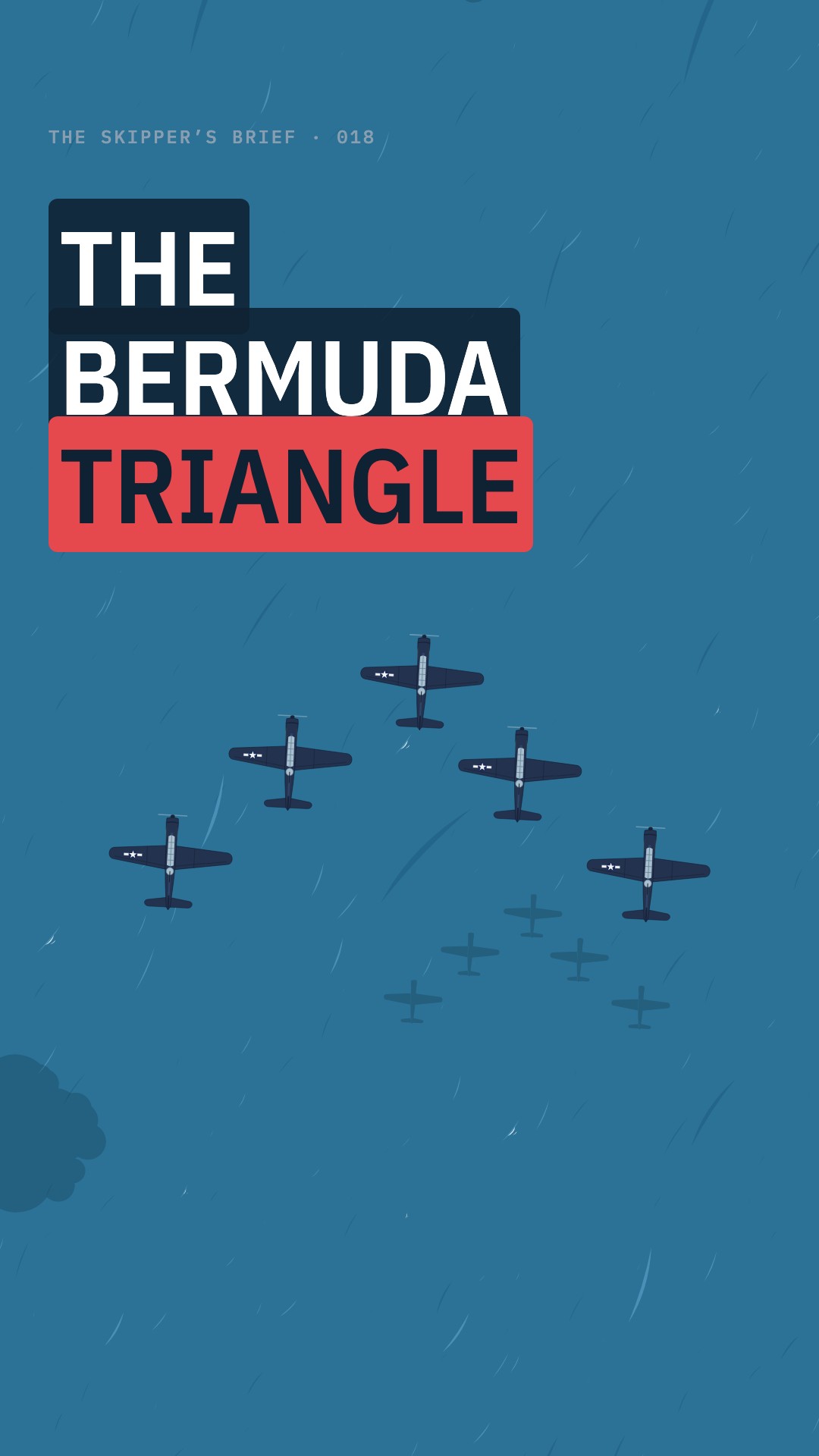
Five Navy bombers vanished in the Bermuda Triangle in 1945, but NOAA finds no evidence that ships or planes go missing there more often than in any other busy stretch of ocean. The real dangers are natural: hurricanes, and the Gulf Stream, which stacks up short, steep seas when the wind blows against it.
Transcript
What makes the Bermuda Triangle so dangerous? Five Navy bombers and 14 men vanished here in 1945. No trace has ever been found.
A flying boat sent to find them was lost too, with 13 men.
In 1964, a magazine called it the Deadly Bermuda Triangle.
But is it really more dangerous? No. There's no sign that ships or planes go missing here more often than in any other busy stretch of ocean. The Navy and the Coast Guard agree: nothing supernatural.
The real dangers are natural. Most Atlantic hurricanes pass through it.
And the Gulf Stream races through, carrying more water than all the world's rivers combined.
When the wind blows against it, the sea stacks up short and steep.
Crossing the Gulf Stream? Check the forecast, and wait out any north wind. Want to learn more interesting facts like this? Follow the page.
Sources
- Naval History and Heritage Command, H-Gram 057-4: The Disappearance of “Flight 19” and “Training 49”, 5 December 1945
- Wikipedia: Vincent Gaddis (“The Deadly Bermuda Triangle”, Argosy, February 1964) – secondary
- Wikipedia: Bermuda Triangle (usual vertices Miami, Bermuda and San Juan, Puerto Rico) – secondary
- NOAA Ocean Service: Does the Bermuda Triangle really exist?
- NOAA Ocean Service: How fast is the Gulf Stream? (average 4 mph, up to about 5.6 mph; more water than all the world’s rivers combined)
- National Weather Service, Public Information Statement, 16 April 2015: experimental Graphical Wind Against Current product (Ocean Prediction Center)
- NWS Melbourne Marine Web Letter, October 2008: higher seas when winds oppose the Gulf Stream
- Waterway Guide: Tips & Strategies for Crossing the Gulf Stream (republished by BoatTEST, December 2025)