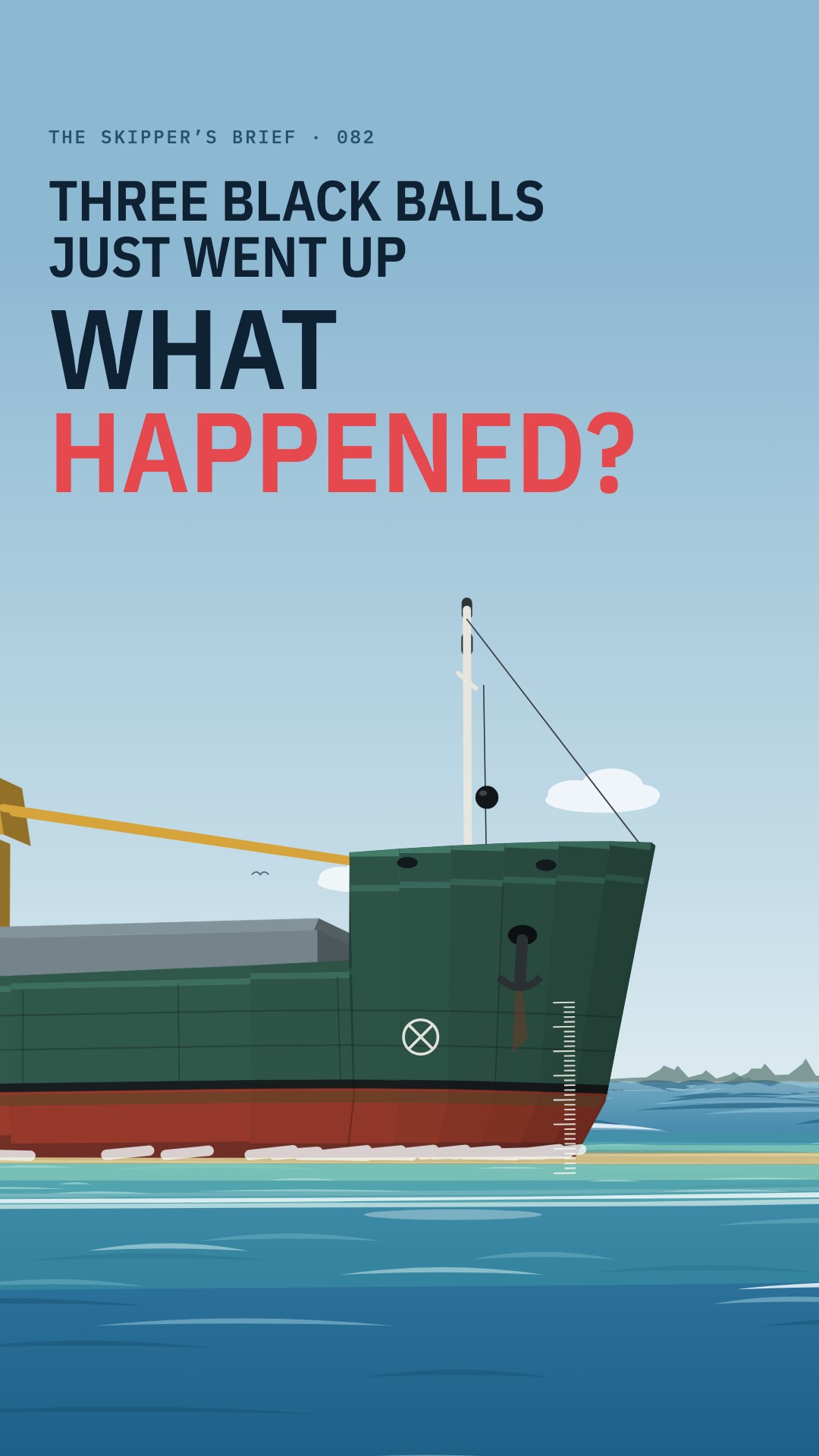
Brief #082 · DAY SHAPES
Three black balls on a ship. What happened to her?
Rules of the road
Three black balls in a vertical line mean a vessel aground (COLREG Rule 30(d)). At night she shows her anchor lights plus two all-round red lights in a vertical line. She can't move, and the water round her is shallow: if she found the bottom there, so can you, so keep well clear and check your chart. Count up the line: one ball, at anchor; two, not under command; three, aground. Three balls in a triangle are something else: a vessel clearing mines, to be given 1,000 m. A vessel under 12 m doesn't have to show the aground signals.
International rules (COLREGs). The US Inland Rules (33 CFR 83.30) use the same signals, shown 'if practicable'. A vessel under 12 m that runs aground doesn't have to show them. Inland waters can have their own rules.
Transcript
This ship just hoisted three black balls. What happened to her?
It's a real question from the test at theskippersbrief.com.
She's aground. She's stuck on the bottom and can't move.
So the water around her is shallow. If she found the bottom there, so can you. Keep well clear, and check your chart.
At night: her anchor lights, plus two reds, one above the other.
Three in a triangle is different: she's clearing mines. Keep a kilometre off.
Remember it by counting. One ball: at anchor. Two: not under command. Three: aground.
The more balls, the worse her day.
Take the free test at theskippersbrief.com.
Sources
- COLREGs Rule 30: (a) a vessel at anchor shows, where it can best be seen, in the fore part an all-round white light or one ball, and at or near the stern, lower down, an all-round white light; (b) under 50 m she may show one all-round white light instead; (d) a vessel aground shows the anchor lights of (a) or (b) and in addition, 'where they can best be seen', 'two all-round red lights in a vertical line' and 'three balls in a vertical line'; (f) a vessel of less than 12 m, when aground, is not required to show the lights or shapes of (d)(i) and (ii) (International text, Canada's Collision Regulations, Schedule 1)
- COLREGs Rule 27(a): a vessel not under command shows (i) two all-round red lights in a vertical line and (ii) 'two balls or similar shapes in a vertical line where they can best be seen' (International text, Canada's Collision Regulations, Schedule 1)
- COLREGs Rule 27(f): a vessel engaged in mine clearance operations shall, in addition to the lights for a power-driven vessel (Rule 23) or the anchor lights or shape (Rule 30), exhibit three all-round green lights or three balls, one near the foremast head and one at each end of the fore yard; 'These lights or shapes indicate that it is dangerous for another vessel to approach within 1 000 metres of the mine clearance vessel' (International text, Canada's Collision Regulations, Schedule 1)
- COLREGs Annex I: 6(a) shapes shall be black, a ball not less than 0.6 m in diameter; 6(b) 'The vertical distance between shapes shall be at least 1.5 metres'; 6(c) under 20 m, smaller shapes may be used. 2(i) two or three lights in a vertical line on a vessel of 20 m or more are spaced at least 2 m apart, the lowest at least 4 m above the hull; 2(k) the forward anchor light, when two are carried, at least 4.5 m above the after one, and on a vessel of 50 m or more at least 6 m above the hull (International text, Canada's Collision Regulations, Schedule 1)
- US Inland Rules, 33 CFR 83.30: (d) a vessel aground shows the anchor lights 'and in addition, if practicable, where they can best be seen': two all-round red lights in a vertical line and three balls in a vertical line; (f) a vessel of less than 12 meters, when aground, is not required to show them (Cornell LII)
- Wikipedia, Day shapes: black shapes hung from a mast to show a vessel's status by day; a ball is at least 0.6 m across and the vertical distance between shapes at least 1.5 m; its table lists anchored, one ball; not under command, 2 balls in a vertical line; aground, 3 balls in a vertical line; minesweeping, 3 balls
- Wikipedia, Ship grounding: 'the impact of a ship on seabed or waterway side'; when unintentional it is commonly called running aground, and it may leave the ship stranded
- The Skipper's Brief, Lights and Signals course (checked 2026-11-14): every course starts with 3 free questions, with no sign-up. Module 'Day shapes', question 'A ship shows three black balls in a vertical line. What does it mean?' Options: she is at anchor; she is not under command; she is aground (right); she is restricted by her work. Its explanation: two balls would mean not under command and one at anchor, and a vessel aground marks shallow water, so stay well clear. Module 'Pilot boats, at anchor and aground': aground at night is her anchor lights plus two reds in a vertical line, and 'Aground means shallow water nearby: keep well clear of her'