Brief #060 · LIGHTS
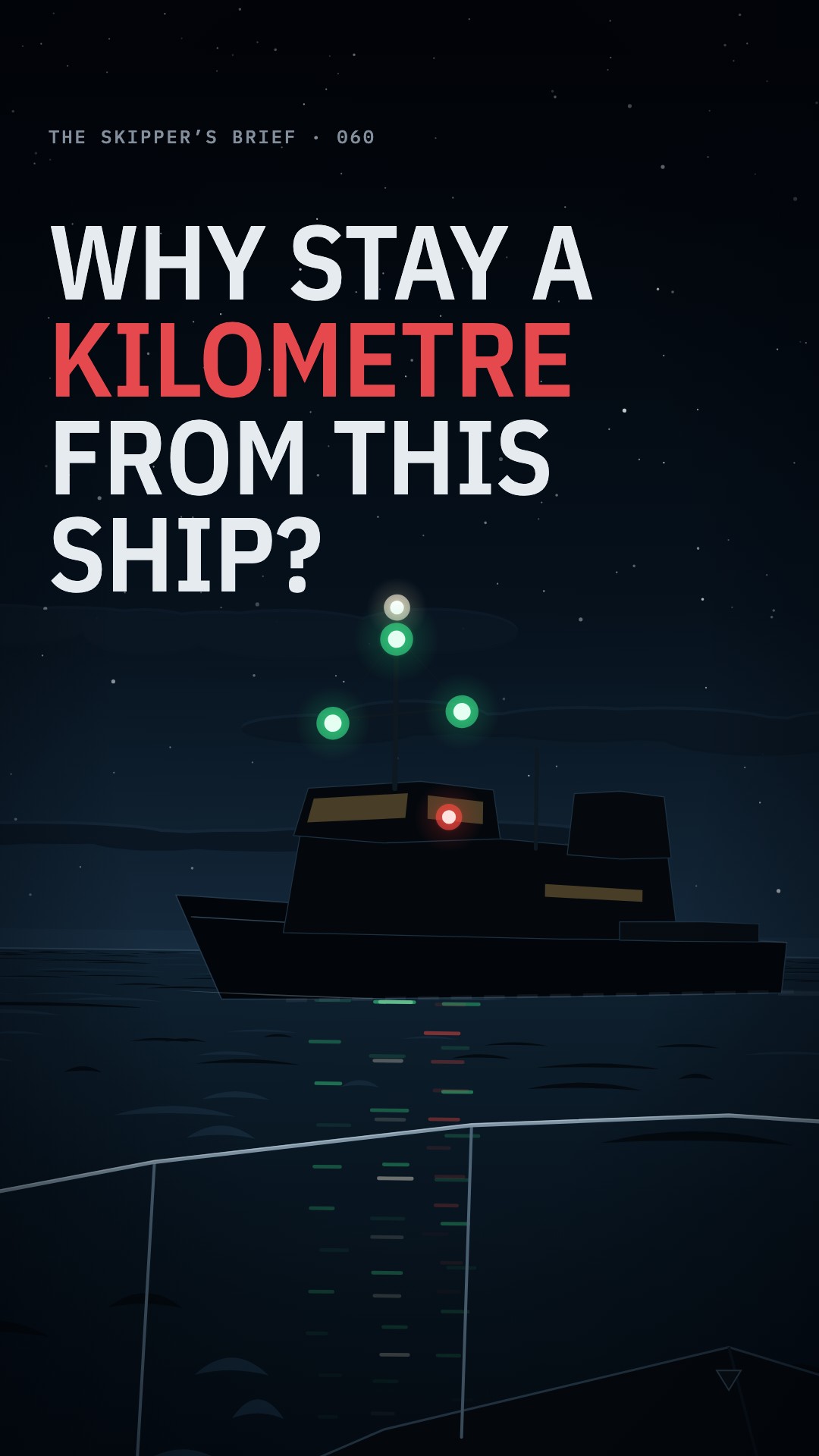
Why stay a kilometre away from this ship?
Rules of the road
Three green lights in a triangle at night, or three black balls in a triangle by day, mean a vessel clearing mines, and it is dangerous to come within 1,000 m of her. Why it still matters: about 160,000 mines were laid in the Baltic in the two world wars, tens of thousands are still on the seabed, and navies hunt them every year. Three balls in a vertical line mean something else: aground.
International rules (COLREGs), the same in the US Inland Rules. Inland waters can have their own rules.
Transcript
Why stay a kilometre away from this ship?
She's hunting mines. In two world wars, about 160,000 were laid in the Baltic. Tens of thousands are still down there.
Navies still hunt them every year.
She shows three green lights: one high on the mast, one at each end of the yard.
Coming within a kilometre of her is dangerous.
It's the first free question in my Lights and Signals course.
By day you see three black balls in a triangle. What is she doing?
Clearing mines. In a line, they'd mean aground. Three in a triangle: keep a kilometre off.
Try three free questions at theskippersbrief.com.
Sources
- COLREGs Rule 27(f): a vessel engaged in mine clearance operations shall, in addition to the lights for a power-driven vessel (Rule 23) or the anchor lights or shape (Rule 30), exhibit three all-round green lights or three balls, one near the foremast head and one at each end of the fore yard; 'These lights or shapes indicate that it is dangerous for another vessel to approach within 1 000 metres of the mine clearance vessel' (International text, Canada's Collision Regulations, Schedule 1)
- COLREGs Rule 30(d): a vessel aground shows the anchor lights and, where they can best be seen, two all-round red lights in a vertical line and three balls in a vertical line (International text, Canada's Collision Regulations, Schedule 1)
- COLREGs Annex I, 6(a): shapes shall be black; a ball shall have a diameter of not less than 0.6 metre (International text, Canada's Collision Regulations, Schedule 1)
- US Inland Rules, 33 CFR 83.27(f): the same three all-round green lights or three balls, near the foremast head and at each end of the fore yard; 'it is dangerous for another vessel to approach within 1000 meters' (Cornell LII)
- HELCOM Thematic Assessment on Hazardous Submerged Objects in the Baltic Sea: Warfare Materials (2024), 2.1.2.1.2 Naval mines: 'The number of mines laid during both World Wars in the Baltic Sea and approaches (including Kattegat) is 160,000. Extensive military mine clearance during the years 1996-2022 show that about 25% of the contact mines remain sunken in the area they were laid and approximately 75% of the ground mines remain in the positions they were laid.' Moored mines: a spherical case with horns, moored to the sea floor by wire or chain from the mine chair. In the Gulf of Finland the German Seeigelsperre alone had around 25,000 mines, and moored EMC, EMD and EMF mines are still fused and attached to their moorings. 5.5.4.2: the OPEN SPIRIT clearance operation rotates between the Baltic nations so that Estonia hosts it every third year
- NATO on Open Spirit 2021 (UK Defence Journal, 17 May 2021): the mine warfare of both world wars 'introduced approximately 160 000 mines to the Baltic Sea, from which, up to date barely 20% have been removed or destroyed'; Open Spirit is held annually, its leadership rotating between the Baltic states; in 2021 more than 130 items were identified and 49 countermined
- Rafał Miętkiewicz, PhD, Polish Naval Academy, BalticWind.EU (24 January 2022): estimates from the Baltic countries put 165,000 to 180,000 sea mines laid in the Baltic; with 10 to 35% remaining, 'between 16,000 and 61,000 sea mines, remnants of armed conflicts, remain in the Baltic Sea'
- Open Spirit 26 (Counter-IED Report, citing NATO, 14 May 2026): NATO ships took part in the international mine countermeasures operation off Latvia, 1 to 13 May 2026, against the threat of historical naval mines
- MTV Uutiset, 3 November 2025, on the Finnish Navy's release: NATO's Standing Mine Countermeasures Group 1, with the Finnish minehunter Katanpää, searched for and cleared historical sea mines off Hanko and Porkkala in the Gulf of Finland until 14 November 2025; 'Itämeren pohjassa on edelleen huomattava määrä ensimmäisen ja toisen maailmansodan aikaisia merimiinoja' (a considerable number of WWI and WWII sea mines still lie on the Baltic seabed), which as such pose no threat to shipping
- The Skipper's Brief, Lights and Signals course page (live 2026-10-29): 3 questions free, no sign-up; free question 1 of 3 is 'At night this vessel shows three green lights in a triangle, as well as her other lights. What is she doing?' (answer: clearing mines, stay 1,000 m away)