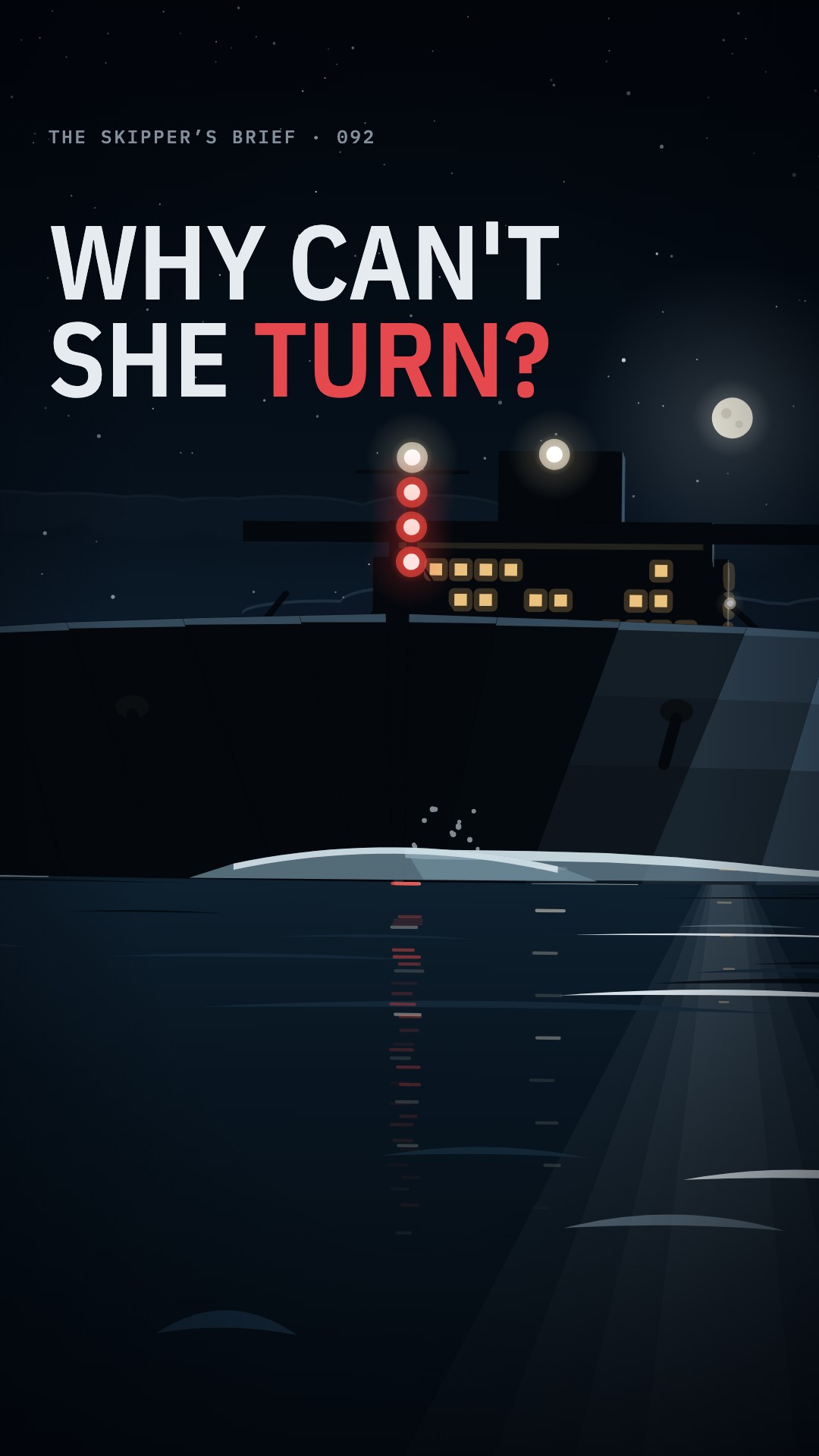
Brief #092 · CONSTRAINED
Three red lights in a vertical line. Why can't she get out of your way?
Rules of the road
Three all-round red lights in a vertical line, shown with a power-driven vessel's lights, mean a vessel constrained by her draught (COLREG Rule 28): a ship so deep for the water around her that she can hardly leave her course. In a dredged channel her keel runs just above the bottom, and either side of it the water is too shallow for her, so she can't turn out of your way. So you don't impede her, under power or under sail (Rule 18(d)): keep out of the deep water she needs, and if you have to cross her channel, cross early and quickly (Rules 8(f) and 9(d)). By day she may hoist a black cylinder. Two reds alone mean something else: not under command. One way to remember it: three reds, stuck in her lane.
International rules (COLREGs) only, and the signals are optional: she 'may' show them. The US Inland Rules have no vessel constrained by her draft (33 CFR 83.28 and 83.18(d) are reserved), and in Canada's inland waters no vessel may show the three reds or the cylinder (Rule 28(b) of Canada's Collision Regulations). Other inland waters can have their own rules.
Transcript
Three red lights, one above the other. Why can't she get out of your way?
It's a real question from the test at theskippersbrief.com.
She's constrained by her draught. Too deep to leave the channel.
Her keel is just above the bottom. Either side, she'd run aground.
So don't impede her, under power or sail. Keep out of her channel, or cross it early and quickly.
By day, she may hoist a black cylinder.
Only two reds? That's not under command.
One way to remember it: three reds, stuck in her lane.
Take the free test at theskippersbrief.com.
Sources
- COLREGs Rule 28, Vessels constrained by their draught: (a) 'A vessel constrained by her draught may, in addition to the lights prescribed for power-driven vessels in Rule 23, exhibit where they can best be seen three all-round red lights in a vertical line, or a cylinder.' Canada adds (b): in Canadian inland waters no vessel shall show them. Rule 23(a): a power-driven vessel underway shows a masthead light forward, a second one abaft of and higher than it (vessels of 50 m or more), sidelights and a sternlight (International text, Canada's Collision Regulations, Schedule 1)
- COLREGs Rule 3(h): a vessel constrained by her draught is a power-driven vessel that, because of her draught in relation to the available depth and width of navigable water, is severely restricted in her ability to deviate from the course she is following (International text, Canada's Collision Regulations, Schedule 1)
- COLREGs Rule 18(d): (i) any vessel other than a vessel not under command or a vessel restricted in her ability to manoeuvre shall, if the circumstances of the case admit, avoid impeding the safe passage of a vessel constrained by her draught, exhibiting the signals in Rule 28; (ii) the vessel constrained by her draught shall navigate with particular caution, having full regard to her special condition (International text, Canada's Collision Regulations, Schedule 1)
- COLREGs Rule 9, Narrow channels: (b) a vessel of less than 20 metres or a sailing vessel shall not impede the passage of a vessel which can safely navigate only within a narrow channel or fairway; (d) 'A vessel shall not cross a narrow channel or fairway if such crossing impedes the passage of a vessel which can safely navigate only within such channel or fairway' (International text, Canada's Collision Regulations, Schedule 1)
- COLREGs Rule 8(f)(i): a vessel required not to impede the passage or safe passage of another vessel shall, when required by the circumstances of the case, 'take early action to allow sufficient sea room for the safe passage of the other vessel'; (ii) she is not relieved of that obligation when risk of collision develops (International text, Canada's Collision Regulations, Schedule 1)
- COLREGs Rule 27(a): a vessel not under command shows 'two all-round red lights in a vertical line where they can best be seen', two balls by day, and when making way through the water, sidelights and a sternlight as well; she shows no masthead lights (International text, Canada's Collision Regulations, Schedule 1)
- COLREGs Annex I: 2(a) on a power-driven vessel of 20 m or more the forward masthead light is at least 6 m above the hull (need not be more than 12 m) and the after one at least 4.5 m higher; 2(b) the after masthead light 'will be seen over and separate from the forward light at a distance of 1 000 metres from the stem when viewed from sea level'; 2(f) the masthead lights go above and clear of all other lights, and the Rule 28 lights may go above the after masthead light only when it is impracticable to carry them below the masthead lights; 2(g) sidelights no higher than three-quarters of the forward masthead light's height above the hull; 2(i) lights in a vertical line at least 2 m apart, the lowest at least 4 m above the hull; 3(a) masthead lights at least half the vessel's length apart (need not be more than 100 m); 6(a)(iii) 'a cylinder shall have a diameter of at least 0.6 metre and a height of twice its diameter' (International text, Canada's Collision Regulations, Schedule 1)
- US Inland Rules, 33 CFR Part 83, Subpart C (Lights and Shapes): '§ 83.28 [Reserved] (Rule 28)'; and in § 83.18 (Responsibilities between vessels), paragraph (d) is reserved: the Inland Rules have no vessel constrained by her draft (Cornell LII)
- SIMMAN 2008 workshop (FORCE Technology), KRISO/MOERI tanker KVLCC2, the standard research hull of a modern VLCC: full scale 320 m between perpendiculars, 58 m beam, 30 m depth, 20.8 m draught. The reel's tanker is drawn to these proportions; its channel depths (23 m dredged, 8 m outside) are an example, labelled so
- Wikipedia, Under keel clearance: 'the vertical distance between seabed and the keel or hull of a ship'; 'Inadequate UKC, caused by shallow water and squat may lead to ship groundings'
- Wikipedia, Day shapes: black shapes hung from a mast to show a vessel's status by day; its table lists 'Constrained by draft: Cylinder', and not under command, two balls in a vertical line
- The Skipper's Brief, Lights and Signals course (checked 2026-11-14): every course starts with 3 free questions, with no sign-up. Module 'Working vessels', question 'Under International rules: three reds in a vertical line, a white masthead light and a red sidelight. What is she?' Options: not under command; aground; constrained by her draught (right); restricted by her work. Its explanation: three all-round reds mean constrained by her draught, a power-driven vessel so deep for the water that she can't leave her channel; don't impede her; US inland rules have no such signal. Module 'Day shapes': one black cylinder means constrained by her draught
- The Skipper's Brief, Rules of the Road course, module 'Responsibilities' (Rules 3(h) and 18(d)): 'You are sailing. The ship is constrained by her draught. What must you do?' Right answer: keep clear early, don't impede her: every vessel except one not under command or restricted must avoid impeding her, yachts included; act early, so she never has to alter for you