Brief #085 · RULE 12
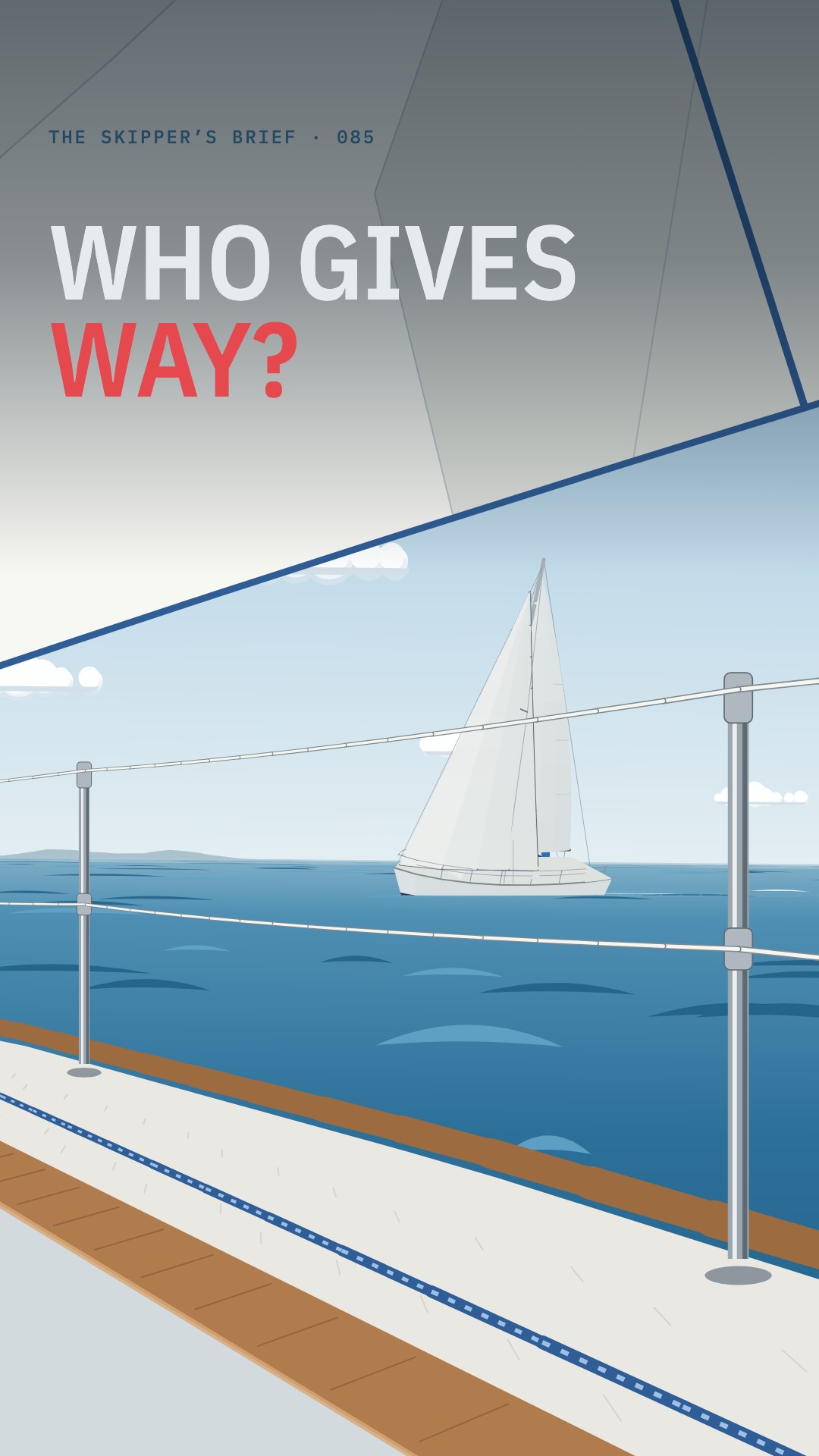
Two sailboats are heading for each other. Who gives way?
Rules of the road
When two sailing boats meet with a risk of collision, it goes by the wind. On different tacks, the one with the wind on her port (left) side keeps out of the way of the other. On the same tack, the one to windward (upwind) keeps clear of the one to leeward. And a boat on port tack that can't tell which tack a boat to windward is on keeps clear too. To tell a boat's tack, look at her mainsail: the wind is on the other side. The give-way boat acts early and by a lot, often bearing away to pass behind; the other holds her course and speed. It only counts as sailing with no engine running, and a boat that's overtaking keeps clear whatever her tack.
International rules (COLREGs); the US Inland Rules say the same. Inland waters can have their own rules, and boats racing each other follow their racing rules.
Transcript
Two sailboats are heading for each other. No engines. Who gives way?
It's a real question from the test at theskippersbrief.com.
The one on port tack: the wind comes over her port side, her left.
To tell her tack, look at her mainsail. The wind is on the other side.
Here that's you. Bear away early, and pass behind her.
Wind on the same side? The boat upwind keeps clear of the one downwind.
Can't tell the tack of a boat upwind? If you're on port tack, keep clear.
Easy to remember: port tack, keep clear. Same tack, upwind keeps clear. In doubt, keep clear.
Take the free test at theskippersbrief.com.
Sources
- COLREGs Rule 12: '(a) When two sailing vessels are approaching one another, so as to involve risk of collision, one of them shall keep out of the way of the other as follows: (i) when each has the wind on a different side, the vessel which has the wind on the port side shall keep out of the way of the other, (ii) when both have the wind on the same side, the vessel which is to windward shall keep out of the way of the vessel which is to leeward, (iii) if a vessel with the wind on the port side sees a vessel to windward and cannot determine with certainty whether the other vessel has the wind on the port or on the starboard side, she shall keep out of the way of the other. (b) For the purposes of this Rule, the windward side shall be deemed to be the side opposite to that on which the mainsail is carried ...' No Canadian modification. The memory line in the close is our own summary of (a)(i) to (iii), not a traditional saying (International text, Canada's Collision Regulations, Schedule 1)
- COLREGs Rule 3(c): 'The term sailing vessel means any vessel under sail provided that propelling machinery, if fitted, is not being used.' Why the hook says no engines: with one running, Rule 12 doesn't apply (International text, Canada's Collision Regulations, Schedule 1)
- COLREGs Rule 16: 'Every vessel which is directed to keep out of the way of another vessel shall, so far as possible, take early and substantial action to keep well clear.' (International text, Canada's Collision Regulations, Schedule 1)
- COLREGs Rule 8(b): an alteration of course to avoid collision shall 'be large enough to be readily apparent to another vessel observing visually or by radar'; (d) action 'shall be such as to result in passing at a safe distance' (International text, Canada's Collision Regulations, Schedule 1)
- COLREGs Rule 17(a)(i): 'Where one of two vessels is to keep out of the way, the other shall keep her course and speed.' (International text, Canada's Collision Regulations, Schedule 1)
- COLREGs Rule 21(b): sidelights are 'a green light on the starboard side and a red light on the port side', each shown 'from right ahead to 22.5 degrees abaft the beam on its respective side', so you see both only from about right ahead (International text, Canada's Collision Regulations, Schedule 1)
- COLREGs Rule 25(a) and (b): 'A sailing vessel underway shall exhibit: (i) sidelights, (ii) a sternlight'; under 20 metres they 'may be combined in one lantern carried at or near the top of the mast'. None of her lights shows which side her sails are on (International text, Canada's Collision Regulations, Schedule 1)
- COLREGs Rule 13(a), for the post texts: 'Notwithstanding anything contained in the Rules of Part B, Sections I and II, any vessel overtaking any other vessel shall keep out of the way of the vessel being overtaken.' (International text, Canada's Collision Regulations, Schedule 1)
- US Code of Federal Regulations, 33 CFR 83.12, Sailing vessels (Rule 12) of the Inland Navigation Rules: the same three cases as the International Rule, and 'the windward side shall be deemed to be the side opposite to that on which the mainsail is carried'
- Wikipedia, Tack (sailing): 'a craft is on a starboard tack if the wind is coming over the starboard (right) side with sails on port (left) side'; 'On a starboard tack the mainsail is on the port side; on a port tack the mainsail is on the starboard side.' Close-hauled is about 45° off the wind (Wikipedia, Point of sail)
- Wikipedia, Glossary of nautical terms (A–L): bear away, 'To turn or steer a vessel away from the wind'; leeward, 'In the direction toward which the wind is blowing. Contrast windward.'
- The Skipper's Brief, Rules of the Road course, module 'Two sailing boats' (paid part; every course starts with 3 free questions, with no sign-up). Question port-tack-keeps-clear, a tap question: 'Two yachts are sailing upwind on opposite tacks. Tap the one that must keep clear.' Answer: you, on port tack; 'bear away (turn away from the wind) in good time and pass behind her.' The reel's four options are adapted from the tap. Question same-tack-windward: the windward yacht keeps clear of the leeward one. Question cant-tell-her-tack: on port tack, with a yacht's red and green lights to windward and her tack unknown, keep out of her way