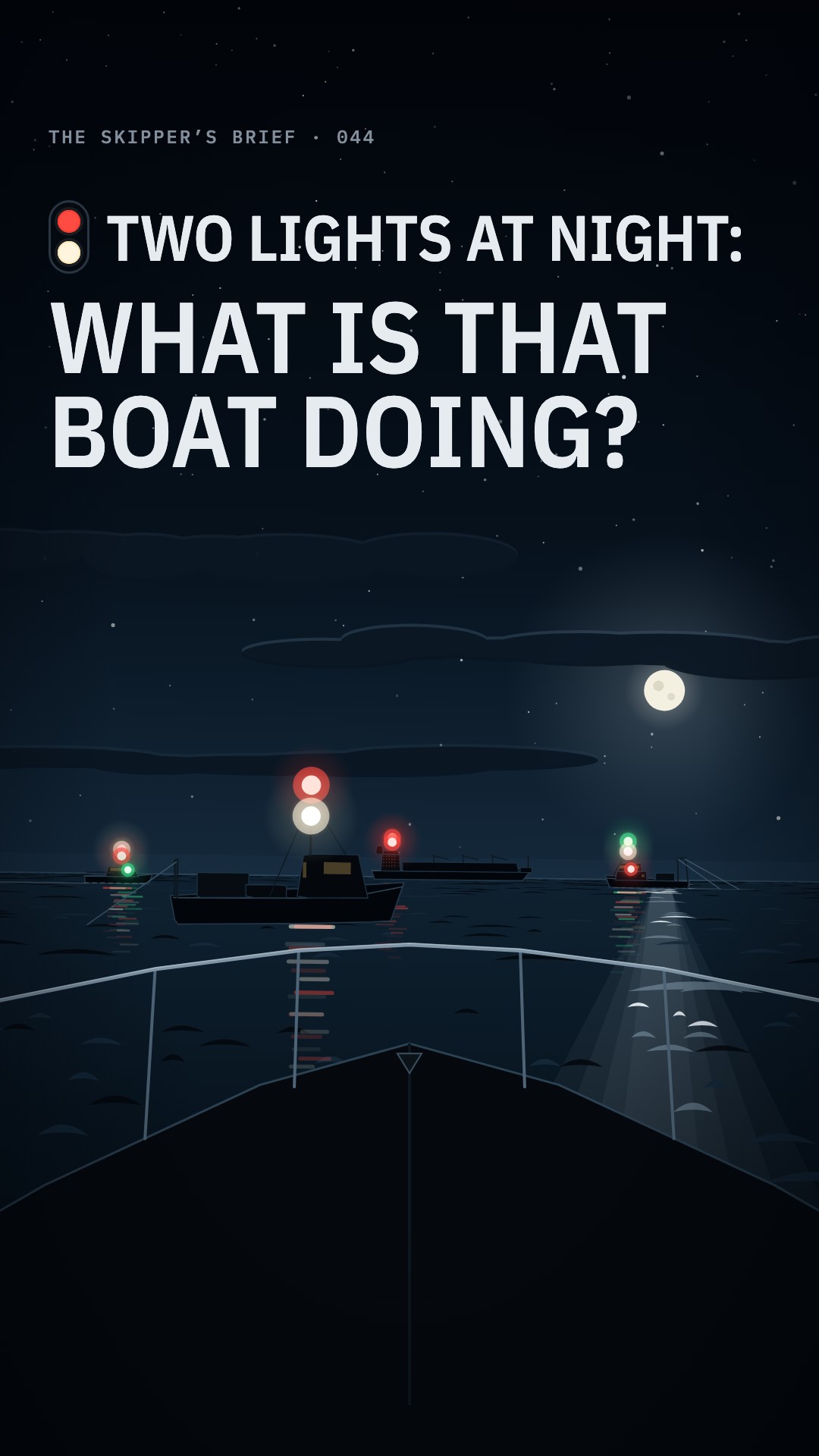
Brief #044 · NIGHT LIGHTS
Two lights at night: what is that boat doing?
Rules of the road
Two all-round lights one above the other tell you what a boat is busy with: red over white is fishing, green over white trawling, white over red a pilot boat on duty, and red over red a vessel not under command. Fishing vessels and vessels not under command can't easily get out of your way, so power and sail keep clear of them; a pilot boat gets no special right of way.
International COLREGs. Narrow channels, traffic lanes, overtaking and local rules can change who keeps clear.
Transcript
Two lights at night: what is that boat doing?
Red over white? Fishing at night, with nets or lines out.
Green over white? Trawling tonight: she's dragging a net.
White over red? Pilot ahead: a pilot boat on duty.
No special right of way, but give her room.
Red over red? The captain is dead.
Relax, nobody died. She just can't manoeuvre, maybe a broken engine or rudder.
Fishing, trawling or broken down, they can't easily get out of your way.
So under power or sail, you keep clear.
Four pairs, four rhymes, worth knowing by heart.
Want to learn more interesting facts like this? Follow the page.
Sources
- COLREGs Rule 26, Fishing vessels: a vessel engaged in trawling ('the dragging through the water of a dredge net or other apparatus') shows 'two all-round lights in a vertical line, the upper being green and the lower white'; a vessel engaged in fishing other than trawling shows 'two all-round lights in a vertical line, the upper being red and the lower white'; when making way, also sidelights and a sternlight (USCG Navigation Rules, International text)
- COLREGs Rule 27(a), Vessels not under command: 'two all-round red lights in a vertical line where they can best be seen'; when making way, also sidelights and a sternlight (USCG Navigation Rules, International text)
- COLREGs Rule 29, Pilot vessels: a vessel engaged on pilotage duty shows 'at or near the masthead, two all-round lights in a vertical line, the upper being white and the lower red'; when underway, also sidelights and a sternlight (USCG Navigation Rules, International text)
- COLREGs Rule 3, Definitions: a 'vessel engaged in fishing' is fishing 'with nets, lines, trawls, or other fishing apparatus which restrict maneuverability'; a 'vessel not under command' is one which 'through some exceptional circumstance is unable to maneuver as required by these Rules and is therefore unable to keep out of the way of another vessel' (USCG Navigation Rules, International text)
- COLREGs Rule 18, Responsibilities between vessels: 'Except where Rules 9, 10, and 13 otherwise require', a power-driven vessel underway keeps out of the way of a vessel not under command, a vessel restricted in her ability to maneuver, a vessel engaged in fishing and a sailing vessel; a sailing vessel underway keeps out of the way of the first three. Pilot vessels are not on either list (USCG Navigation Rules, International text)
- Pat Mundus, Boat Navigation Lights: Mastering Night Watch and Safety, Power & Motoryacht (29 January 2026): '“White over red, pilot ahead,” versus “red over white, fishing at night.”'; cheat sheet: Green over White 'Trawling Tonight' (trawler with nets out); Red over Red 'Captain is Dead' (vessel not under command / mechanical failure)
- Pat Mundus, What To Know About Navigation Lights, Soundings (January 2020): '“White over red, pilot ahead,” versus “red over white, fishing at night.”'
- Frank Lanier, Navigation Mnemonics, BoatUS Magazine (April 2022): 'Green over white, trawling tonight'; two vertical red lights indicate a vessel 'dead in the water or not under command': 'Red over red, the captain is dead,' or for the more squeamish, 'Red over red, the captain's in the head'
- Drew Frye, Lights and Shapes that Signal Status and Intentions, Practical Sailor (5 November 2024): not under command is 'A boat with steering failure, dismasting, or some other situation that makes it impossible to control'
- Falmouth Harbour, Pilot services and safety advice for leisure users: 'Keep an eye out for the two pilot boats; if they are operating slowly within the harbour it is possible that there is a pilot aboard a large commercial craft engaged in pilotage nearby'; 'Large ships take a very long time to change course or stop, so the safest option is to keep well clear'