Brief #055 · RULE 14
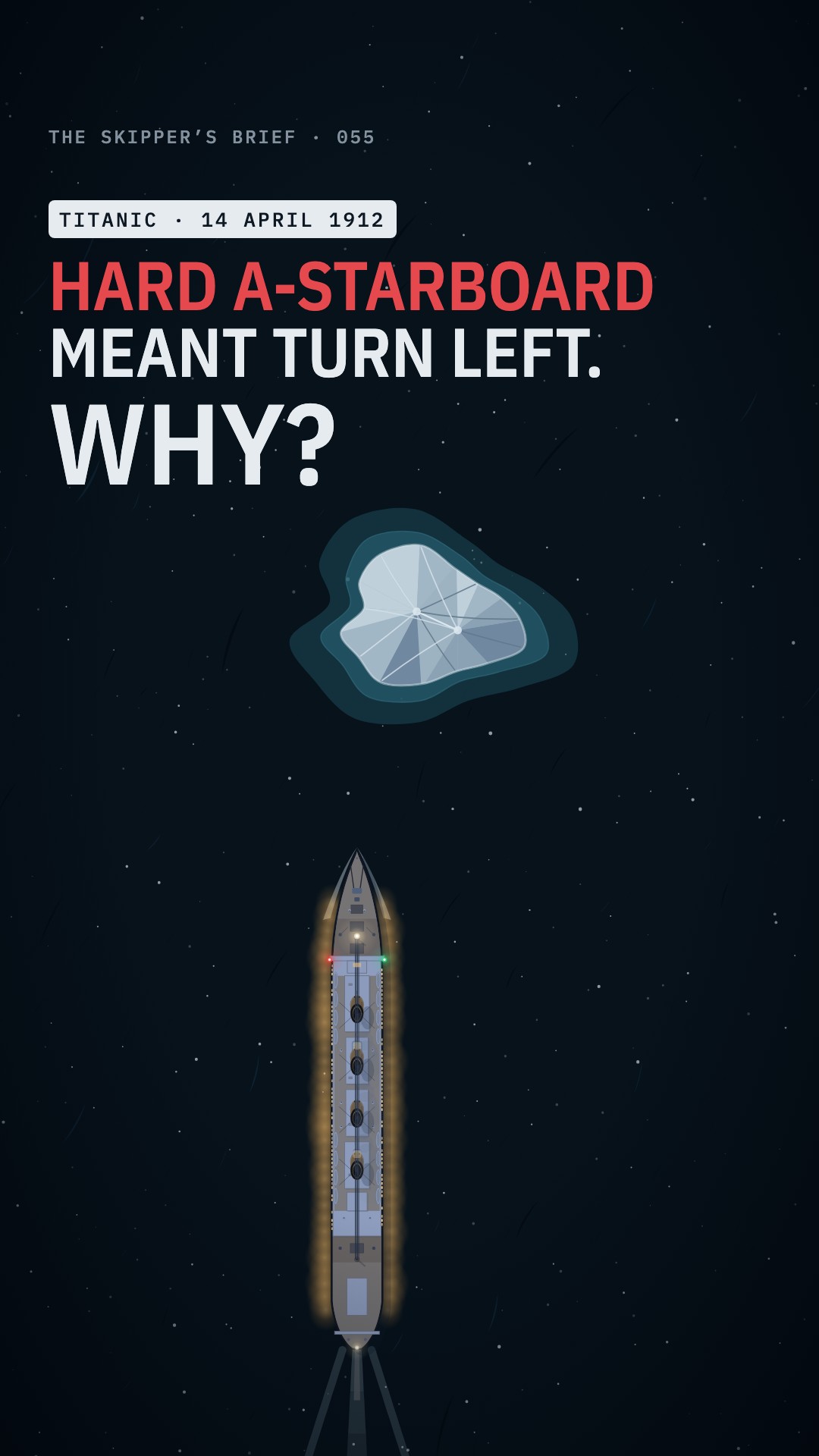
On the Titanic, 'hard a-starboard' meant turn left. Why?
Rules of the road
When the Titanic's lookout reported an iceberg right ahead, the order was 'hard a-starboard', and her bow swung to port. Helm orders were still tiller orders: push a tiller to starboard and the bow goes to port. Ships kept the words after they got wheels, and crews mixed them up, until the 1929 Safety of Life at Sea convention made helm orders name the way the ship's head goes (in force on British ships from 1933). The head-on turn itself never changed: 'helm to port' in 1840, 'alter course to starboard' today. Then a test: two motorboats meeting head-on both turn to starboard and pass port to port.
International rules (COLREGs). The head-on rule is for two power-driven vessels; a motorboat meeting a boat under sail keeps out of her way instead. Inland waters can have their own rules.
Transcript
On the Titanic, 'hard a-starboard' meant turn left. Why?
Iceberg right ahead. The order: hard a-starboard. And her bow swung left.
Old helm orders meant the tiller: push it to starboard, the bow goes to port.
Wheels kept the old words, and crews mixed them up, until a 1929 treaty flipped them.
The head-on turn never changed. In 1840: helm to port. Today: turn to starboard. Same turn.
Head-on meetings are in my Rules of the Road course.
Two motorboats meet head-on. Which way does each turn?
Both to starboard, port side to port side. Head-on? Both go right.
Try three free questions at theskippersbrief.com.
Sources
- British Wreck Commissioner's Inquiry, Report (1912), Account of the ship's journey: the lookout struck three blows on the gong and telephoned the bridge 'Iceberg right ahead'; 'Mr. Murdoch, the officer of the watch, gave the order "Hard-a-starboard,"' and telegraphed 'Stop. Full speed astern'; 'The helm was already "hard over," and the ship's head had fallen off about two points to port, when she collided with an iceberg', a little before 11.40 pm
- British Wreck Commissioner's Inquiry, Day 3 (7 May 1912), Quartermaster Robert Hichens, at the wheel, Q949: 'We had the order, "Hard-a-starboard," and she just swung about two points when she struck'; Q957: 'The wheel was over then, hard over'
- Wikipedia, Tiller (citing the National Maritime Museum and Beveridge, Titanic: The Ship Magnificent, 2008): Murdoch's 'Hard-a-Starboard' was a tiller order, so the wheel went to port, the rudder to port and the ship turned to port; the order was given and executed correctly, and the ship struck the iceberg anyway – secondary
- Crosbie, J. W. (2013), 'A Note on Helm Orders After the Coming of Steam', The Journal of Navigation 66, 315–320: 'pushing against the tiller in one direction turns the ship's head in the other'; steamers kept the sailing ships' tiller orders; the 1840 Trinity House and Admiralty rule: 'each vessel shall put her helm to port, so as always to pass on the larboard side of the other'; 1863: when meeting end on 'the helms of both shall be put to port'; France reversed the meaning in 1874, and mixed-up orders led to accidents (the Indus in the Thames, 1884); resolved by the 1929 Safety of Life at Sea convention, illegal on British ships from 1 January 1933 to give helm orders with reference to the tiller
- IMO, 'IMO and the safety of navigation' (1998), Collision Regulations history: the London Trinity House regulations of 1840 required steam vessels to 'alter course to starboard so as to pass on the port side of each other'; from 1863 steam vessels meeting end-on altered course to starboard; the 1929 SOLAS Conference's direct helm orders 'came into force in 1933 – clearing confusion over helm orders due to the difference between the movement of the wheel and the tiller'
- International Convention for the Safety of Life at Sea, London 1929, Article 41 (Helm Orders), First Schedule of the UK Merchant Shipping (Safety and Load Line Conventions) Act 1932: after midnight on 30 June 1931 helm orders 'shall on all their ships be given in the direct sense': 'starboard' or 'right' only when 'the wheel, the rudder-blade and the head of the ship, shall all move to the right'
- US House of Representatives Report No. 1237, 74th Congress (15 June 1935), Amending the steering rules on vessels: the helm-order problem was understood to be 'one of the contributing factors in the Mohawk disaster, as the direction to starboard or port the helm were interpreted in opposite ways'; quotes SOLAS 1929 Article 41
- COLREGs Rule 14(a), Head-on situation: 'When two power-driven vessels are meeting on reciprocal or nearly reciprocal courses so as to involve risk of collision each shall alter her course to starboard so that each shall pass on the port side of the other' (International text, Canada's Collision Regulations, Schedule 1)
- The Skipper's Brief, Rules of the Road course (€15): module 3 'Overtaking, head-on and crossing' (Rules 13 to 17); 'Every course starts with 3 free questions, with no sign-up'