Brief #094 · SAID AT SEA
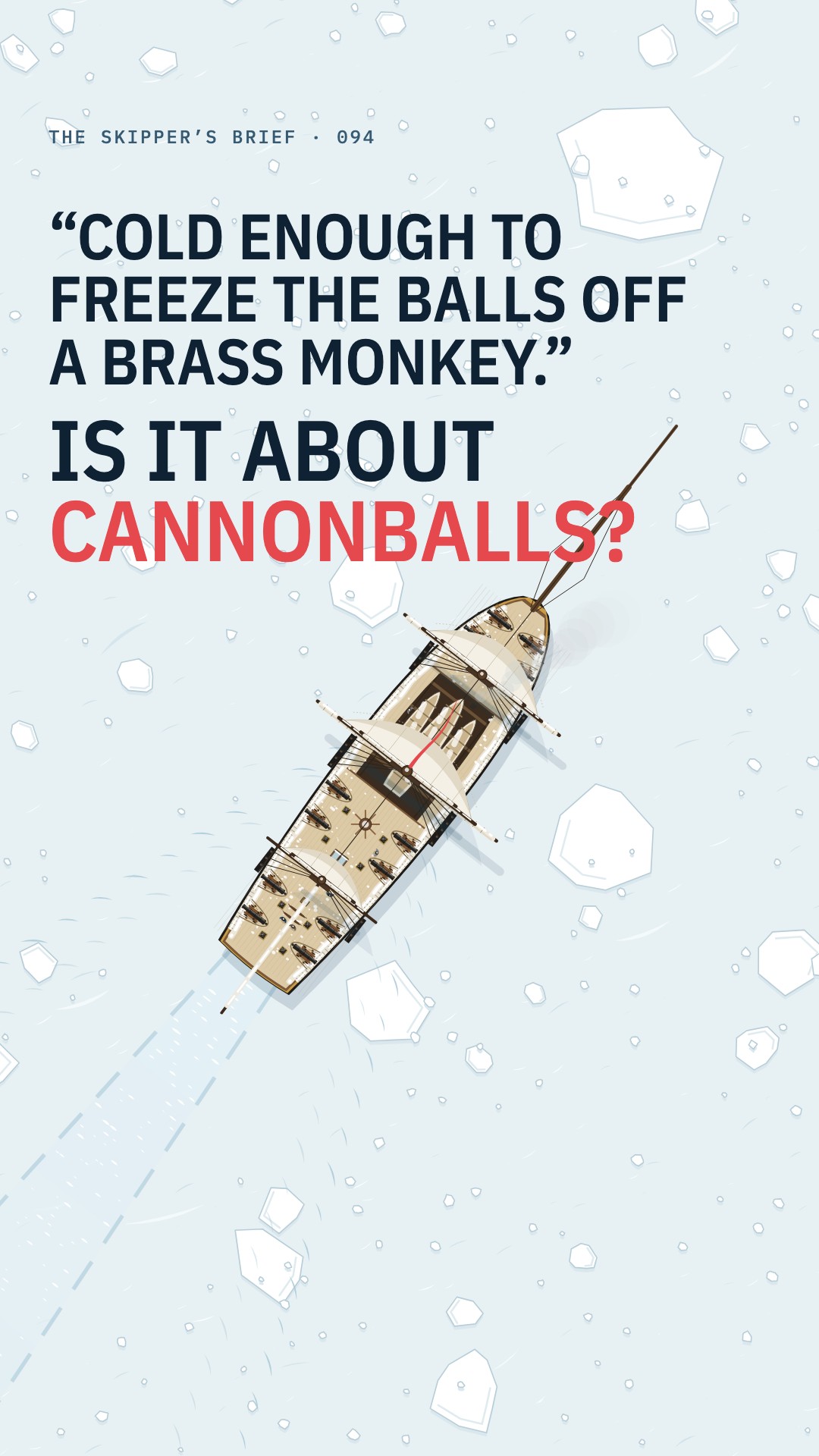
“Freeze the balls off a brass monkey.” Is it about cannonballs?
Stories
The popular story says warships stacked cannonballs in a pyramid on a brass tray called a monkey, and in a hard frost the brass shrank more than the iron, so the balls rolled off. It's a myth: warships kept their shot in wooden racks with a hollow for each ball (the shot garland of Falconer's 1769 marine dictionary), no record calls any shot holder a monkey, and brass shrinks more than iron by only about a tenth of a millimetre on a 50 cm tray in a 30-degree frost. The oldest known uses are about a monkey's nose or tail: in 1838 the weather was cold enough to freeze the nose off a brass monkey, and in Melville's Omoo (1847) it was hot enough to melt it. The brass monkey was probably just a brass figure of a monkey; the balls only appear in print in the 20th century.
Transcript
“Cold enough to freeze the balls off a brass monkey.” Is it about cannonballs?
Most people think warships stacked cannonballs on a brass tray, called a monkey.
In a hard frost, the brass shrank, and the balls rolled off.
Great story. It's a myth.
Ships kept shot in wooden racks, a hollow for each ball. No trays on record, and no monkeys.
Brass does shrink more than iron. By a tenth of a millimetre.
The oldest known version, 1838: cold enough to freeze the nose off a brass monkey.
1847: hot enough to melt it.
The monkey was probably just a brass ornament. The balls came later.
Want to learn more interesting facts like this? Follow the page.
Sources
- Wikipedia: Brass monkey (colloquialism) (the story that a 'monkey' was a brass tray holding cannonballs on warships, the brass contracting in the cold so the balls fell off; 'nearly all historians and etymologists' call it a myth, with the U.S. Navy, Michael Quinion and the OED; shot kept in racks, shot garlands in the Royal Navy; the contraction too small; early versions name the nose, tail, toes or whiskers; the testicle reference a 20th-century variant; the brass monkey probably a brass figure of a monkey)
- Michael Quinion, World Wide Words: Brass monkey weather (the story of shot piled in a pyramid on a brass plate called a monkey; a pyramid of shot 'hugely unsafe on a rolling and pitching deck'; ships used 'wooden frames with holes in, called garlands, fixed to the sides of the ship'; the movement between brass plate and iron balls 'only a fraction of a millimetre'; much more likely 'a real brass monkey')
- David Wilton, Wordorigins.org: brass monkey, cold enough to freeze the balls off a ('there is no record of monkey being used to mean a rack holding cannonballs (or anything similar)'; shot was 'stored in holes drilled in horizontal wooden planks known as shot garlands'; the shrinkage 'infinitesimal'; 1838 'cold enough to freeze the nose off of a brass monkey', 1842 toes, 1847 Melville; balls not in print until Partridge in 1937; a brass figure of a monkey)
- The Phrase Finder: Cold enough to freeze the balls off a brass monkey (shot planks 'known as shot garlands, not monkeys', in print by 1769; a pyramid of balls topples if tilted more than 30 degrees; expansion coefficients brass 0.000019, iron 0.000012, a negligible difference; Melville's Omoo, 1847, about heat; C. A. Abbey, 1857, 'it would freeze the tail off of a brass monkey'; the 'balls' wording from the 20th century)
- William Falconer, An Universal Dictionary of the Marine (London, 1769), via the Internet Archive: 'Shot-GARLAND, a piece of timber nailed horizontally along the ship's side from one gun-port to another', with 'semi-globular cavities' for the cannon-balls; the dictionary has no entry for 'monkey'
- W. H. Smyth, The Sailor's Word-Book (1867), Project Gutenberg: SHOT-RACKS 'Wooden frames fixed at convenient distances to contain shot'; GARLAND, among other senses 'a large rope grommet, to place shot in on deck'; MONKEY a pile-driving weight, a grog kid, a small trading vessel and more, with no shot tray among them
- Wikipedia: Thermal expansion, coefficients at 20 °C (brass 19, iron 11.8 × 10⁻⁶ per kelvin). Our arithmetic for a 50 cm tray cooled by 30 °C: brass 0.5 m × 19 × 10⁻⁶ × 30 = 0.29 mm, iron 0.18 mm; difference 0.11 mm, about a tenth of a millimetre (Wikipedia, Paper: paper is 0.07 to 0.18 mm thick)
- Bonnie Taylor-Blake, American Dialect Society list (27 August 2011): The Morning Herald (New York), 30 May 1838, p. 2, 'Stray Leaves from a Straggler's Note Book': the weather 'was cold enough to freeze the nose off of a brass monkey'
- Pascal Tréguer, Word histories: origin of 'brass monkey' (earliest instances: Morning Herald, New York, 30 May 1838, the nose; Plattsburgh Republican, 1842, the toes 'in winter'; Boon's Lick Times, 1843, 'to freeze a brass monkey's tail off'; the cannonball rack 'not proven'; probably jokes about brass monkey statuettes, very cold in winter and very hot in summer)
- Herman Melville, Omoo (1847), chapter LIII, Project Gutenberg: Shorty's 'hyperbolical phrase', 'It was 'ot enough to melt the nose h'off a brass monkey'
- Wikipedia: Paper ('Paper may be between 0.07 and 0.18 millimetres … thick')