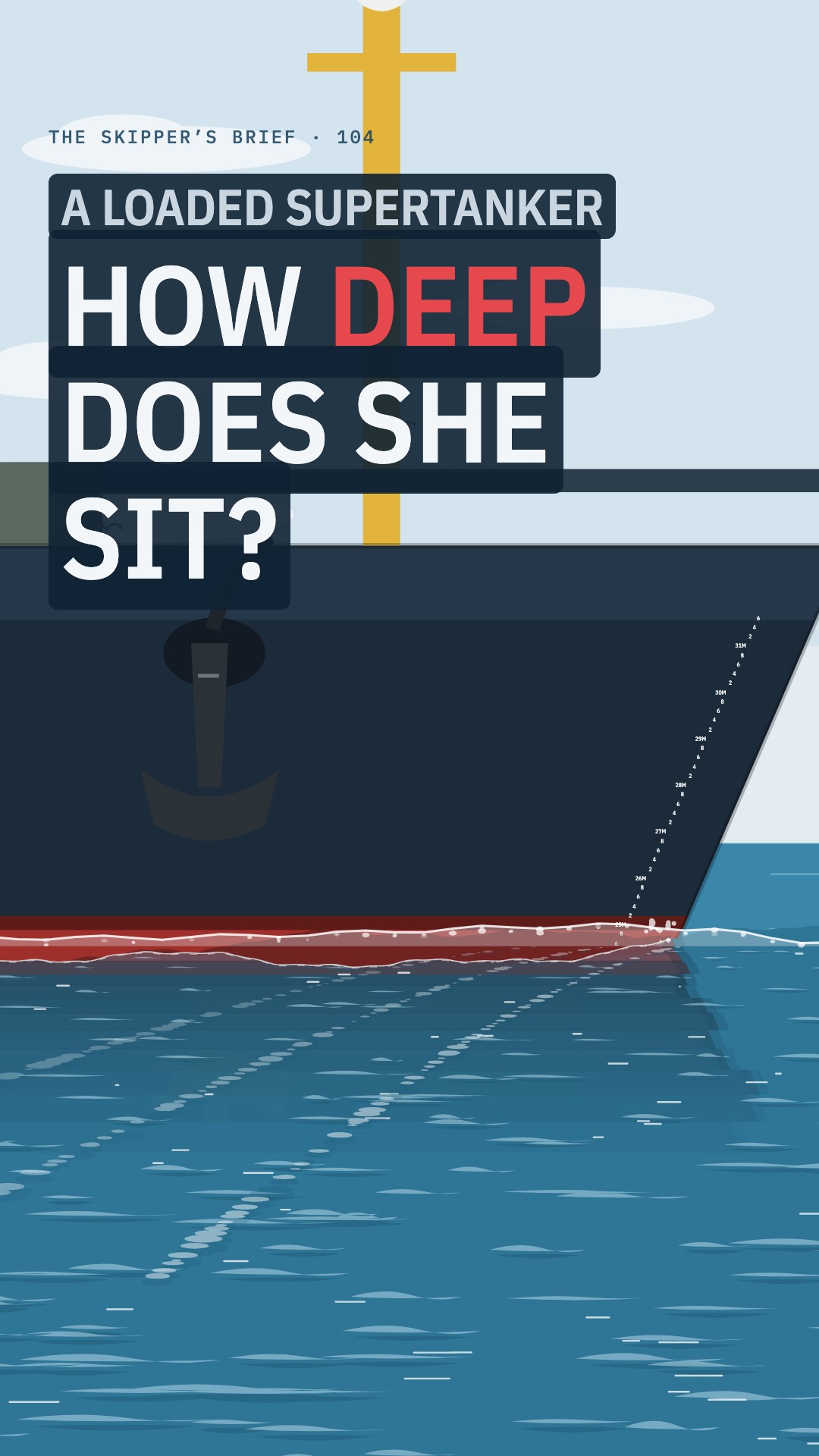
Brief #104 · HOW BIG
How deep does a supertanker sit in the water?
Stories
Fully loaded, Seawise Giant, the longest ship ever built (458.45 m), drew 24.6 m: with a moulded depth of 29.8 m, only about 5 m of her side showed above the water. Under it was about an eight-storey building (at about 3 m a storey), or five and a half double-decker buses (4.38 m each), and more than an entry-level scuba diver's usual limit of 18 m. In a dredged channel, ports that ask for 10% of a ship's deepest draught under her keel would leave her about 2.5 m; leave the channel and she runs aground, which is what 'constrained by her draught' means.
Transcript
How deep does a loaded supertanker sit in the water?
Fully loaded, the longest ship ever built showed just five metres above the water.
Under it: 24.6 metres.
That's about an eight-storey building.
Or five and a half double-decker buses, stacked.
A new scuba diver may go 18 metres down. Her keel is deeper still.
In a dredged channel, the bottom can be just two and a half metres under her keel.
Leave the channel, and she runs aground. She's constrained by her draught.
Want to learn more interesting facts like this? Follow the page.
Sources
- Guinness World Records: Longest ship ever (Mont, ex-Seawise Giant, 458.45 m; scrapped at Alang, India, in 2010)
- Wikipedia: Seawise Giant (length 458.45 m, beam 68.6 m, draft 24.611 m, depth 29.8 m; 'a laden draft of 24.6 m'; too deep for the English Channel, the Suez Canal and the Panama Canal). 'Five metres above the water' is our arithmetic: depth 29.8 m minus draught 24.6 m is 5.2 m of side from the waterline to the main deck, before the raised forecastle and poop. The reel's tanker is drawn to these dimensions, generic, with no name or livery (secondary)
- Marine Insight: Biggest oil tanker ever constructed (draught 24.6 m)
- Wikipedia, Draft (hull): draught is 'a determined depth of the vessel below the waterline'; draft marks sit on both sides 'as close as possible to the bow and stern'; in metric marks 'the bottom of each draft mark is the draft in decimeters and each mark is one decimeter high', every 2 decimetres. So at 24.6 m the water lies at the bottom of the 6 above 24M, as the reel's bow shows
- Wikipedia, Storey: a storey is generally 'around 3.0 m' floor to floor; a review of tall buildings gives 3.1 m for apartments (3.9 m for leased office floors). Eight storeys is our arithmetic: 24.6 m ÷ 3.0–3.1 m ≈ 8. The reel's building is generic: eight 3 m storeys and a 0.6 m parapet
- Wikipedia, AEC Routemaster: height 14 ft 4½ in (4.38 m), a classic double-decker bus. Five and a half is our arithmetic: 24.6 m ÷ 4.38 m = 5.6. The reel's bus is generic, at 4.38 m tall, with no operator's livery
- Wikipedia, Recreational diving: 'Entry level divers may be restricted to a depth of 18 or 20 metres'; under most entry-level programmes (PADI, SSI, NAUI, BSAC and others) a qualified diver may dive without supervision 'to depths typically restricted to 18 meters'; more advanced divers to 30, 40, 50 or 60 m, depending on the certification and agency. 'Her keel is 6.6 m deeper' is our arithmetic: 24.6 m − 18 m
- Wikipedia, Under keel clearance: 'the vertical distance between seabed and the keel or hull of a ship'; UKC = charted depth − draft ± height of tide, kept above a minimum with a safety margin; 'Inadequate UKC, caused by shallow water and squat may lead to ship groundings'
- Hong Kong Marine Department, Berthing Guidelines (endorsed by the Pilotage Advisory Committee, 2005), General remarks (4): 'An under-keel clearance of 10% of the vessel's deepest draught is required in maneuvering basins, sheltered fairways and approaches to berths. 15% under-keel clearance for any exposed waterways.' Two and a half metres is our arithmetic: 10% of 24.6 m is 2.46 m. The reel's channel (dredged to about 27 m, 15 m outside it) is an example, not a real one
- Port Authority of New South Wales, Port of Eden navigation: a vessel's maximum draft in the port's navigational channels must be such that 'the under-keel clearance is not less than 10% of the vessel's deepest draft'
- COLREGs Rule 3(h): a vessel constrained by her draught is a power-driven vessel that, because of her draught in relation to the available depth and width of navigable water, is severely restricted in her ability to deviate from the course she is following (International text, Canada's Collision Regulations, Schedule 1)