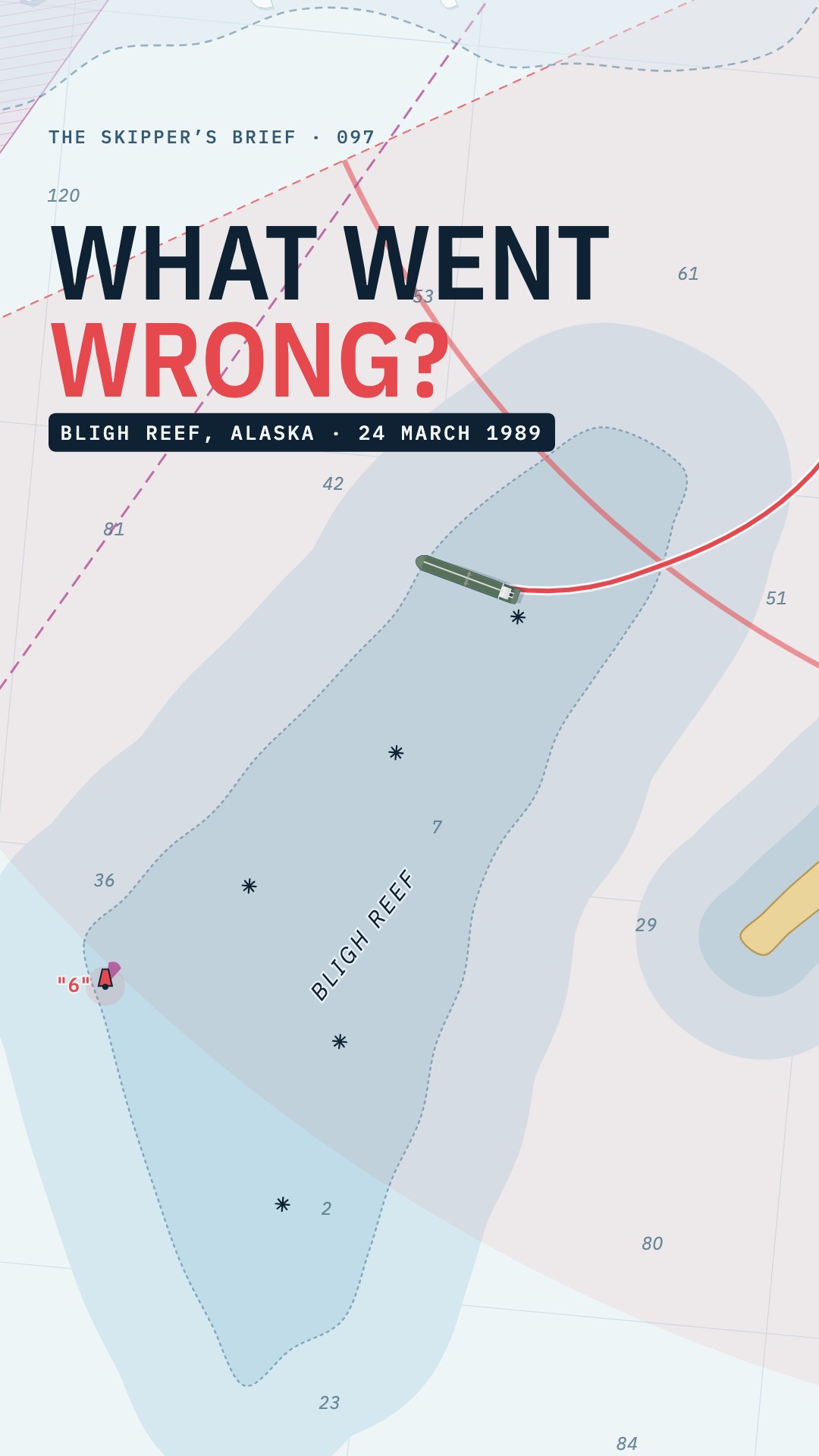
Brief #097 · ACCIDENT REPORT
Exxon Valdez hit a reef that was on the chart. What went wrong?
Stories
Just after midnight on 24 March 1989 the loaded tanker Exxon Valdez ran onto Bligh Reef in Prince William Sound, Alaska: a charted reef, marked by a buoy and by the red sector of Busby Island light. Eight cargo tanks tore open and about 258,000 barrels of crude oil spilled, nearly 11 million US gallons; no one was hurt. The US National Transportation Safety Board (NTSB) found three turning points. Glacier ice lay across the shipping lanes, so the master told the Coast Guard and left the lanes to go round it, a decision the Board found probably reasonable. He then left the bridge to the third mate, the only officer there, who was to turn back towards the lanes near Busby Island light; the Board found that leaving him in charge was against federal rules and company policy. The light came abeam at 23:55, but the turn began only about six minutes later and with too little rudder, and the light's red warning sector over the reef apparently went unnoticed. The Board's probable cause: the third mate's failure to manoeuvre properly because of fatigue and excessive workload; the master's failure to provide a proper navigation watch because of impairment from alcohol; Exxon's failure to provide a fit master and a rested, sufficient crew; an ineffective Vessel Traffic Service; and the lack of effective pilotage. The lesson for any boat: when danger is close, never leave one tired person to carry the whole watch.
Facts as the NTSB's report (MAR-90/04, adopted 31 July 1990) states them, in our own words. Some points the report leaves open: where exactly the master meant the turn to start (abeam of the light, or about 0.7 mile farther south), and why the turn started late. The chart in the video is our own simplified drawing, not to scale and not for navigation.
Transcript
A reef on the chart. Nearly eleven million gallons of oil. What went wrong?
Exxon Valdez, 1989. Outbound at night, with glacier ice in the lanes.
The captain left the lanes to go round it. Investigators found that reasonable.
Then he left the bridge. The third mate had the watch, to turn back near Busby Island light.
The turn began six minutes past the light, with too little rudder. Its red warning sector apparently went unnoticed.
Just after midnight, she ran onto Bligh Reef. Eight cargo tanks tore open.
The probable cause: the third mate's fatigue and workload, the master's impairment from alcohol, and failures ashore.
The lesson: near danger, never leave one tired person with the whole watch.
Take the free test at theskippersbrief.com.
Sources
- NTSB Marine Accident Report NTSB/MAR-90/04, Grounding of the U.S. Tankship Exxon Valdez on Bligh Reef, Prince William Sound, near Valdez, Alaska, March 24, 1989 (adopted 31 July 1990; a US government report, free to read). Executive Summary: about 0009 on 24 March 1989 the tankship, loaded with about 1,263,000 barrels of crude oil, grounded on Bligh Reef with the third mate in charge of the navigation; there were no injuries, but about 258,000 barrels of cargo spilled when eight cargo tanks ruptured, 'resulting in catastrophic damage to the environment'. She had left the Alyeska terminal at Valdez at about 2112 on 23 March, outbound for sea
- NTSB MAR-90/04, The Accident (pp. 4–7), Analysis (pp. 112–113) and Finding 1: ice floes from the Columbia Glacier lay across both the inbound and outbound lanes of the traffic separation scheme; at 2325 the master told the Coast Guard's Vessel Traffic Center he would probably divert from the scheme, and the watchstander concurred (no reported traffic); she came to 200° at 2331 and 180° at 2339, out of the lanes towards the shoal water east of Bligh Reef. Finding 1: the decision to leave the scheme to avoid ice 'was probably reasonable, even though it required a heading toward shoal water'
- NTSB MAR-90/04, The Accident (pp. 8–9), Analysis (pp. 113–116) and Findings 2 and 3: the master left the bridge about 2352, the third mate the only officer there (with a helmsman and a lookout); by the third mate's account he was to start turning back towards the lanes when Busby Island Light was abeam, though both men later marked a point about 0.7 mile farther south, and the report calls the master's intentions uncertain. Analysis (p. 116): the master could easily have determined that she would be past the reef in about 20 minutes. Finding 2: two officers were needed on the bridge between the ice and the reef. Finding 3: leaving the third mate in charge 'was contrary to Federal regulations and Exxon policy'
- NTSB MAR-90/04, Tests and Research (the CAORF simulator study, pp. 52–54), Analysis (pp. 117–120) and Findings 6 and 7: she passed abeam of Busby Island Light at 2355, about 0.9 mile off; the turn from 180° began at 0001.5, about 1.4 miles past the light, with right 10° rudder for about half a minute and then an average of about 4° to 5°; with 10° held throughout she would probably have passed north of the reef, and the same 4° turn begun with the light abeam would have passed about 0.9 mile north of it. Busby Island Light's red sector showed over Bligh Reef 'to warn mariners'; she was in it for several minutes before grounding, a warning that 'apparently was not noticed by the third mate or the lookout'. Finding 6: the third mate's failure to turn 'at the proper time and with sufficient rudder'
- NTSB MAR-90/04, Vessel Damage (pp. 24–27) and Figures 2 and 3: center cargo tanks 1 to 5 and starboard cargo tanks 1, 3 and 5 were holed (Table 1 lists the eight), with the forepeak and starboard ballast tanks; no damage to the port tanks; a large boulder lodged in the hull. The course recorder shows her heading swinging fast through 280° to 290° about 0009, on the reef. The chart in the video is our own simplified drawing after the report's description, not to scale
- NTSB MAR-90/04, Probable Cause (p. 170), in short: the third mate's failure to properly manoeuvre the vessel because of fatigue and excessive workload; the master's failure to provide a proper navigation watch because of impairment from alcohol; Exxon Shipping Company's failure to provide a fit master and a rested and sufficient crew; the lack of an effective Vessel Traffic Service (equipment, manning, training and oversight); and 'the lack of effective pilotage services'
- NTSB MAR-90/04, Analysis (pp. 115–116, 127–128) and Findings 2, 5 and 8: the water between the ice and the reef needed one officer to conn and one to fix the position, and 'demanded the master's presence on the bridge'; the third mate could have had as little as 5 or 6 hours of sleep in the 24 hours before and was working beyond his normal watch; no rested deck officer was available when she sailed
- NTSB MAR-90/04, Meteorological Information and Appendix F: at Valdez at 2350 on 23 March, overcast, visibility 3 miles in light snow and fog, wind calm; the scenes are drawn that way
- Our arithmetic from the NTSB's figure: 258,000 barrels × 42 US gallons = about 10.8 million US gallons, about 41 million litres. Wikipedia, Barrel (unit): an oil barrel is 42 US gallons, about 159 litres
- Wikipedia, Exxon Valdez oil spill: background on the spill in Prince William Sound and the clean-up (context only; the reel's facts follow the NTSB report)
- COLREGs Rule 5, Look-out: every vessel shall 'at all times maintain a proper look-out by sight and hearing as well as by all available means appropriate', so as to make a full appraisal of the situation and of the risk of collision (International text, Canada's Collision Regulations, Schedule 1)
- The Skipper's Brief, Rules of the Road course (checked 2026-11-14): every course starts with 3 free questions, with no sign-up. Module 'Lookout and speed', question 'When do the rules say you must keep a proper lookout?' Options: only at night or in poor visibility; only when other boats are close; at all times, by sight and hearing (right); only when you are going fast (COLREG Rule 5)