Brief #047 · SEA LORE
Does "posh" mean Port Out, Starboard Home?
Stories
The story says wealthy passengers sailing between Britain and India booked the shady port side going out and starboard coming home, and had tickets stamped P.O.S.H. It is almost certainly a myth: no such ticket has ever been found, "posh" was in print by 1914 while the acronym story only appears from 1932, and the word's real origin is uncertain (possibly old slang "posh", money).
Transcript
Does "posh" mean Port Out, Starboard Home?
Legend says rich passengers sailed to India through the Red Sea heat.
Going out, the shady side was port. Coming home, starboard.
Their tickets were stamped P.O.S.H. Port Out, Starboard Home.
Great story, but almost certainly a myth.
No such ticket has ever been found, not even in the shipping line's own archive.
Posh was in print by 1914. The acronym story only turns up in the 1930s.
Its true origin? Nobody knows for sure. Maybe London slang for money.
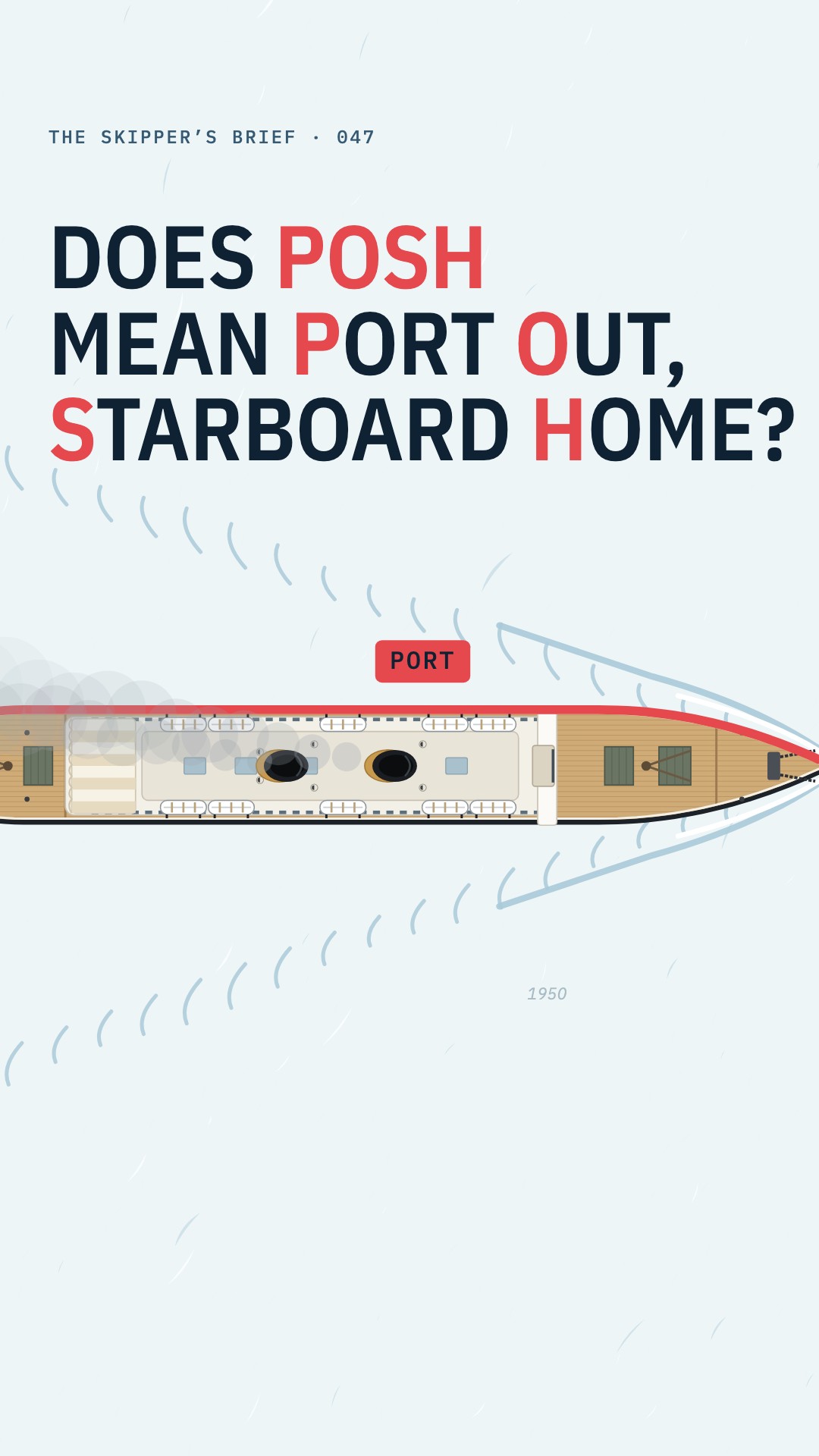
One thing's certain: port is left, starboard is right.
Want to learn more interesting facts like this? Follow the page.
Sources
- Merriam-Webster, Doesn't the word "posh" come from "port out, starboard home"? (the story: the cooler cabins on the P. & O. route via Suez and the Red Sea, port going out to India and starboard coming home, tickets stamped P.O.S.H.; 'We do not know the precise origin of the adjective posh'; the acronym first in print in a Times Literary Supplement letter of 17 October 1935; 'as late as 1962 the librarian of the P. & O. was unable to find any evidence that P.O.S.H. was actually stamped on anything'; 'no evidence of its use has yet appeared … simply a modern invention')
- Michael Quinion, World Wide Words: Posh (the P&O legend of cabins sheltered from the sun on the hottest part of the trip, the Suez Canal and the Red Sea, and tickets stamped POSH: 'there's absolutely no evidence for it and P&O flatly denies any such term existed. It's just a legend'; most probable source, though unprovable, London street slang posh 'money', recorded from 1830, perhaps from Romany posh 'half')
- Online Etymology Dictionary: posh (adj.) 'by 1914 … a word of uncertain origin, but there is no evidence for the common derivation from an acronym of port outward, starboard home' (per OED); the acronym story attested by 1933; more likely from slang posh 'a dandy' (1890), from thieves' slang 'money' (1830); 1914 quotation from E. C. Vivian, The British Army From Within)
- The Spectator, Dot Wordsworth: Posh ('No one has ever found such a ticket or any reference in shipping archives'; the OED's 2006 revision found its earliest citation in a 1914 book by E. C. Vivian; G. Chowdharay-Best, Mariner's Mirror, January 1971: P&O did not issue return tickets when the term supposedly arose)
- The Grammarphobia Blog: From outhouse to our house ("posh" is not an acronym for "port out, starboard home"; 'no such ticket has ever been found'; 'the origin of the adjective "posh" … has never been pinned down'; first showed up during World War I, the acronym decades later)
- The Phrase Finder: POSH, Port out, starboard home (Britain and India both in the northern hemisphere, so port berths were mostly in the shade travelling out and starboard ones coming back; 'P&O say they have never issued such tickets and, although many tickets from that era still exist, no POSH ones have been found'; the true origin is uncertain)
- Fred Shapiro and Garson O'Toole, American Dialect Society list (May 2023): the earliest known telling, News Chronicle (London), 5 August 1932: 'Going out the cabins on the port side afford the best shelter from the sun. On the homeward-bound ships the starboard cabins are the most sought. Hence "Port Out, Starboard Home."'
- Garson O'Toole, American Dialect Society list (September 2011), quoting the OED entry: posh, adj., first cited 1914 (E. C. Vivian, The British Army from Within: 'posh' clothing); the acronym explanation much later; Fred Shapiro's 1933 Times of India find
- NOAA Ocean Service: Why do ships use port and starboard instead of left and right? (port is the left side and starboard the right when facing the bow)