Brief #078 · A · B · C
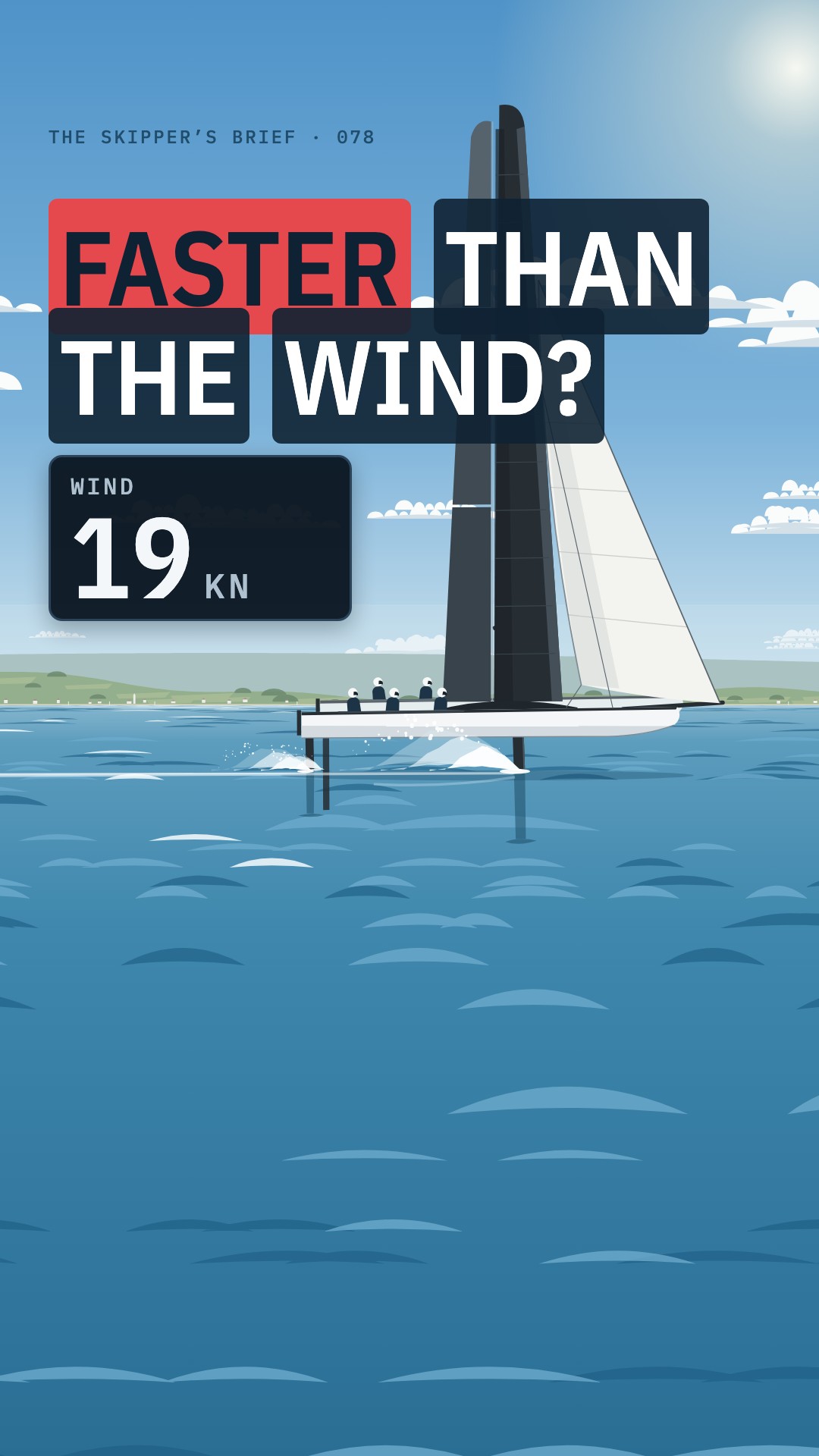
19 knots of wind. 50 knots of boat. How?
Stories
Answer: B. She makes her own wind: moving at speed she meets a headwind of her own, and the wind her wing actually feels, the apparent wind, is the true wind and that headwind added together, so it grows stronger and swings ahead as she speeds up. Her rigid wing sail works like an aircraft wing and turns that apparent wind into lift, and with her hulls lifted clear of the water on hydrofoils she has so little drag that, sailing across the wind, she keeps accelerating past the true wind's speed; iceboats, with no waves at all, reach up to five times the speed of the wind. It isn't surfing: even a fully developed sea in 20 knots of wind has waves averaging under 12 knots, and her hulls aren't in the water. And it isn't the wind up high: over open water the wind at the top of a 24 m wing is only about 10 to 30 per cent stronger than at the usual 10 m measuring height, nowhere near 2.6 times.
The case is the foiling F50 catamaran's 50.22 knots in 19.3 knots of wind, off the Isle of Wight in August 2019, as reported at the time. The wind gradient figures use Wikipedia's Hellmann exponents for open water, 0.10 in neutral air and 0.27 in stable air, from 10 m up to 24 m.
Transcript
19 knots of wind. 50 knots of boat. How can she sail faster than the wind?
Off the Isle of Wight, in 2019, she hit 2.6 times the speed of the wind.
Is she surfing the waves, like a surfboard?
Is she making her own wind, as she goes?
Or is the wind far faster, high up her sail?
A, B or C? Tell me in the comments, and why you think so. Follow, so you don’t miss the answer.
Sources
- Mysailing (Australia), 'Dylan Fletcher marks new frontier in sailing, wins race to 50 knots', Cowes, 6 August 2019 (the SailGP release): the British F50 crew were the first to reach '50.22 knots on the 50-foot foiling catamaran', in training off Egypt Point on the Solent, off the Isle of Wight; 'The top speed was achieved in 19.3 knots of wind speed.' 50.22 ÷ 19.3 = 2.6 is our arithmetic
- PressMare, 7 August 2019 (the same SailGP release): the British team 'had recorded 50.22 knots', the first SailGP team through the 50-knot barrier; 'The top speed was achieved in 19.3 knots of wind speed.'
- Associated Press via KSL, 'British SailGP team breaks 50-knot barrier during training', Cowes, 6 August 2019: the crew flew their foiling 50-foot catamaran at 50.22 knots in training on the Solent, off Egypt Point on the Isle of Wight
- Wikipedia, 'F50 (catamaran)': a one-design foiling catamaran, 15 m long with an 8.8 m beam and a 24 m wingsail as standard (what the boat in the reel is drawn from, without any team's livery)
- Wikipedia, 'Apparent wind': the wind felt on a moving craft combines the true wind and the wind of her own motion; as she speeds up across the wind, the apparent wind grows and comes from further ahead. Fast multihulls, ice and land yachts can sail faster than the true wind; foiling AC72 catamarans 'up to double the environmental wind speed'
- Wikipedia, 'Forces on sails': apparent wind is 'the vector sum of true wind velocity' and the wind from the boat's own velocity; the sail 'acts as an airfoil to generate lift'; 'Ice boats can sail up to five times the speed of the wind'
- Wikipedia, 'Wingsail': a rigid aerodynamic structure in place of a soft sail; 'Wingsails are analogous to airplane wings', used most on high-performance racing multihulls
- Wikipedia, 'Hydrofoil': as a craft gains speed, the hydrofoils 'lift the boat's hull out of the water, decreasing drag'; several America's Cups have been raced in foiling yachts
- Wikipedia, 'Iceboat' (the ice yacht): 'iceboats can sail up to five times the speed of the true wind', on ice with no waves to ride, given their low forward resistance; their apparent wind is only a few degrees off the direction of travel
- Wikipedia, 'Wind wave', table of fully developed seas: in a 37 km/h (20 knot) wind the waves average 21.4 km/h (11.6 knots), and in every row the waves are slower than the wind. A boat at 50 knots can't be riding waves that move at about 12
- Wikipedia, 'Wind gradient': over the sea the wind slows less near the surface than over land; Hellmann exponent 0.10 for open water in neutral air (0.06 unstable, 0.27 stable), and 'the change in wind speed is very small for heights over 2 meters'. From the usual 10 m measuring height to the top of a 24 m wing that is about 9 % more wind in neutral air, 27 % in stable air (our arithmetic): nowhere near 2.6 times