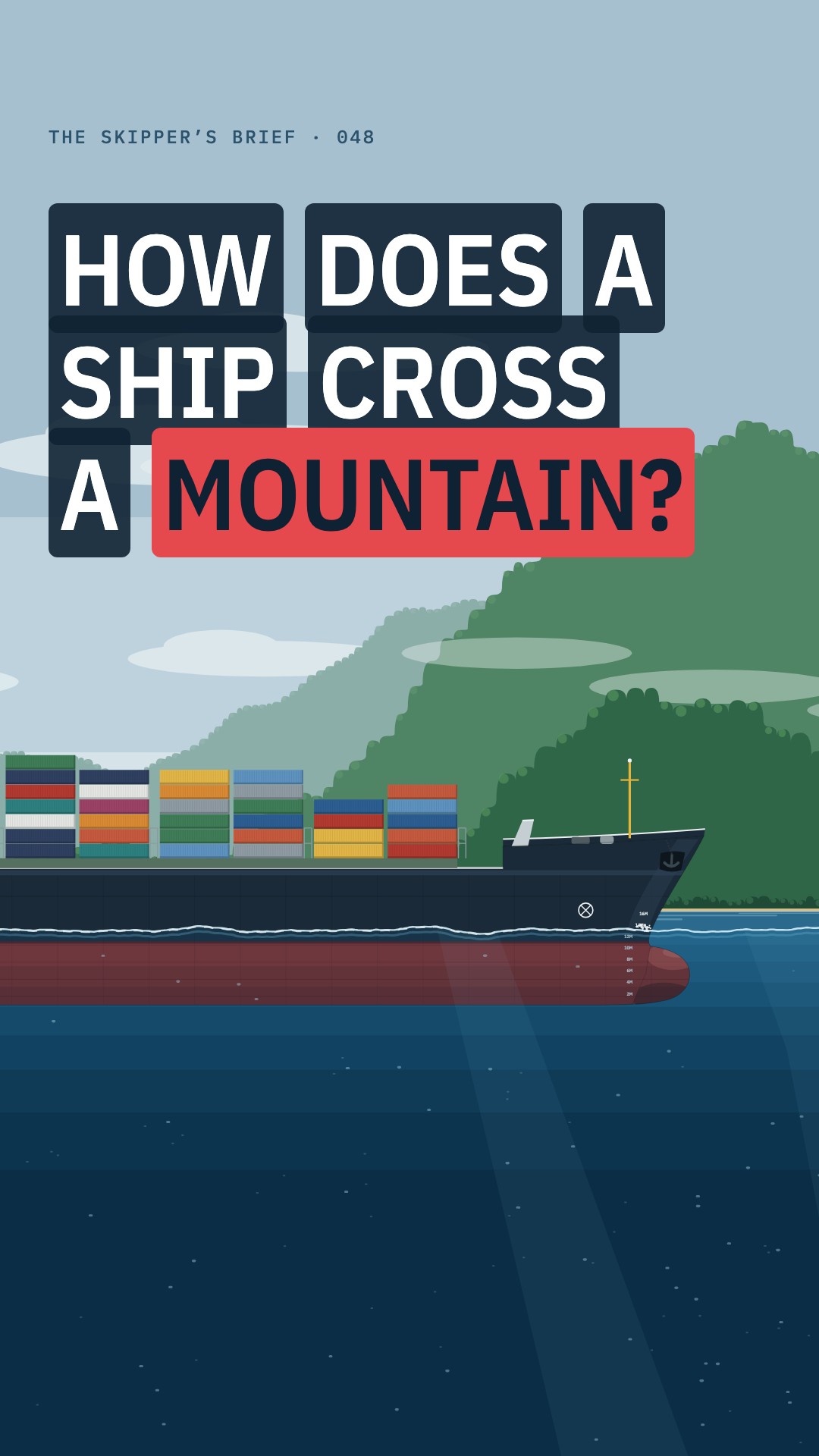
Brief #048 · PANAMA CANAL
How does a ship cross a mountain?
Stories
The Panama Canal lifts ships 26 m (85 ft) up to the man-made Gatun Lake in three steps of locks on each side (Gatun on the Atlantic; Pedro Miguel and Miraflores on the Pacific) with no pumps: lake water flows into the chambers by gravity, and in the original locks electric locomotives called mules keep each ship centred. Every transit sends about 200 million litres (some 50 million US gallons) of rain-fed fresh water out to sea, so in the 2023 drought the canal cut daily transits from 36 to 22 and ships queued for up to three weeks.
Transcript
How does a ship cross a mountain?
It climbs a staircase of water.
In Panama, locks lift ships 26 metres up to a man-made lake in the hills.
Gates close, valves open, and lake water pours in.
No pumps. Just gravity.
The ship floats up, kept centred by electric locomotives called mules.
Three steps up, across the lake, three steps down.
But each crossing pours about 200 million litres of fresh water into the sea.
In the 2023 drought, the lake ran low, and ships queued for weeks.
Ships cross Panama on a staircase of rain.
Want to learn more interesting facts like this? Follow the page.
Sources
- Panama Canal Authority, Design of the locks: 'Water lifts ships 85 feet above sea level to the surface of Gatun Lake'; 'Gatun Locks consists of three steps or pairs of chambers, there is one step at Pedro Miguel and two at Miraflores'; chambers 110 by 1,000 feet; 'No pumps are used at the Panama Canal, the water does its work by force of gravity alone'; 18-foot culverts in the walls feed cross culverts with 100 openings in each chamber floor
- Encyclopaedia Britannica, Panama Canal, Locks: 'At Gatún a series of three locks lifts vessels 85 feet (26 meters) to Gatún Lake'; larger craft 'are guided by electric towing locomotives, which operate on cog tracks on the lock walls and serve to keep the ships centered in the lock'; the locks 'operate by gravity flow of water from Gatún, Alajuela, and Miraflores lakes, which are fed by the Chagres and other rivers'
- Encyclopaedia Britannica, Gatún Dam: completed in 1912 across the Chagres River, forming Gatún Lake, once the largest artificial lake in the world, which supplies water to the canal's locks
- Panama Canal locks (Wikipedia, citing the Panama Canal Authority): the original canal has six steps, three up and three down; 'The water is moved by gravity and is controlled by huge valves in the culverts'; each chamber needs 26,700,000 US gal (101,000 m³) to fill from the lowered to the raised position; electric locomotives called mules handle side-to-side and braking control, eight on a large ship; mules are not used on the 2016 expansion locks
- Panamax (Wikipedia, from the Panama Canal Authority's Vessel Requirements): length overall up to 289.6 m (294.1 m for container and passenger ships); maximum beam 32.3 m (106 ft) in original lock chambers 33.5 m (110 ft) wide, which leaves about 60 cm (2 ft) on each side
- Anadolu Agency, 25 August 2023: 'For each ship that crosses the route, some 200 million liters of fresh water are discharged', water the canal takes from the Gatun and Alajuela lakes; waits rose from 3–5 days to 19 days
- Engineering News-Record, 15 March 2024, Panama Canal proposes new reservoir to secure water supply: 'The original Panamax locks use about 50 million gallons of water with each transit' (about 190 million litres), water lost to the open ocean
- Reuters (via gCaptain), 12 September 2023, Drought-hit Panama Canal could further reduce daily transits: Gatun Lake at 24.2 m (79.7 ft) against a usual 26.6 m for September; more than 160 vessels waiting in August; the longest wait 21 days a month earlier; up to 32 daily transits, down from 36 in normal conditions
- Panama Canal Authority, 15 December 2023, Panama Canal to increase daily transits to 24 starting in January: 22 vessels a day were transiting (36 in the regular scenario) because of unusually low water levels in Gatun Lake under El Niño; October 2023 was the driest October on record in the Canal Watershed
- World Weather Attribution, 1 May 2024, Low water levels in Panama Canal due to increasing demand exacerbated by El Niño event: the Panama Canal Watershed's rainfall is the 'source of 100% of the water used by the Panama Canal for its operations'; low 2023 rainy-season rain left Lake Gatun extremely low
- Panama Canal Authority, 3 October 2023, Beyond scarcity: how the Canal manages the fresh water challenge: the Gatun and Alhajuela lakes 'rely on rainfall and river inflows'
- Panama Canal Authority, 5 February 2016, First Panama Canal water-saving basin filled: three basins beside each chamber of the new Agua Clara and Cocolí locks, 18 in all, reuse 60 percent of the water used per lockage, which comes from Gatun Lake
- Panama Canal Authority profile (World Economic Forum): the canal is some 80 km long between the Atlantic and Pacific oceans