Brief #080 · A · B · C
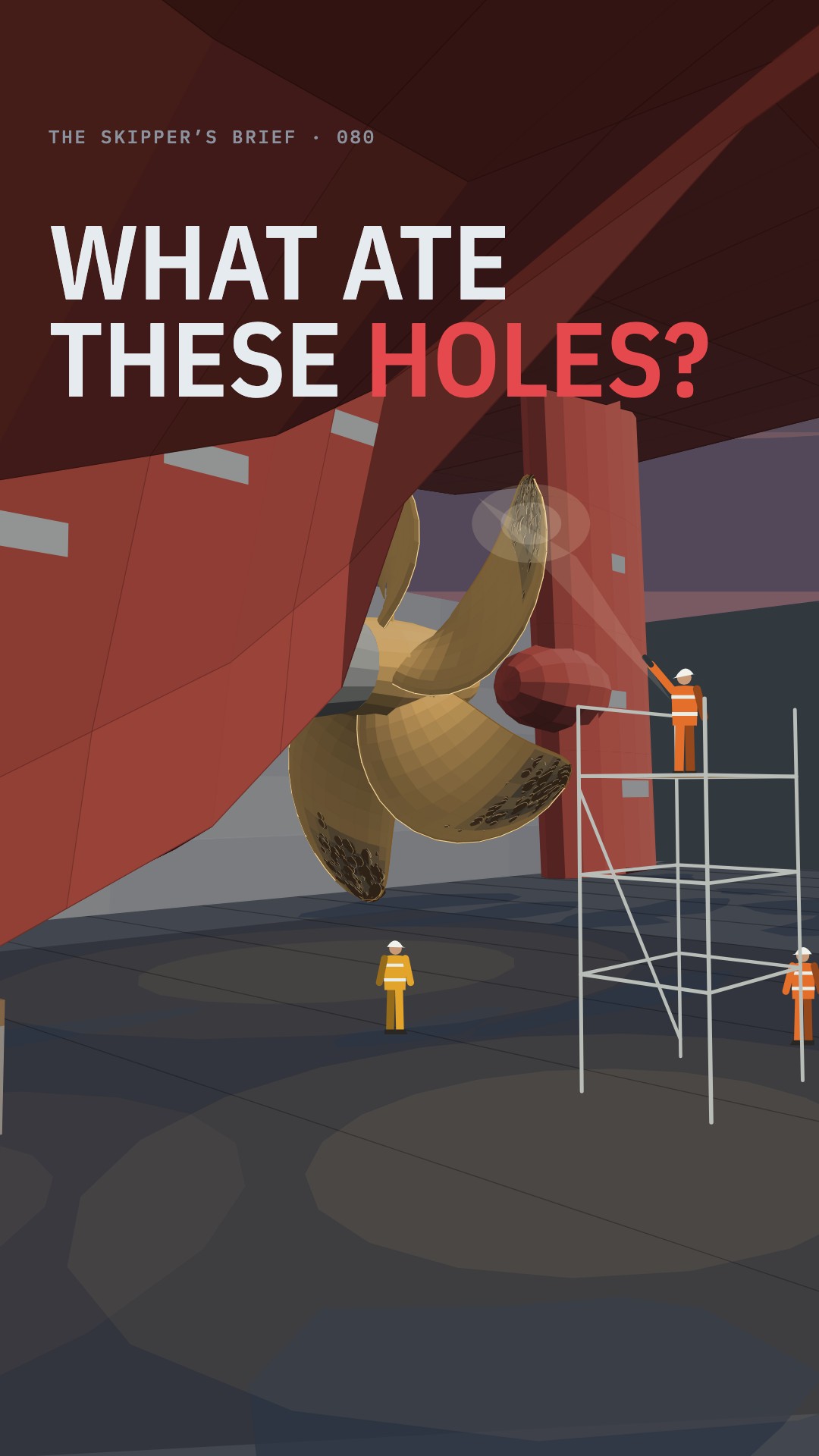
Nothing hit this propeller. So what ate these holes in it?
Stories
Answer: C. Tiny bubbles: cavitation. On the back of a fast-turning blade the water speeds up and its pressure drops below its vapour pressure, so it turns into bubbles of vapour at sea temperature; swept on into higher pressure, the bubbles collapse, and next to the metal each one fires a tiny jet and a shock wave at it, blow after blow, until the surface fatigues into pits and spongy holes, mostly on the back of the blades and out towards the tips, where the blade moves fastest. Not sea worms: shipworms bore only into wood, and the copper in a bronze propeller keeps sea life off, the very reason wooden warships were sheathed in copper. Not sand: where water carries sand, it wears blades along their leading edges into a wavy surface (as in river hydro turbines), while erosion on the back of the blades is what Wärtsilä's encyclopedia puts down to collapsing cavitation bubbles.
The propeller is drawn, not a particular ship, with its damage where cavitation erosion usually sits: on the back (forward-facing) side of the blades, out towards the tips. The 130 tonnes is the record propeller, made in 2006 for the container ship Emma Maersk (Guinness World Records).
Transcript
Nothing hit this propeller. So what ate these holes in it?
Propellers like this are bronze. The biggest weigh over 130 tonnes.
Is it sea worms, slowly boring their way into the metal?
Is it sand in the water, slowly grinding the metal away?
Or is it tiny bubbles, in the water all around it?
A, B or C? Tell me in the comments, and why you think so. Follow, so you don’t miss the answer.
Sources
- Wikipedia, 'Cavitation': cavities form when 'the static pressure of a liquid reduces to below the liquid's vapor pressure'; 'The pressure on the suction side of the propeller blades can be very low'; carried into higher pressure the cavities 'implode or collapse', and those that implode near a hard surface cause 'surface fatigue of the material', called cavitation damage or erosion; next to a surface the collapsing bubble forms a jet, and 'This jet of liquid damages the solid surface'; inside a collapsing bubble 'several thousand Kelvin' and 'several hundred atmospheres'; 'The faster the blade moves, the lower the pressure can become around it'; Thornycroft and Barnaby first saw cavitation 'on the back sides of propeller blades'
- Wikipedia, 'Propeller', Cavitation: 'Cavitation is the formation of vapor bubbles in water near a moving propeller blade in regions of very low pressure'; on the suction side, 'as the vapor bubbles collapse it rapidly erodes the screw's surface due to localized shock waves'; tip vortex cavitation forms first and is 'less damaging to the blade', its bubbles collapsing downstream
- Wärtsilä Encyclopedia of Marine and Energy Technology, 'Cavitation erosion': 'The erosion of material, for example backside of the blades usually attributed to the collapse of cavitation bubbles.'
- Wärtsilä Encyclopedia of Marine and Energy Technology, 'Cavitation': the static pressure of a liquid falls below its vapour pressure and small vapour-filled cavities form; when the pressure rises again they collapse and can send out shock waves that damage machinery
- Guinness World Records, 'Largest propeller (by weight)': 'The largest propeller has a diameter of 9.6 m (31 ft 6 in) and weighs more than 130 tonnes', made by Mecklenburger Metallguss (MMG) of Germany for the Emma Maersk, 31 August 2006
- Wikipedia, 'Aluminium bronze': 'found in marine hardware like propellers'; 'resistant to corrosion in sea water'; 'The copper component of the alloy prevents colonization by marine organisms.'
- Wikipedia, 'Shipworms': they eat 'wood submerged in saltwater', drilling with their two shells to 'rasp away and consume timber'; worm-like, but 'more akin to clams'
- Wikipedia, 'Copper sheathing': copper on the bottom protected a wooden hull 'from attack by shipworm, barnacles and other marine growth'; in the Royal Navy's trial 'The copper performed very well'
- Kashyap et al., 'Silt erosion and cavitation impact on hydraulic turbines performance', Heliyon 10 (2024) e28998, open access: sand-laden water eroded the turbine blades' 'inlet (leading) and exit sides', 'Pure Sand Erosion indicated by wavy pattern', while cavitation pitting was found 'on the blade suction side, rim, and outer end'