Brief #057 · BUOYAGE
Two ships hit the same wreck. How?
Navigation
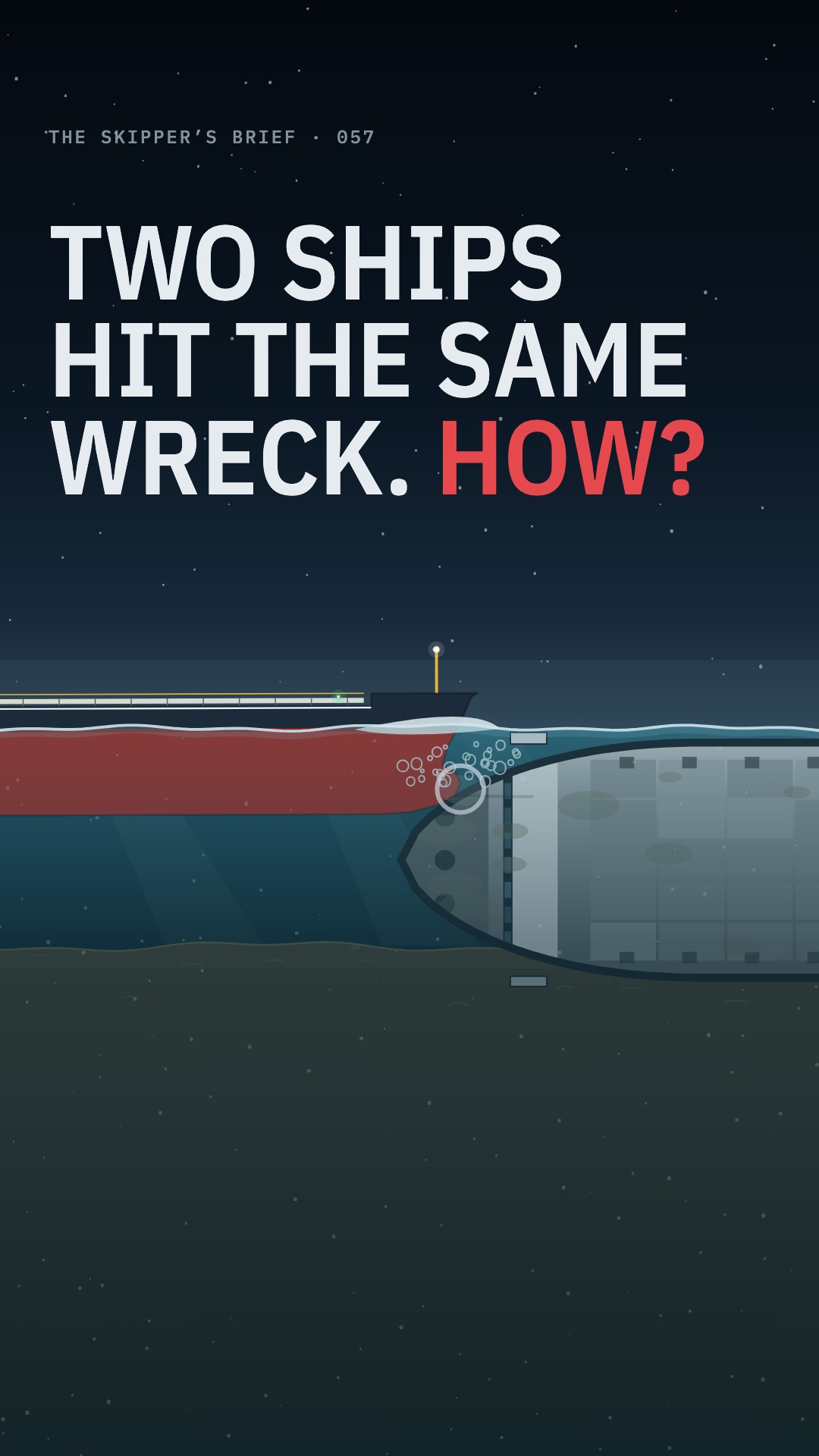
In fog on 14 December 2002 the car carrier Tricolor, with 2,862 new cars, sank in the Dover Strait after a collision with the container ship Kariba, and lay on her side just under the surface, 30 m down. Two days later the cargo ship Nicola ran into the wreck, and on 1 January 2003 the tanker Vicky did too, despite guard ships, buoys and radio warnings. In busy waters, ordinary buoys don't stand out as a new danger, so in 2005 IALA, the lighthouse authorities' association, made a new buoy just for new dangers: the emergency wreck mark, blue and yellow vertical stripes with an upright yellow cross and a light that flashes blue, then yellow. Then a test: which of four buoys marks a new wreck? Blue and yellow: the wreck is new, and your chart may not show it.
The IALA Maritime Buoyage System: the emergency wreck mark is the same in Regions A and B. It marks a new danger until the danger is surveyed, charted and permanently marked.
Transcript
Two ships hit the same wreck. How?
Dover Strait, in fog: the car carrier Tricolor is hit and sinks.
She lies on her side, just under the surface.
Two days later, a cargo ship runs into her. Then a tanker. Despite guard ships, buoys and radio warnings.
Why? In all that traffic, ordinary buoys don't stand out as new.
So the lighthouse authorities made a new buoy, just for new dangers. It's in my Buoyage course.
Which one is it?
The blue and yellow one. Blue and yellow: the wreck is new, and your chart may not show it. Keep well clear.
Try three free questions at theskippersbrief.com.
Sources
- BEAmer (French marine accident investigation office), supplementary report on the collision between the car carrier TRICOLOR and the container vessel KARIBA on 14 December 2002 near Westhinder: 'the subsequent collisions with the wreck of the TRICOLOR of the general cargo vessel NICOLA on 16th December 2002 and the Ore/Oil carrier VICKY on 1st January 2003'; the wreck lay on her side
- Cedre incident sheet, Tricolor/Kariba: on 14 December 2002 at about 2.30 am the Tricolor collided with the container ship Kariba and 'sank 30 m deep in a matter of minutes, in the Pas-de-Calais, 20 miles northwest of Dunkirk', carrying '2,862 new luxury cars and 77 containers'; the wreck lay on the seabed on one side; a light buoy and a Gendarmerie Maritime patrol boat, and many radio messages, yet on 16 December the Dutch coaster Nicola 'collided with the wreck, which emerged by only a few centimetres'; cardinal buoys from 20 December; on 1 January 2003 the Turkish tanker Vicky, with 66,000 t of kerosene, hit it too
- House of Lords, English Channel: Collisions, 19 December 2002 (HL Deb vol 642 cc782-4): the French police vessel Glaive and HMS Anglesey are guarding the wreck of the Tricolor with two salvage boats; coastguards broadcast navigational warnings twice an hour, four an hour in bad visibility; three wreck buoys mark the site; 'the accident ... took place in thick fog'
- Professional Mariner, 'The Tricolor/Kariba/Clary incident': 'At night and in fog on Dec. 14, 2002', in the Westhinder branch of the traffic separation scheme; Tricolor carried more than 2,800 cars, capsized and sank with no loss of life; 'within three weeks two vessels had run up upon her partially submerged wreck and had to be pulled off'
- Wikipedia, MV Tricolor: she 'remained lodged on her side in the mud of the 30 metres deep waterway' and was 'just completely submerged'; 'despite standard radio warnings, three guard ships, and a lighted buoy' the Dutch vessel Nicola struck the wreck, and on 1 January 2003 the loaded fuel carrier Vicky struck it too; two more patrol ships and six more buoys were added
- Maritime and Coastguard Agency, Dover Strait crossings: Channel Navigation Information Service: 'Over 400 commercial vessels use the Dover Strait every day'
- IALA Recommendation O-133 on the Emergency Wreck Marking Buoy, Edition 1, December 2005 (adopted for use on a trial basis): 'The wreck of the Tricolor in the Dover Straits in 2002 has brought into sharp focus' how to mark new dangers quickly; 'a new wreck can be very dangerous for shipping ... even when the position is known and the wreck is properly marked'; 'the volume of traffic, background lighting and proliferation of AtoN in the area may make the deployment of cardinal or lateral marks difficult for mariners to quickly identify a new danger', so authorities may deploy a buoy 'specifically designed to mark new dangers': a pillar or spar with equal blue and yellow vertical stripes (4 to 8), an alternating blue and yellow light (B 1 s + 0.5 s + Y 1 s + 0.5 s), a standing yellow cross topmark, kept on station until the wreck is published, surveyed and permanently marked (IALA is the International Association of Marine Aids to Navigation and Lighthouse Authorities)
- IALA Recommendation R1001, The IALA Maritime Buoyage System, Edition 2.0 (2023), copy hosted by Irish Lights: six types of mark, the five other than lateral marks common to Regions A and B; §2.6 'New dangers may be marked with an Emergency Wreck mark': blue and yellow vertical stripes in equal number (4 to 8), pillar or spar, a vertical yellow cross topmark, a light of one second blue and one second yellow with 0.5 s eclipses; §3.2.2 new dangers 'may not yet be shown in nautical documents and publications'; for comparison §2.3–2.5: isolated danger black with red bands and two black balls, safe water red and white vertical stripes with a red ball, special marks yellow with a yellow X
- The Skipper's Brief, Buoyage course (live 2026-10-29): its module 'Danger, safe water, special and wreck marks' runs from the isolated danger mark to the emergency wreck buoy; every course starts with 3 free questions, no sign-up
- Irish Lights, IALA page: 'In the Dover strait in 1971 the Merchant Ship Brandenburg struck the wreckage of the Texaco Caribbean and sank'; a few weeks later the wreckage, despite being marked by a wreck-marking vessel and many buoys, 'was struck by the Niki, which also sank'; 'A total of 51 lives were lost'; this disaster gave rise to the IALA Maritime Buoyage System (used in the Facebook text only)
- House of Commons, Channel shipping accident, 1 March 1971 (HC Deb vol 812 cc1220-5): the Greek motor vessel Niki foundered off the mid Varne buoy on the evening of 27 February, probably after striking a wreck; crew of 21, no survivors; the wrecks of the Texaco Caribbean and Brandenburg were marked by Trinity House with a wreck vessel and wreck buoys (used in the Facebook text only)