Brief #016 · CONTAINERS
The box that changed the world
Stories
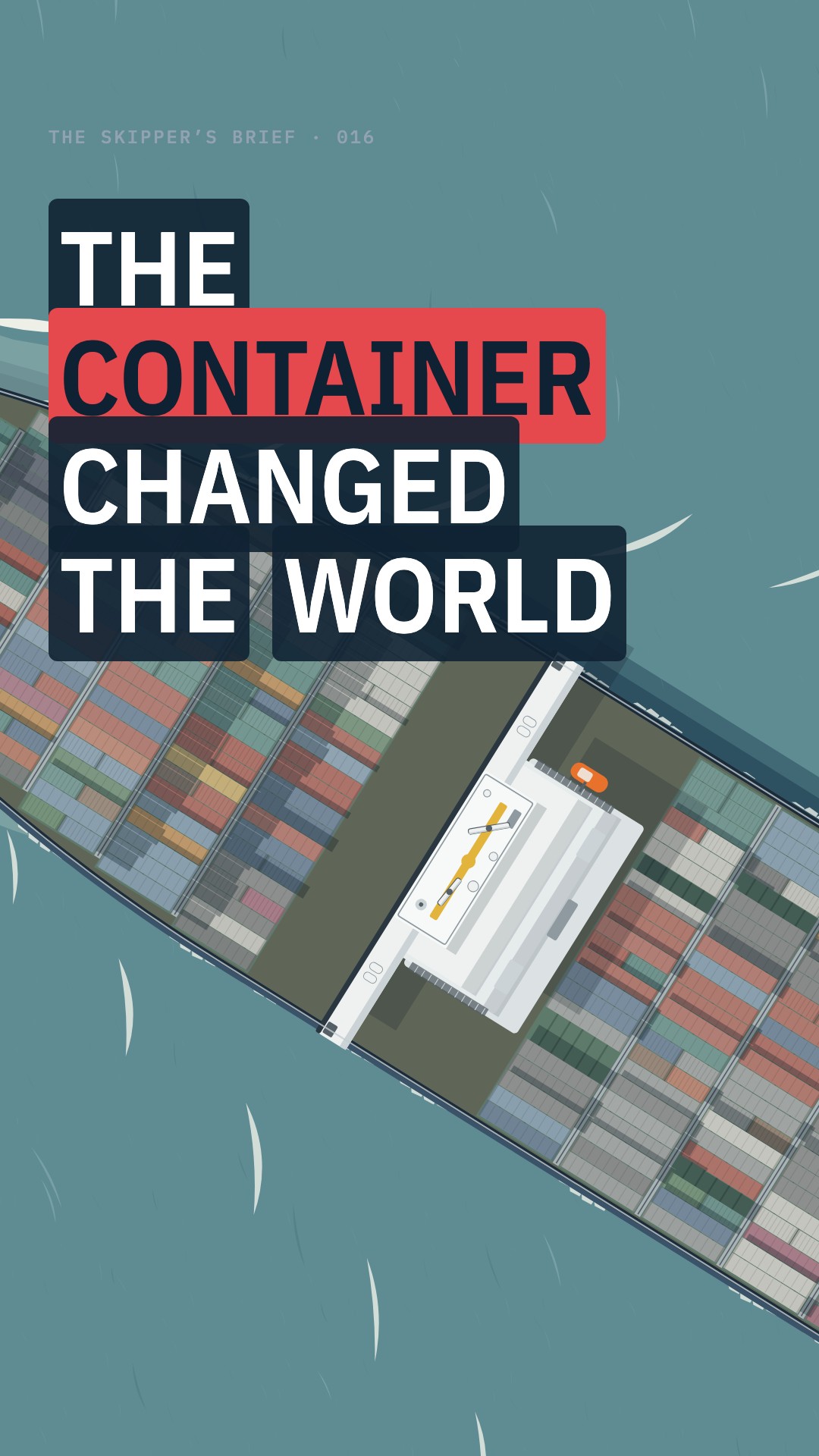
The shipping container changed the world. In 1956 Malcom McLean put 58 boxes on the Ideal X; standard containers cut loading costs from dollars to cents per ton.
Transcript
The shipping container changed the world. In 1956, a trucking boss put 58 of them on a ship.
Before that, cargo went aboard piece by piece: sacks, crates and barrels, by hand.
A gang of twenty longshoremen worked each hold.
Then Malcom McLean's Ideal X sailed from Newark to Houston, with the cargo already packed in boxes.
Loading by hand cost almost six dollars a ton. In boxes: 16 cents.
By 1968, international standards fixed the sizes. Twenty feet is one TEU. Forty feet is two.
Eight steel corners on every box, so they lock together and stack up to ten high.
Today's largest ships carry over 24,000 TEU, on hulls 400 metres long.
And some go over the side: 1,478 boxes in 2025, mostly in heavy weather and fires.
After a big blow, keep a sharp lookout. Want to learn more interesting facts like this? Follow the page.
Sources
- PBS, Who Made America?: Malcom McLean
- Wikipedia: Malcom McLean (Ideal X 26 April 1956; $5.86 vs $0.16 per ton) – secondary
- Wikipedia: Containerization (58 containers; break-bulk; gangs of 20–22; ISO 668 1968) – secondary
- Wikipedia: Intermodal container (TEU; corner castings; stacking) – secondary
- Wikipedia: List of largest container ships (MSC Irina class, 24,346 TEU, 399.9 m) – secondary
- World Shipping Council: Containers Lost at Sea (2026 report: 1,478 lost in 2025)
- World Shipping Council: mandatory IMO reporting of container losses from 1 January 2026