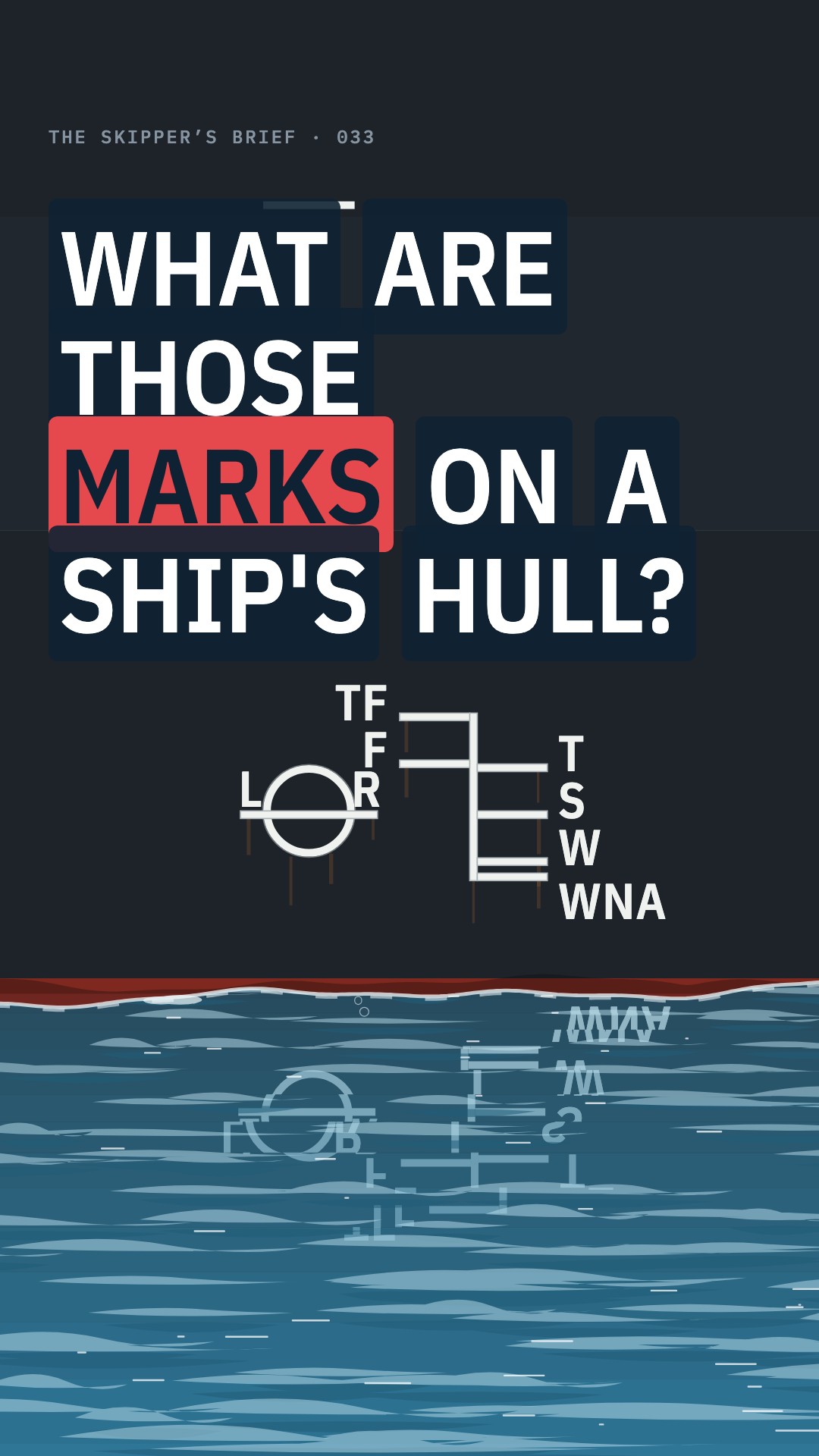
Brief #033 · LOAD LINE
What are those marks on a ship's hull?
Stories
The circle and ladder of lines on a ship's side is the Plimsoll mark: how deep she may safely be loaded, with lines for fresh water, the tropics and winter seas. It comes from the overloaded coffin ships of the 1870s and Samuel Plimsoll's campaign; Britain made load lines law in 1876.
Transcript
What are those marks on a ship's hull?
That's the Plimsoll mark: how deep she may safely be loaded.
The ladder beside it adjusts for water and season. Ships float lower in fresh water, so F sits higher. In winter seas, she must ride higher: W.
Why? In the 1870s, overloaded, over-insured coffin ships sank with their crews.
MP Samuel Plimsoll fought for a mark. In 1876, Britain made it law.
The catch? Owners chose where to paint it. Today, international rules fix where it goes.
Your boat has one too: the max load on its builder's plate. Respect it. Want to learn more interesting facts like this? Follow the page.
Sources
- Royal Museums Greenwich, Samuel Plimsoll and ship safety: load lines show 'how low it may safely rest in the water'; overloading and poor repair made 'coffin ships'; Plimsoll's campaign from 1870, Royal Commission 1872; the Merchant Shipping Act of 1876 made load lines compulsory; position fixed by law in 1894; foreign ships in British ports from 1906; a circle with a horizontal line through its centre
- Royal Museums Greenwich collections, Medal commemorating Samuel Plimsoll (1824–1898) and the coffin-ships (1875): 'It was due to Samuel Plimsoll's services in the Parliament that the famous load-line recording his name was established'
- National Museums Liverpool, Commemorating an MP's furious outburst on behalf of seafarers: coffin ships 'poorly maintained, overloaded, and over-insured'; 22 July 1875; 'The 1876 load line was set by ship owners themselves'; 14 more years before the Board of Trade standardised it
- National Museums Liverpool, It's Plimsoll Day! (and we're talking about ships, not shoes): families who 'lost loved ones to the coffin ships'; the 1876 Merchant Shipping Bill; the load line standardised by the Board of Trade in 1890
- Hansard, House of Commons, 27 March 1877, Merchant Shipping Act (1876): The Load-Line, Question: Parliament 'carefully avoided allowing Government to fix any load-lines, but imposed the duty on shipowners'
- IMO, International Convention on Load Lines: the first convention in 1930; the 1966 convention (in force 1968) and its 1988 Protocol; all assigned load lines marked amidships on each side, with the deck line
- US 46 CFR Part 42 (the 1966 Load Line Convention's rules): §42.13-25 load line mark (ring 12 in./300 mm with a horizontal line through its centre, at the summer freeboard below the deck line); §42.13-30 lines S, W, WNA, T, F, TF; §42.13-35 assigning authority's initials; §42.20 tropical = summer minus 1/48 of the draught, winter = summer plus 1/48, fresh-water allowance
- Wikipedia: Load line (watercraft): TF, F, T, S, W, WNA; fresh water (about 1,000 kg/m³) is less dense than seawater (about 1,025 kg/m³), so a ship floats deeper in it; class society initials such as LR; 1876, 1894, 1930, 1966 (secondary)
- Wikipedia: Samuel Plimsoll: coffin ships, 'unseaworthy and overloaded vessels, often heavily insured'; Our Seamen (1873); the 1876 act; influence leading to the 1930 International Convention on Load Lines (secondary)
- Recreational Craft Directive essential requirements (UK SI 2004/1464, Schedule 1): 2.2 builder's plate with the manufacturer's maximum recommended load and number of persons; 3.6 maximum recommended load (fuel, water, provisions, equipment and people, in kg); 3.2 stability and freeboard for that load
- US 33 CFR Part 183 Subpart B, Display of Capacity Information: monohull boats under 20 ft must be marked with maximum persons and maximum weight capacity (persons, motor, gear)