Brief #026 · SALTSTRAUMEN
The world's strongest tidal current?
Navigation
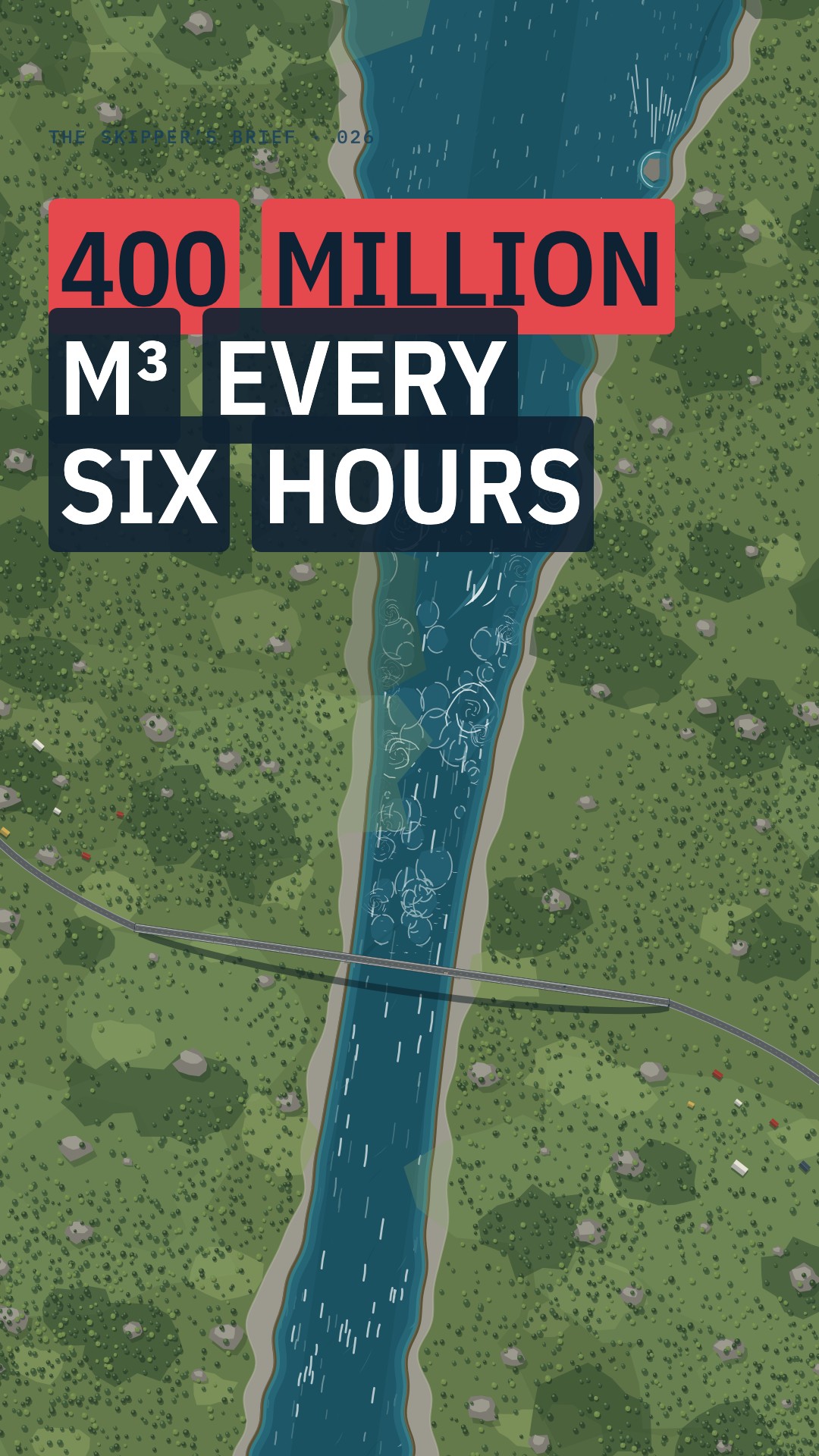
Every six hours about 400 million m³ of sea squeezes through Saltstraumen near Bodø, a strait 150 m wide: around 7 knots on average, whirlpools up to 10 m across. One of the strongest tidal currents in the world, and boats go through at the turn.
Transcript
Every six hours, 400 million cubic metres of sea squeeze through a gap 150 metres wide.
This is Saltstraumen, near Bodø in northern Norway.
The tide is trying to fill the big fjord behind it. Outside, the sea can stand up to a metre higher.
So the water pours through at around seven knots, and much faster at peak. It spins off whirlpools up to 10 metres across.
Brochures call it the world's strongest tidal current. Oceanographers say: one of the strongest, not the strongest.
Four times a day, the current turns, and the strait goes quiet. Slower boats pass from 20 minutes before the turn until 20 minutes after.
Narrows ahead? Slack isn't always at high or low water. Check the current tables. Want to learn more interesting facts like this? Follow the page.
Sources
- Visit Bodø: Saltstraumen (400 million m³ every sixth hour through a 3 km long, 150 m wide strait; whirlpools up to 10 m across and 4–5 m deep)
- Store norske leksikon: Saltstraumen (Bodø; 3 km long, 150 m at the narrowest; mean speed about 7 knots, peaks considerably higher; strongest at new and full moon; turns four times a day)
- Wikipedia: Saltstraumen (the tide fills Skjerstad Fjord; up to 1 m level difference; whirlpools 10 m × 5 m; navigable when the current turns; Den norske los: over 8 knots outflowing) – secondary
- Hurtigruten: Saltstraumen ("the world's strongest tidal current")
- NRK, 7 May 2016: Er Saltstraumen egentlig verdens sterkeste tidevannsstrøm? (MET Norway oceanographer: one of the strongest, not the strongest)
- BarentsWatch / Norwegian Coastal Administration: Strait talk for a safe passage (local practice: displacement vessels pass from 20 minutes before until 20 minutes after the tide turns)
- Canadian Hydrographic Service: Canadian Tide and Current Tables 2024, Vol. 5, Introduction (current tables give slack water; required in narrow passes; slack and high or low tide not necessarily coincident)