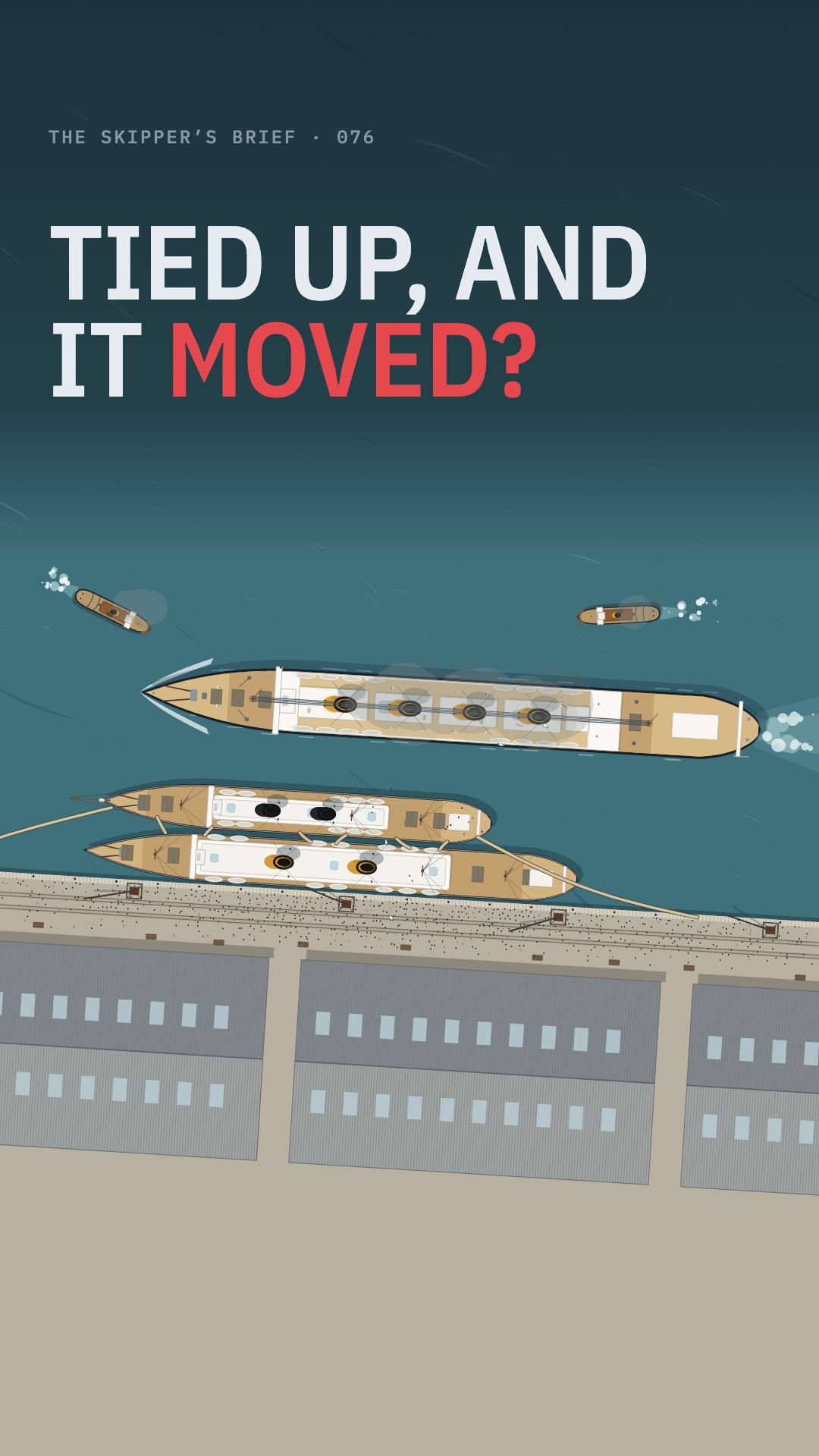
Brief #076 · A · B · C
Titanic nearly crashed before she left port, into a moored ship. Why?
Stories
Answer: A, the water rushing between them. As Titanic's huge hull and her propellers moved past at close range in the confined dock, she set the water moving: it rushed through the narrowing gap between the ships, the level and pressure there dropped, and the smaller New York, moored alongside the Oceanic, was lifted, dropped and drawn toward her until her mooring ropes snapped and her stern swung to within about 4 feet (1.2 m). People at the time called it suction, or the wash of her propellers; today it's called hydrodynamic interaction: strongest in shallow, confined water, growing roughly with the square of speed and felt most by the smaller ship, which is why ships slow right down to pass moored vessels. Not the wind or the tide: no account blames either, the pull stopped when Titanic stopped, and the Teutonic, moored further on, strained after Titanic and settled back as soon as she had passed.
Southampton, 10 April 1912. Accounts differ on the closest distance (most give about 4 feet; Lawrence Beesley, watching from Titanic, saw the New York's stern glide past 'some few yards away' once Titanic had stopped) and on the delay (about an hour, or at most three-quarters of an hour).
Transcript
Titanic nearly crashed before she even left port, into a ship tied to the dock. Why?
Her ropes snapped like pistol shots. Her stern swung within about 4 feet of Titanic.
Was it the water, rushing between the two ships?
A gust of wind, hitting her high side?
Or the tide, turning at just that moment?
A, B or C? Tell me in the comments, and why you think so. Follow, so you don’t miss the answer.
Sources
- Wikipedia, Titanic, Maiden voyage: at noon on 10 April 1912, passing the moored liners New York and Oceanic, Titanic's displacement lifted both 'by a bulge of water' and dropped them into a trough; New York's mooring cables snapped and she swung stern-first towards Titanic; the tug Vulcan took her in tow; the two ships missed by about 4 feet (1.2 m); about an hour's delay
- Wikipedia, Sinking of the Titanic, Maiden voyage: the same near-collision with New York at Southampton, about 4 feet (1.2 m); the incident and a stop to land stragglers delayed Titanic by 'at most three-quarters of an hour'
- Wikipedia, SS City of New York (1888): renamed New York; moored alongside Oceanic at Southampton when Titanic sailed; Titanic's passing created a 'suction effect' that tore her from her moorings; two funnels after her 1901–03 refit
- Wikipedia, TB Vulcan: the 1893 tug-tender whose captain, Charles Gale, got a second line on New York after the first one parted; New York's steel mooring lines had snapped and her stern drifted into Titanic's path; the ships came within 4 feet (1.2 m)
- Lawrence Beesley, The Loss of the S.S. Titanic (1912, public domain, Project Gutenberg), chapter 1, watching from Titanic's deck: 'a series of reports like those of a revolver' as the New York's ropes parted and flew among the crowd; she crept towards Titanic 'as if drawn by some invisible force'; when Titanic was stopped 'the suction ceased'; the Teutonic, further on, strained at her ropes after Titanic and swung back once she had passed
- Titanic Inquiry Project, New York (American Line): laid up at Southampton, moored in tandem with Oceanic at Berth 38; 'the suction and wave action of her propellers and huge bulk' tore New York loose; the tugs Vulcan and Hercules kept her in check until Titanic had passed
- IrishCentral, 'Letter describes how Titanic nearly hit two other ships before voyage': Titanic's chief engineer Joseph Bell wrote to his son that 'the wash of our propellers made the two ships range about' and their mooring ropes broke
- UK Maritime and Coastguard Agency, MGN 199 (M), Dangers of interaction: a moving ship has a 'negative pressure field amidships'; passing close, there can be a strong attraction 'due to the reduced pressure between the underwater portion of the hulls', the smaller vessel feeling the greater effect; strength varies about as the square of the speed and is amplified in shallow water, so pass at low speed
- West of England P&I Club, Interaction damage to vessels moored alongside: a passing ship makes a moored ship surge and sway at her berth, damaging mooring lines and gangways; passing speed 'should be kept as low as possible' and the passing distance as wide as possible