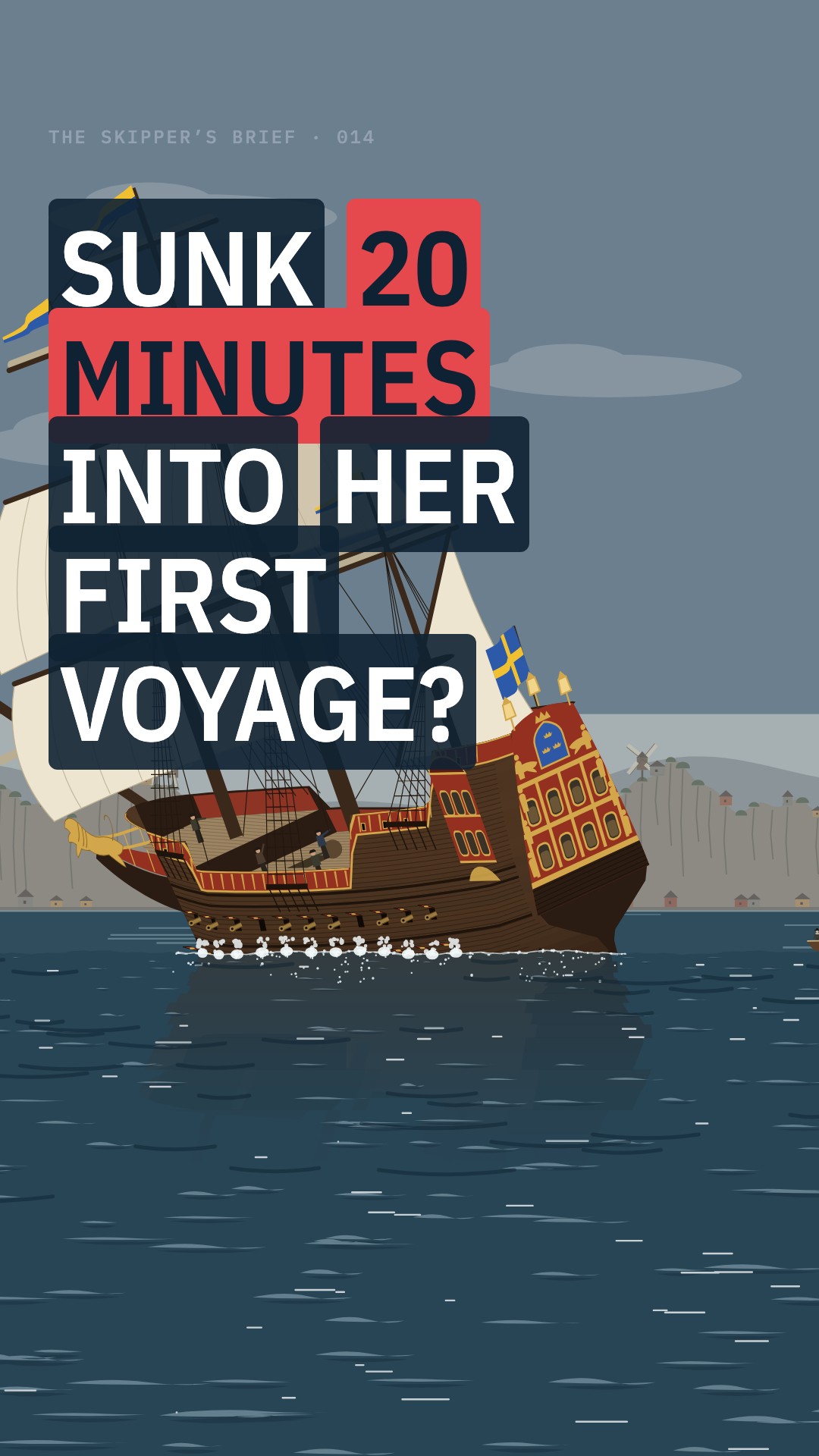
Brief #014 · VASA 1628
How did a warship sink 20 minutes into her first voyage?
Stories
In 1628 the Swedish warship Vasa capsized and sank about 1,300 metres into her maiden voyage, in front of crowds in Stockholm: she was top-heavy, a gust heeled her and water poured in through her open gunports, though a stability test had already shown the danger.
Transcript
How did a warship sink 20 minutes into her first voyage?
Stockholm, 1628. Crowds watch the mighty warship Vasa set sail.
A gust heels her over, and water floods her open gunports.
1,300 metres out, she sinks. About 30 people die.
Why? Top-heavy: two decks of heavy guns, a towering stern, too little hull below.
A test warned them: 30 men ran across her deck, and she rolled so hard they stopped.
Raised in 1961, she's 98 percent original.
On your boat: keep weight low, and shut hatches and ports when it blows.
Want to learn more interesting facts like this? Follow the page.
Sources
- Vasa Museum, The Disaster: on Sunday 10 August 1628 'the quay was packed with people'; four of the ten sails were set and a salute fired; a small gust heeled her to port, then off Tegelviken 'a much stronger gust pushed the ship so far over on its port side that water poured in through the open gunports on the lower gundeck'; 'Within minutes, the ship was on the sea bed at a depth of 32 metres'; 'All but 30 of the crew and guests survived'; 'the upperworks of the hull are too tall and heavily built for the relatively small amount of hull below the waterline ... it put the centre of gravity too far above the water'; had the gunports been closed, 'water could not have poured in'
- Vasa Museum, Timeline: 1628, Vasa sails '1,300 metres and no farther' before heeling in a gust, water pouring in through the open gunports, as thousands of Stockholmers watch; raised on 24 April 1961; 2011: 'Over 98% of the original structure survives'
- Vasa Museum, Familjespåret (family trail, 2025, in Swedish): 'Det gick illa för Vasa – hon sjönk efter bara tjugo minuter!' (she sank after only twenty minutes); 'Vasa hade 64 kanoner ombord'
- Vasa Museum, The Inquest: before she sailed, Vice Admiral Klas Fleming watched a demonstration 'in which thirty men ran back and forth over the upper deck to make the ship roll. After just a few trips, the ship was heeling so badly that there was great fear it might capsize at the quay. The demonstration was interrupted'; 120 tons of stone ballast; the experts: she did not have enough 'belly' to carry the high and heavy upperworks
- Vasa Museum, Vasa – the machine of war: 64 cannons on her maiden voyage; the main armament 48 bronze 24-pounders firing 10 kg shot
- Vasa Museum, The Salvage: divers dug six tunnels under the wreck for steel cables to the pontoons Oden and Frigg; lifted in 18 stages; she broke the surface on Monday 24 April 1961 as thousands crowded the shores
- Vasa Museum FAQ, Is Vasa authentic?: '98% of Vasa is authentic'; replaced parts are lighter in colour
- Vasa Museum, Teacher's guide to the Vasa Museum (2026): 'Vasa sank because it was unbalanced. The part of the ship above the water was too heavy compared to the part below the water'; had the gun ports been closed, 'Vasa might have survived'; around 98% of the timber is original
- Wikipedia, Vasa (ship) (secondary): 'an early example of a warship with two full-length gundecks'; sank after sailing roughly 1,300 m; in the stability test 'the admiral stopped the test after they had made only three trips'
- Australian Maritime Safety Authority, A guide to fishing vessel stability (AMSA 507): adding weight higher up raises the centre of gravity and makes a vessel top heavy; 'Keeping weights as low down as possible is really important'; downflooding can start at much smaller angles of heel 'if openings such as hatches are not closed', and then 'stability is lost very quickly'