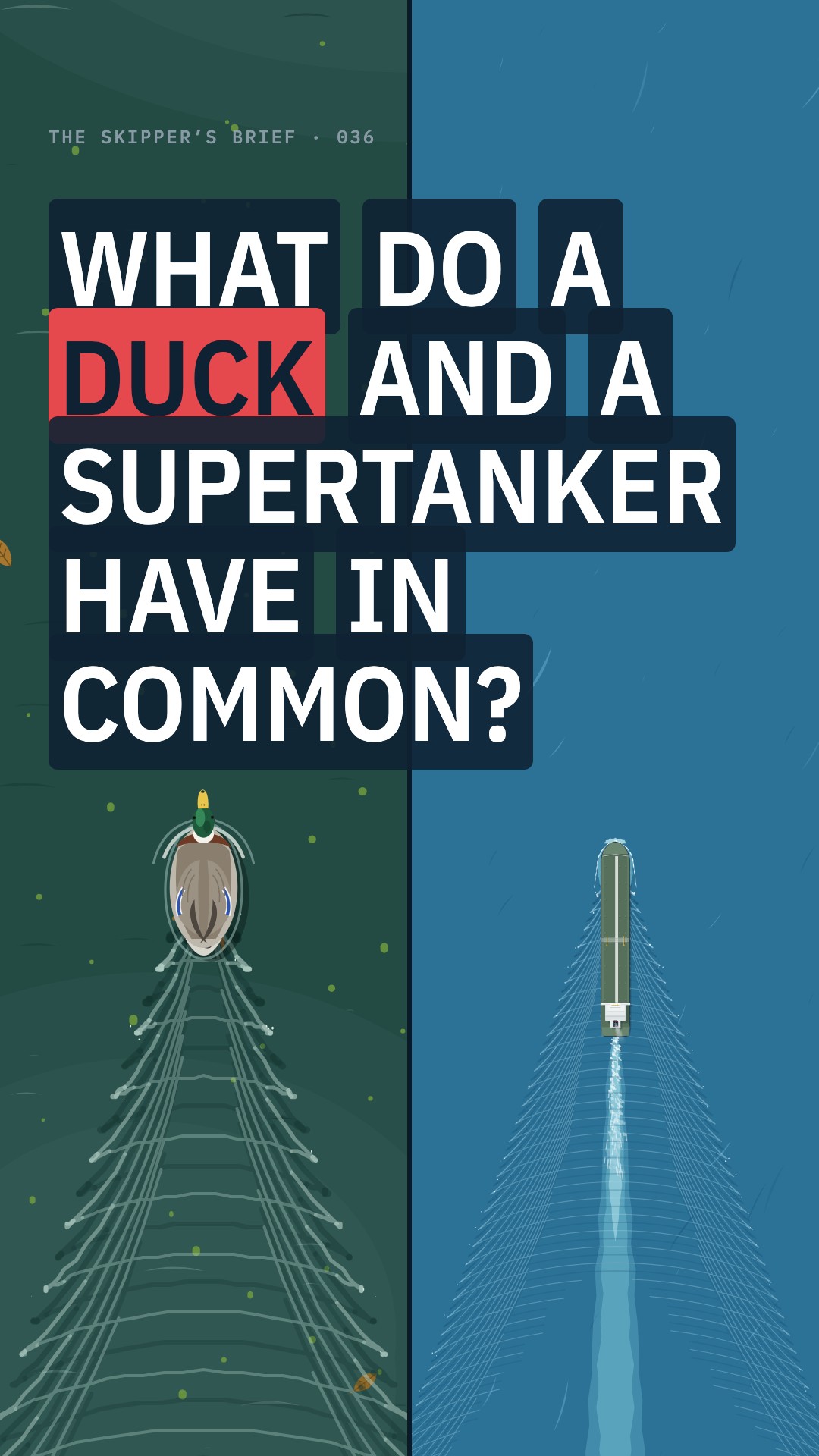
Brief #036 · WAKES
What do a duck and a supertanker have in common?
Stories
In deep water, a duck and a supertanker leave the same V-shaped wake, about 39 degrees wide whatever their size or speed (Lord Kelvin, 1887), because the angle comes from how deep-water waves travel; only very fast boats leave narrower wakes, and because the V trails behind, a big ship's wake reaches you well after she has passed.
Transcript
What do a duck and a supertanker have in common?
Their wakes. Both leave the same V, about 39 degrees wide.
Big or small, fast or slow: same angle.
Lord Kelvin worked it out in 1887.
The angle comes from the water, not the boat.
In deep water, waves of every length add up along one line: 19.5 degrees each side.
The catch: very fast boats can leave narrower wakes.
Out sailing? A big ship's wake reaches you well after she's passed.
Slow down, and take it at a slight angle, not on the beam.
Want to learn more interesting facts like this? Follow the page.
Sources
- Physics World (Institute of Physics), Ceri Perkins, Physicists rethink celebrated Kelvin wake pattern for ships (30 May 2013): Kelvin showed a boat's wake fans out 'at a constant angle of 19.47°, no matter the speed of the vessel'; 'a universal pattern that even holds true for a duck traversing a pond'; Rabaud and Moisy's Google Earth measurements show fast boats leave narrower wakes, with the change at a hull Froude number of about 0.5
- Wikipedia, Kelvin wake pattern (secondary): waterfowl and boats leave a V-shaped wake whose arms lie at arcsin(1/3) ≈ 19.47° to the path, 2 arcsin(1/3) ≈ 39° in all, 'independent of the speed and size of the wake source over a significant range of values'; it follows from the group velocity of a deep-water wave being half its phase velocity; transverse curved waves inside the V, feathery diverging wavelets along its arms. Geometry: the arms trail the bow at 19.47°, so a boat 200 m off a ship's track meets them when the bow is already about 200 ÷ tan 19.47° ≈ 570 m past
- Rabaud & Moisy (2013), Ship wakes: Kelvin or Mach angle?, Physical Review Letters 110, 214503 (open preprint arXiv:1304.2653): Lord Kelvin, from the dispersion of surface gravity waves, predicted a wake half-angle arcsin(1/3) ≈ 19.47° independent of the object's velocity; in deep water each wave's group velocity is half its phase speed, so no wave energy lies outside that wedge when all wavelengths are excited; transverse and divergent waves; airborne images of 37 ship wakes show a plateau at 18.6° ± 1.8° up to a hull Froude number of about 0.5, then narrower wakes, 10° or less for planing boats (a speedboat near Toronto about 9°)
- W. Thomson (Sir William Thomson, made Lord Kelvin in 1892), On Ship Waves, Proceedings of the Institution of Mechanical Engineers 38: 409–434 (1887), a lecture given in Edinburgh on 3 August 1887
- Australian Maritime Safety Authority, Advisory note 01/2024: Vessel speed reduction in the vicinity of Poruma Island, Torres Strait (updated 19 July 2024): wake waves from passing ships 'can arrive at the island without warning, including when a ship is not in sight', and 'may potentially rock, swamp or capsize smaller vessels'
- BoatUS Magazine, Seaworthy, Bob Adriance, Boat wakes and bad tempers (August/September 2011; archived copy): 'slow the boat well before reaching the wake', but not to a complete stop; 'Avoid taking the wake on your beam'; 'bear off a few degrees so that you cross at a slight angle'; warn the crew: 'Hold on. Boat wake!'
- Bay Crossings, Don't roll your boat (1 July 2011), Boating Tips from the U.S. Coast Guard: for waves and other boats' wakes, 'Reduce speed and take them head-on or at a slight angle off the bow'