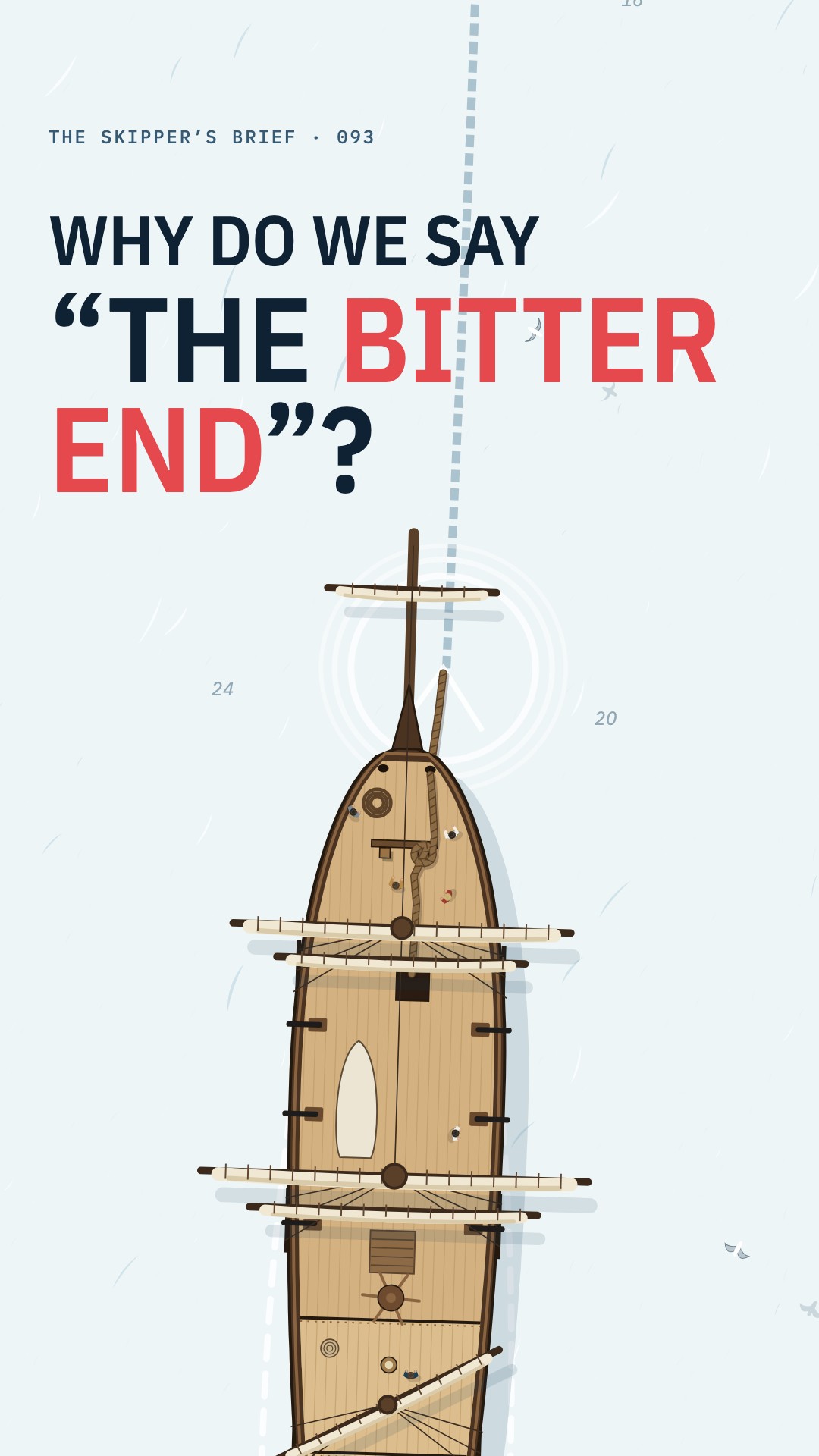
Brief #093 · SAID AT SEA
Why do we say “the bitter end”?
Stories
On a sailing ship the bitts were two great timber posts near the bow where the anchor cable was made fast; a turn of the cable round them was a "bitter", and the end of the cable kept on board was the bitter end, so a cable paid out to the bitter end had no more to give (Captain John Smith's Sea Grammar, 1627; Smyth's Sailor's Word-Book, 1867). The everyday phrase is half that story: the dictionaries say ordinary "bitter" probably shaped it too, and some trace it to the Bible's "her end is bitter". Ships still have one: the end of the anchor chain, made fast in the chain locker.
Transcript
Why do we say “the bitter end”? Every old sailing ship had one.
Most people think it means a bitter, painful end.
But on deck stood the bitts: two great posts for the anchor cable.
A turn of cable round them was called a bitter.
And the end kept on board? The bitter end.
Let go the anchor, and the cable runs out round the bitts.
Run it out to the bitter end, and there's no more to give.
So, is it from ships? Half true.
The sailors' bitter end was in print by 1627. But plain bitterness probably shaped it too.
It's still aboard: the anchor chain's end, made fast in the locker.
Want to learn more interesting facts like this? Follow the page.
Sources
- Captain John Smith, A Sea Grammar (London, 1627), scan on the Internet Archive: 'A Bitter is but the turne of a Cable about the Bits, and veare it out by little and little. And the Bitters end is that part of the Cable doth stay within boord'; the bitts 'are two great peeces of timber, and the Crospeece goeth thorow them … to belay the Cable thereto when you ride at Anchor'
- W. H. Smyth, The Sailor's Word-Book (1867), Project Gutenberg: BITTER 'Any turn of a cable about the bitts is called a bitter'; BITTER-END 'That part of the cable which is abaft the bitts, and therefore within board when the ship rides at anchor … when a chain or rope is paid out to the bitter-end, no more remains to be let go'; BITTS two upright oak timbers in the fore part of a ship 'whereon to fasten the cables as she rides at anchor'; BITT THE CABLE: to put it round the bitts to fasten it or slacken it out gradually
- Wikipedia, Bitts: paired vertical posts for mooring lines and cables; on wooden sailing ships the cable-bitts were large vertical timbers, the anchor cable's attachment point
- Wikipedia, Glossary of nautical terms (A–L), bitter end: 'The last part or loose end of a rope or cable. The anchor cable is tied to the bitts; when the cable is fully paid out, the bitter end has been reached.'
- Online Etymology Dictionary, bitter end: nautical, the part of a cable round about the bitts (the two great timbers to which cables are belayed), in nautical word-lists by 1759; in everyday use from about 1835, with probable influence of, if not displacement by, bitter (adj.)
- Wiktionary, bitter end: (nautical) the part of an anchor cable abaft the bitts, which stays inboard when a ship rides at anchor; 'The figurative usage is influenced by bitter ("unpleasant, arduous")', and most people now read it as bitter + end
- Michael Quinion, World Wide Words: Bitter end (2009): first recorded in Captain John Smith's Seaman's Grammar of 1627; the OED notes 'its history is uncertain'; the figurative sense may come from the Bible ('her end is bitter as wormwood', Proverbs 5:4) and the two strands may have developed in parallel; the tale of a cable running out in deeper water than expected is most likely a later explanation
- The Phrase Finder, The bitter end: earliest citation Captain Smith's Seaman's Grammar, 1627 (a bitter is the turn of a cable about the bitts; paid out to the bitter end, no more rope remains); the naval origin plausible but not proven, and the adjective 'bitter' a candidate too
- Wikipedia, Anchor windlass: the cable runs down the spurling pipe to the chain locker; 'The bitter end of the cable is connected to the bitts using the bitter pin', which can be released from outside the locker to slip the anchor
- Chris Caldwell, Southern Boating, How to Maintain Your Anchor System (2024): the bitter end, the end of the anchor rode, 'should be secured to the vessel so you do not lose the anchor'; better made fast with rope that reaches above deck, 'so it can be cut free in an emergency'