Brief #059 · BUOYAGE
Why does this buoy flash three times?
Navigation
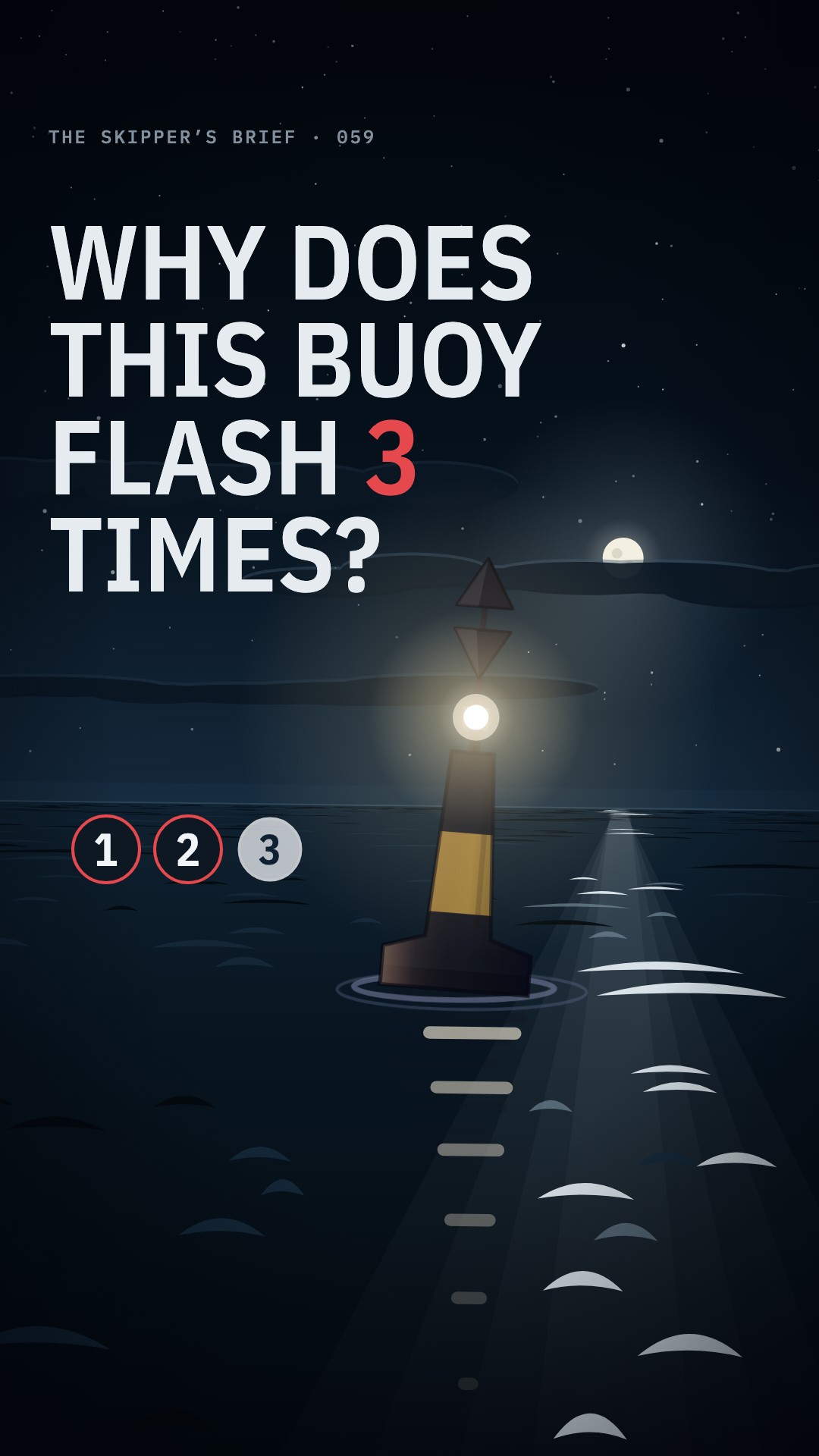
A buoy flashing white in threes is an east cardinal mark, and cardinal lights follow a clock face (IALA, the same in Regions A and B): north flashes without a break, east in threes, south in sixes plus one long flash, west in nines. The long flash (at least 2 s) is there so three or nine can't be mistaken for six. By day the two black cones tell them apart: both up for north, both down for south, base to base (an egg) for east, point to point (a wineglass) for west. Test: six quick flashes, then a long one, means the safe water is south of the mark. Points to the Buoyage course (cardinal marks, lights at night).
IALA Maritime Buoyage System: cardinal marks, their colours, topmarks and lights are the same in Regions A and B. Each mark's exact light character is on the chart.
Transcript
Why does this buoy flash three times?
Look at a clock. Three o'clock is east. It's an east cardinal, so the safe water is east of it.
There are four of them. North flashes nonstop. East in threes, west in nines.
South flashes six, then one long flash, so it can't be confused with three or nine.
All four, by day and night, are in my Buoyage course.
By day, read the cones. Both up, north. Both down, south. An egg, east. A wineglass, west.
Six quick flashes, then a long one. Where's the safe water?
South of it. Cardinal lights tell the time: three east, six south, nine west.
Try three free questions at theskippersbrief.com.
Sources
- IALA Recommendation R1001, The IALA Maritime Buoyage System, Edition 2.0 (June 2023), §2.2 Cardinal marks: 'The Cardinal marks in Region A and Region B, and their use, are the same'; the type of mark indicates which side it should be passed by (safer water lies to the north of a North Cardinal mark). Topmarks, two black cones: north points upward, east base to base, south points downward, west point to point. Colours: north black above yellow, east black with a broad yellow band, south yellow above black, west yellow with a broad black band. White lights: north VQ or Q; east VQ(3) every 5 s or Q(3) every 10 s; south VQ(6) + long flash every 10 s or Q(6) + long flash every 15 s; west VQ(9) every 10 s or Q(9) every 15 s; VQ is 120 or 100 flashes a minute, Q 60 or 50. §2.2.2: 'The concept of three, six or nine flashes is easily remembered when one associates it with a clock face. The long flash, defined as a light appearance of not less than 2 seconds, is to ensure that three or nine very quick or quick flashes cannot be mistaken for six.' (copy hosted by Irish Lights)
- Maritime Safety Queensland (Queensland Government), fact sheet 'Buoys, marks and beacons', Cardinal marks: north, 'The top cones point up'; east, 'The top cones are in the shape of an egg… think of e for egg and for East'; south, 'The top cones point down'; west, 'The top cones make the shape of a wine glass… think of w for wine glass and for West'; at night, 'think of a compass face with the numbers of a clock marked on it beside each direction': 3 flashes for east, 6 followed by a long flash for south, 9 for west, continual flashes for north
- Practical Boat Owner, 'Don't commit a Cardinal sin!' (Ben Meakins, 27 April 2010), easy ways to remember the topmarks: north and south point to the top and bottom edges of the chart; a west cardinal 'looks like a narrow waisted woman or wineglass'; you can draw an E round an east cardinal's topmark 'and it looks a bit like an egg'
- The Skipper's Brief, Buoyage course page (checked 2026-10-29): modules include 'Cardinal marks: North, east, south and west, by day and by night' and 'Lights at night'; '3 questions free, no sign-up'; 3 free questions in every course