Brief #045 · SEA LORE
Why is it called a logbook?
Stories
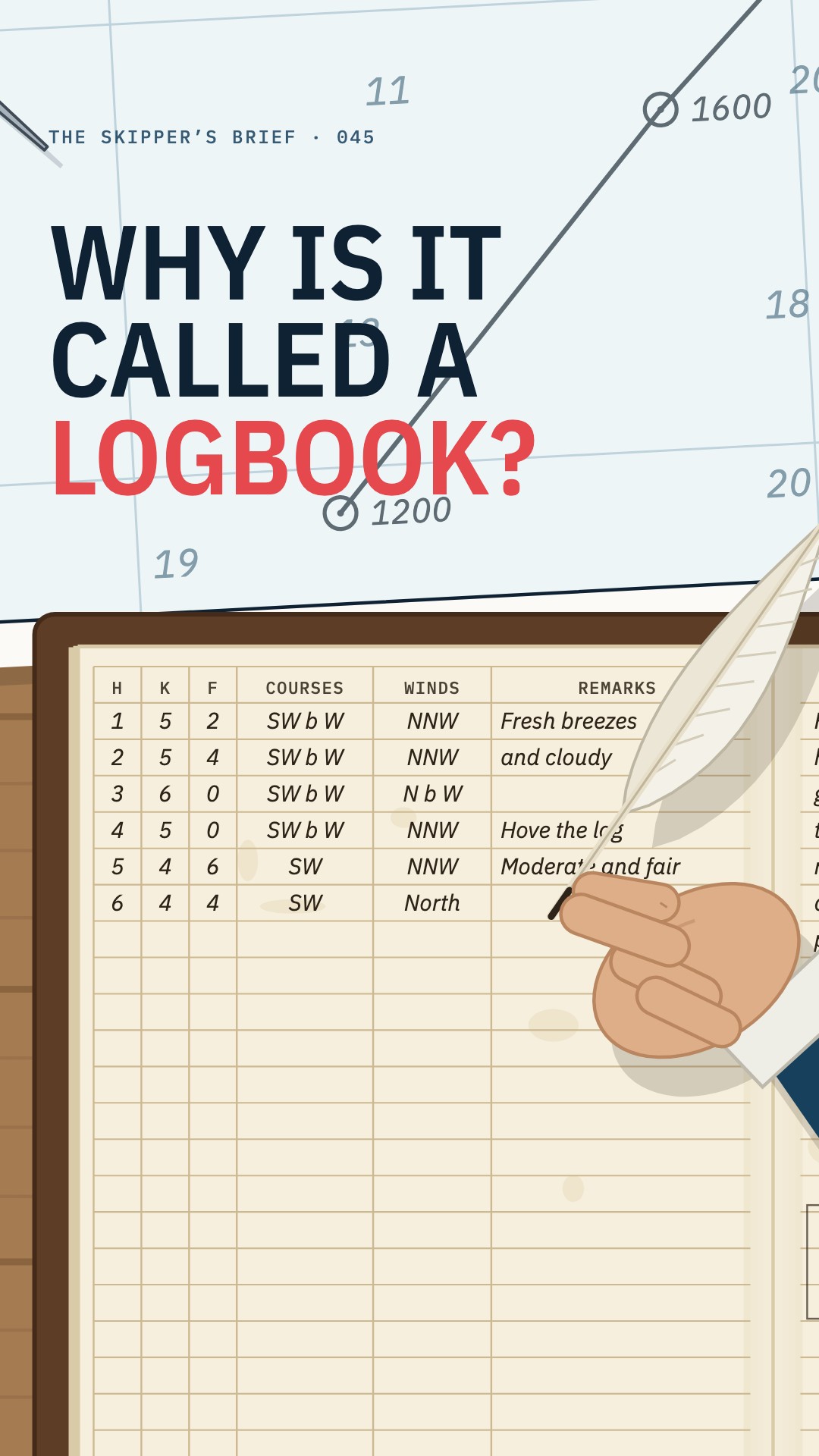
The log in logbook was a piece of wood: the chip log, a weighted wooden board on a knotted line heaved over the stern to measure speed. Its readings were chalked on a log-board through the day and copied into the log-book at noon (the word is on record from the 1670s), so 'to log' came to mean to record; in 1997 Jorn Barger called his web journal a 'weblog', and in 1999 Peter Merholz joked he'd pronounce it 'wee-blog', or 'blog' for short.
Transcript
Why is it called a logbook? The answer was thrown overboard.
Sailors threw a log over the stern: a piece of wood on a knotted line.
Count the knots that ran out: your speed, in knots.
Each reading was chalked on a board: time, knots, course, wind.
At noon, it was copied into a book: the log-book.
Named after the wood. And "to log" came to mean "to record".
In 1997, a site logging the web called itself a weblog.
Then someone joked: say it "we blog". "Blog", for short.
So every blog is named after a piece of wood thrown off a ship.
Want to learn more interesting facts like this? Follow the page.
Sources
- Online Etymology Dictionary, 'log': log (n.2) 'record of a ship's progress', a sailor's shortening of log-book (1670s), from log (n.1) 'piece of wood'; the book so called because it recorded the speed measured with a weighted chip of a tree log on a reeled log line, the line marked with knots; log (v.2) 'to enter into a log-book', 1823; general sense 'any record of facts entered in order' by 1913
- Online Etymology Dictionary, 'blog': 'online journal', short for weblog, from (World Wide) Web + log (n.2), the ship's record named after the piece of wood (it also notes 'weblog' was used earlier for a web server's request log)
- NOAA Ocean Service: What is the difference between a nautical mile and a knot? (the term dates from the 17th century and the 'common log', a rope with knots at regular intervals attached to a piece of wood shaped like a slice of pie, left to float behind the ship; the crew counted the knots that played out in a set time, and 'that number estimated their speed')
- Encyclopædia Britannica, 11th ed. (1911), 'Log', via Wikisource ('a piece of wood attached to a line was thrown overboard to lie like a log in a fixed position'; the common log is a log-ship or log-chip, log-reel, log-line and log-glass; 'A Log Book is a marine or sea journal')
- W. H. Smyth, The Sailor's Word-Book (1867): LOG-BOARD 'Two boards shutting together like a book … to record, through the hours of the day and night, the direction of the wind and the course of the ship … written by the mate of the watch with chalk, is rubbed out every day at noon'; LOG-BOOK 'a journal into which the log-board is daily transcribed'; LOGGED 'Entered in the log'; to heave the log is to throw it into the water; 'so many knots as run out in that time, so many miles the ship sails in an hour'
- William Falconer, Universal Dictionary of the Marine (1780 ed.), via the South Seas Companion: LOG-BOARD 'a sort of table, divided into several columns, containing the hours of the day and night, the direction of the winds, the course of the ship, and all the material occurrences that happen during the twenty-four hours, or from noon to noon'
- William Falconer, Universal Dictionary of the Marine (1780 ed.), via the South Seas Companion: LOG-BOOK 'a book into which the contents of the log-board is daily copied at noon, together with every circumstance deserving notice'
- South Seas Companion (Paul Turnbull), notes on the log-board: on Royal Navy ships the log was generally heaved every hour; the time and result of each heave were recorded on the log-board with the wind direction and the ship's course, and at noon the past 24 hours' entries were copied into the ship's logbook
- Practical Boat Owner, Glossary of nautical terms: 'Log': short for log-book, which was originally a log-board, two black-painted boards hinged together to open like a book, on which the readings of the log could be written in chalk; the log itself short for log-chip (or log-ship), a fan-shaped wedge of wood weighted to float upright
- BBC News, 'Weblogs rack up a decade of posts' (17 December 2007): the word 'weblog' was coined on 17 December 1997 by Jorn Barger for his Robot Wisdom page, 'an abbreviation for the "logging" of interesting "web" sites'; 'in 1999 the word "blog" was coined as a shortened form'
- Wikipedia, 'Blog' (History): 'weblog' coined by Jorn Barger on December 17, 1997; 'blog' coined by Peter Merholz, who jokingly broke the word weblog into the phrase 'we blog' in the sidebar of his blog Peterme.com in May 1999
- Peter Merholz, peterme.com sidebar, 1999 (Internet Archive copy of 13 October 1999): 'I've decided to pronounce the word "weblog" as wee'-blog. Or "blog" for short.'