Brief #041 · ANTIFOULING
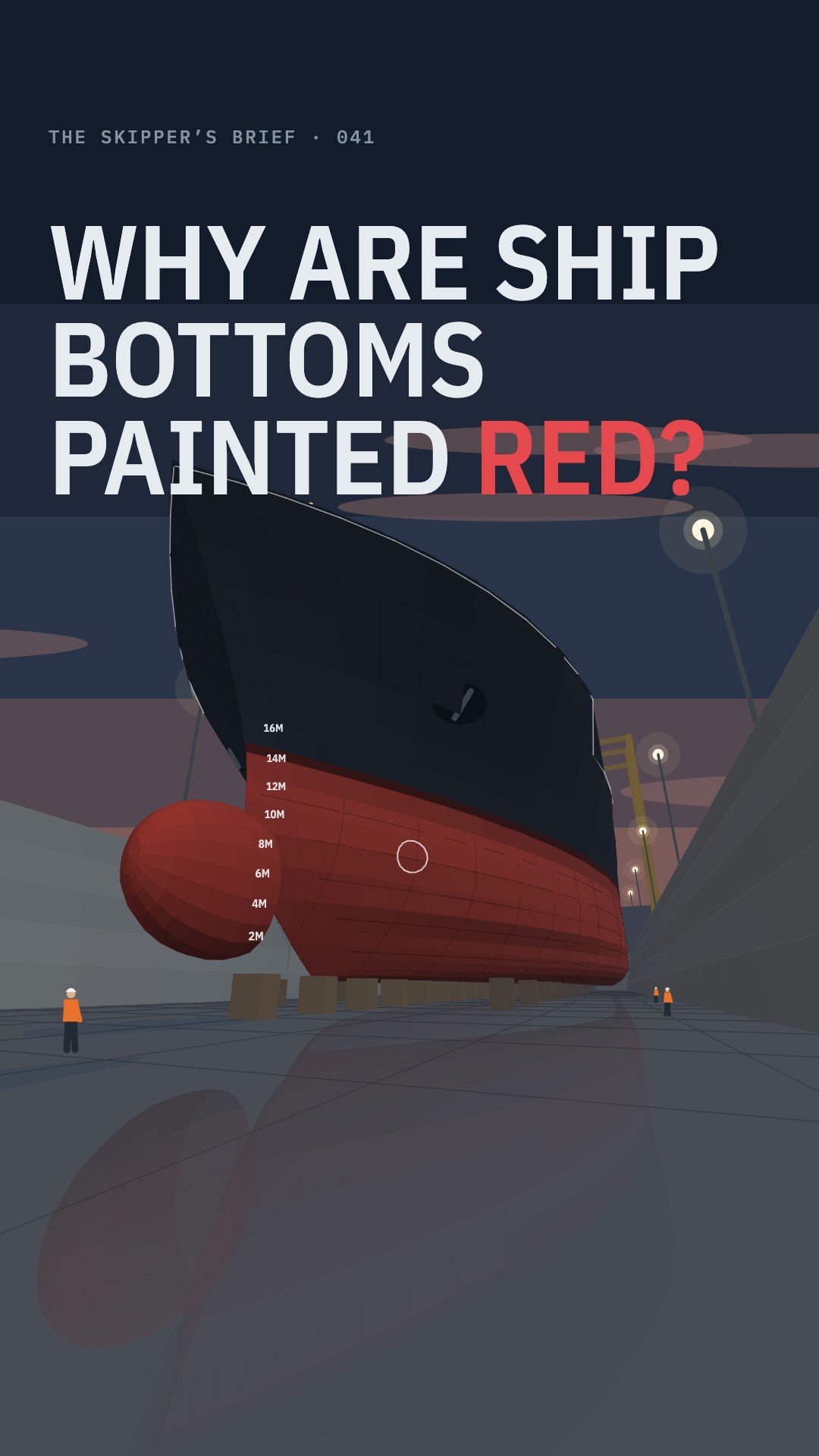
Why are ship bottoms painted red?
Stories
Slime, weed and barnacles grow on any bare hull and can almost double the power a ship needs; in 1761 the Royal Navy fought back by sheathing a frigate in copper, which is toxic to the growth, giving English the word copper-bottomed; today the copper is in the antifouling paint, often as red copper oxide, and red stuck.
Transcript
Why are ship bottoms painted red?
Blame the barnacles.
Slime, weed and barnacles grow on any bare hull.
A heavy crust can almost double the power a ship needs.
In 1761, the Royal Navy sheathed a frigate's hull in copper.
Copper is toxic to the growth, so coppered ships stayed fast.
Whole fleets followed, and copper-bottomed came to mean reliable.
Today the copper is in the paint, often as red copper oxide.
Paint comes in many colours now, but red stuck.
Your boat too: growth makes it slower and thirstier. Keep the bottom clean.
Want to learn more interesting facts like this? Follow the page.
Sources
- GEF-UNDP-IMO GloFouling Partnerships (2022), Analysing the Impact of Marine Biofouling on the Energy Efficiency of Ships and the GHG Abatement Potential of Biofouling Management Measures: biofouling 'the build-up of microorganisms, plants, algae or small animals' on the hull raises drag (biofilm and slime in hours to days, weed and invertebrates over weeks to months); 0.5 mm of slime on up to 50 % of the hull: +25 to 30 % GHG emissions; light calcareous fouling (barnacles or tubeworms) up to +60 %, medium calcareous up to +90 %
- IMO, Video: how biofouling management cuts GHG emissions (13 December 2022): 'a layer of slime as thin as 0.5 mm covering up to 50% of a hull surface could trigger an increase of GHG emissions in the range of 25 to 30%'
- M.P. Schultz (US Naval Academy), Effects of coating roughness and biofouling on ship resistance and powering, Biofouling 23 (2007): for a mid-sized naval surface combatant, 'heavy calcareous fouling results in powering penalties up to 86% at cruising speed'
- Philip K. Allan, Copper-Bottoming the Royal Navy, Naval History (US Naval Institute) June 2019: the 1761 decision to copper the entire bottom of the 32-gun frigate HMS Alarm; after two more years in the Caribbean 'no sign of worm attack' and 'minimal weed growth'; copper's film is toxic to most marine plants, so coppered ships were faster and more manoeuvrable; Lloyd's list of 1786 shows 275 merchant ships 'copper-bottomed', a description that entered English meaning 'of lower risk'
- Chris Baraniuk, Hakai Magazine, The secrets of ships' super smooth hulls (14 June 2023): 'because copper is toxic to many marine organisms', copper-plated ships stayed smooth; 'By the early 1780s, the entire British naval fleet' was coppered (Royal Museums Greenwich curator quoted); 'Today, copper is still applied to many oceangoing vessels', often in characteristically red antifouling paints
- Antique Metalware Society (oldcopper.org), HMS Victory copper sheathing: copper cladding 'first used on HMS Alarm in 1761'; it reduced biofouling 'very significantly' and gave ships 'a great advantage of speed'
- Wikipedia, Copper sheathing (secondary): in 1761 HMS Alarm 'was ordered to have her entire bottom coppered'; the fleet coppered from 1778–79; 'copper-bottomed' for a safe, reliable venture
- Cambridge Dictionary, copper-bottomed: 'A copper-bottomed plan, deal, or investment can be trusted completely because it is safe and certain to succeed'
- A.Word.A.Day (Anu Garg), copper-bottomed: 'Reliable, genuine, or trustworthy', 'from the practice of covering a ship's hull with copper (or alloy) to protect it from salt water and marine organisms'; earliest documented use 1795
- PubChem (US National Library of Medicine), copper(I) oxide: also called 'red copper oxide'; 'commonly used as a pigment, a fungicide, and an antifouling agent for marine paints'
- Wikipedia, Anti-fouling paint (secondary): modern antifouling paints use cuprous oxide or other copper compounds; 'Historically, copper paints were red, leading to ship bottoms still being painted red today'
- Andrew P. Collins, Jalopnik, Why so many ships are red on the bottom (13 August 2019): copper oxides gave antifouling paint its red; today it 'can be made pretty much any color', and red is kept 'for the sake of tradition'
- Jonathan R. Matias, PCI Magazine, Time to reconsider the color red for underwater hulls (22 November 2024; the author's firm develops alternatives): cuprous-oxide antifouling from the 1840s, standard by the 1860s; 'the tradition of red-colored hulls was born and continues today'
- North Carolina Sea Grant, Is there an environmentally friendly way to keep hitchhiking organisms off your boat? (2022): biofouling 'adds weight and increases friction, which leads to less maneuverability and slower speeds, and, in turn, greater fuel consumption'; time hull cleanings to the growth
- California Sea Grant (L.T. Johnson & J.A. Miller, 2002), What you need to know about nontoxic antifouling strategies for boats: fouling 'can slow sail boats and increase fuel consumption for power boats'; frequent hull cleaning as an alternative