Brief #069 · SEA LAW
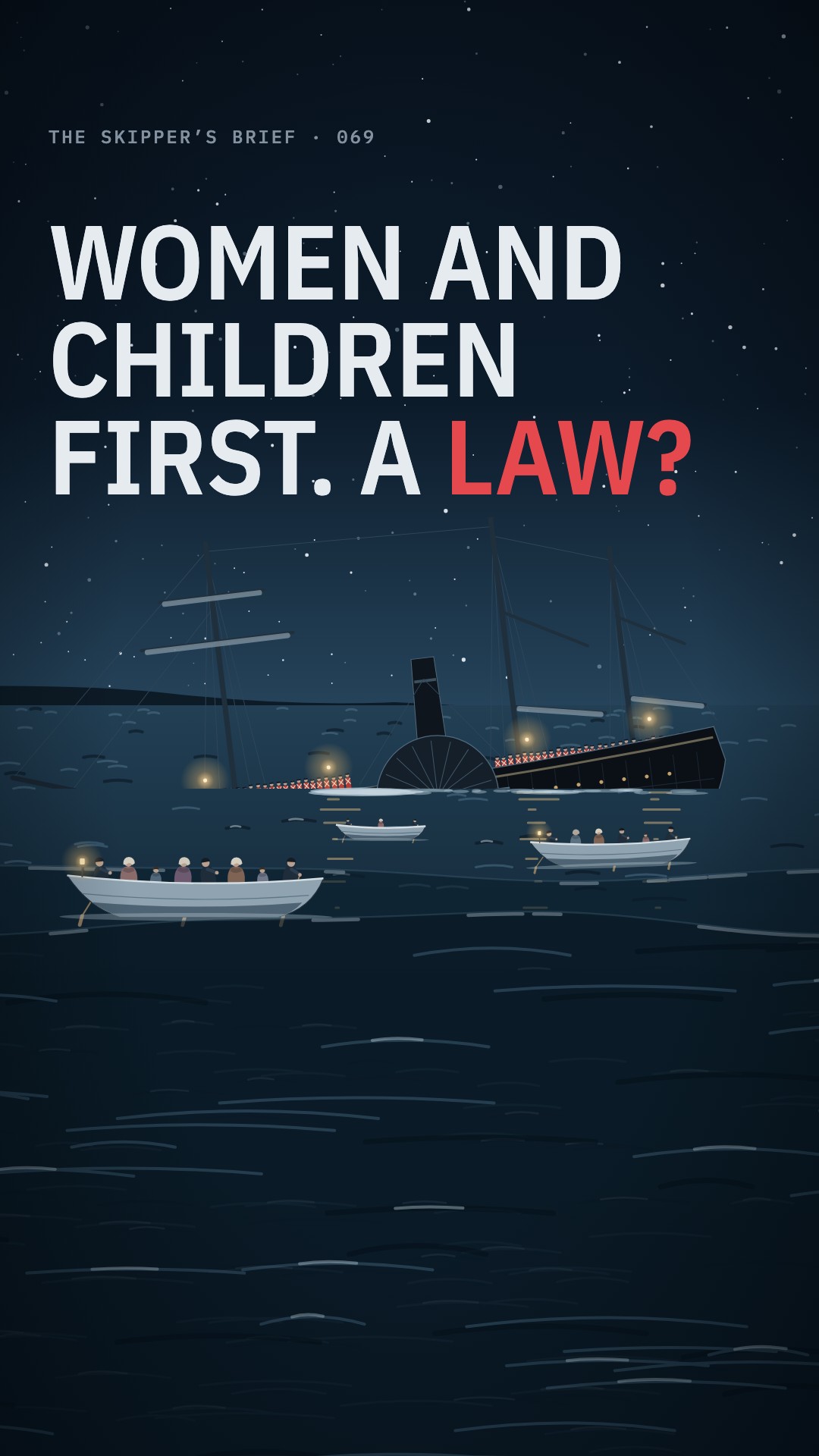
'Women and children first.' Is that actually a law of the sea?
Stories
'Women and children first' is a custom, not a law: no legal provision or IMO regulation mandates it. It's usually traced to the troopship HMS Birkenhead, wrecked off South Africa in 1852, where the soldiers stood fast and all the women and children were saved, though the phrase itself isn't in the reports of the time. In 2012, Elinder and Erixson published a study of 18 shipwrecks from 1852 to 2011, covering over 15,000 people. On the 16 that hadn't been studied before, 17.9 % of women survived against 34.6 % of men, and crew were 18.7 percentage points more likely to survive than passengers; children appear to have had the lowest rate, where the data exists. There's some evidence that a captain's order helped women, but it was given on only five of the ships. Women had the survival advantage in just two of the 18: the Birkenhead and the Titanic.
The survival figures come from one study of 18 wrecks, 1852–2011, chosen because their passenger and crew lists record survivors by sex.
Transcript
Women and children first. Is that actually a law of the sea?
Everyone thinks they know the rules of the sea. Test yourself at theskippersbrief.com. But first, the answer.
No. It's a custom, not a law.
It's usually traced to the Birkenhead, in 1852. Soldiers stood fast. Every woman and child was saved.
Researchers checked eighteen wrecks. On average, women survived at about half the rate of men.
Crew survived more often than passengers.
A captain's order seemed to help women. Only five ships are known to have had one.
Women had the better odds in just two of the eighteen. Titanic was the exception, not the rule.
Try three free questions at theskippersbrief.com.
Sources
- Elinder and Erixson (2012), 'Gender, social norms, and survival in maritime disasters', PNAS 109(33):13220–13224, doi:10.1073/pnas.1207156109. 'a database of 18 maritime disasters spanning three centuries, covering the fate of over 15,000 individuals of more than 30 nationalities'; Table 1 runs from HMS Birkenhead (1852) to MV Bulgaria (2011). The norm 'has often been referred to as the "unwritten law of the sea"'; the Birkenhead is 'often referred to as giving rise to the expression'. Main sample (the 16 previously uninvestigated wrecks, without the Titanic and the Lusitania): 'the survival rate of women is 16.7 percentage points lower than, or about half of (17.9 vs. 34.6%) that of men'; 'crew members are 18.7 percentage points more likely to survive than passengers'. Over the whole study: 'the survival rate of women is, on average, only about half that of men'; 'Children appear to have the lowest survival rate' (children's rates available for nine wrecks). Separate analyses of all 18: women have a survival advantage 'in only 2 of the 18 disasters: the Birkenhead and the Titanic'; crew an advantage in 9 of 18. The captain's order: 'We find some evidence'; 'the WCF order was given on only five ships' (Table 1: Birkenhead, Arctic, Northfleet, Titanic, Lusitania; no on 11, not known on 2, treated as not given); the joint test indicates women's relative survival 'improves by 9.6 percentage points when the captain orders WCF' (the separate test on the main sample is not significant). 'compliance with the WCF norm is exceptional in maritime disasters'; 'the sinking of the Titanic was exceptional in many dimensions'
- Deutsche Flagge (the German ship registry, with the Federal Ministry of Transport), Q&A on whether 'women and children first' applies when a ship sinks: 'No, at least there is no legal provision that mandates it'
- Prof Ed Galea (University of Greenwich, Fire Safety Engineering Group), on the Costa Concordia evacuation, 2012: 'There are no IMO regulations that states women and children must be given preference in boarding lifeboats'; the concept 'is not mandated'; 'It is not clear where this code of practice originates, but it is suggested to have arisen out of the sinking of HMS Birkenhead in 1852'
- Associated Press (Laurie Kellman, December 2023), in the Anchorage Daily News: Galea, 'There's no law or regulation that says women and children must be saved first'; on the Birkenhead, Britain's National Army Museum says all 26 women and children aboard survived
- National Army Museum, 'Women and children first': the troopship Birkenhead struck rocks off Danger Point, South Africa, on 26 February 1852; 193 of 638 survived but 'all the women and children were saved'; the soldiers kept their ranks and, when she broke up, Colonel Seton ordered 'Stand fast!' so that the men would not swamp the boats; the 'Birkenhead Drill'
- Wikipedia, 'HMS Birkenhead (1845)' (for the picture: the route and the ship): a Royal Navy troopship with an iron hull and paddle wheels, 64 m, two masts until a third was added in 1851 (a barquentine); sailed from Simon's Bay on 25 February 1852, bound for Algoa Bay; 'The sea was calm and the night was clear'; struck an uncharted rock near Danger Point shortly before 02:00 on 26 February
- The Phrase Finder, 'Women and children first': the Birkenhead 'is widely believed to be the origin of the phrase', but it 'doesn't appear in any of the contemporary reports of the wreck'; the 'first use of the precise phrase' it found is in W. D. O'Connor's 1860 novel Harrington