Brief #035 · THE DEEP
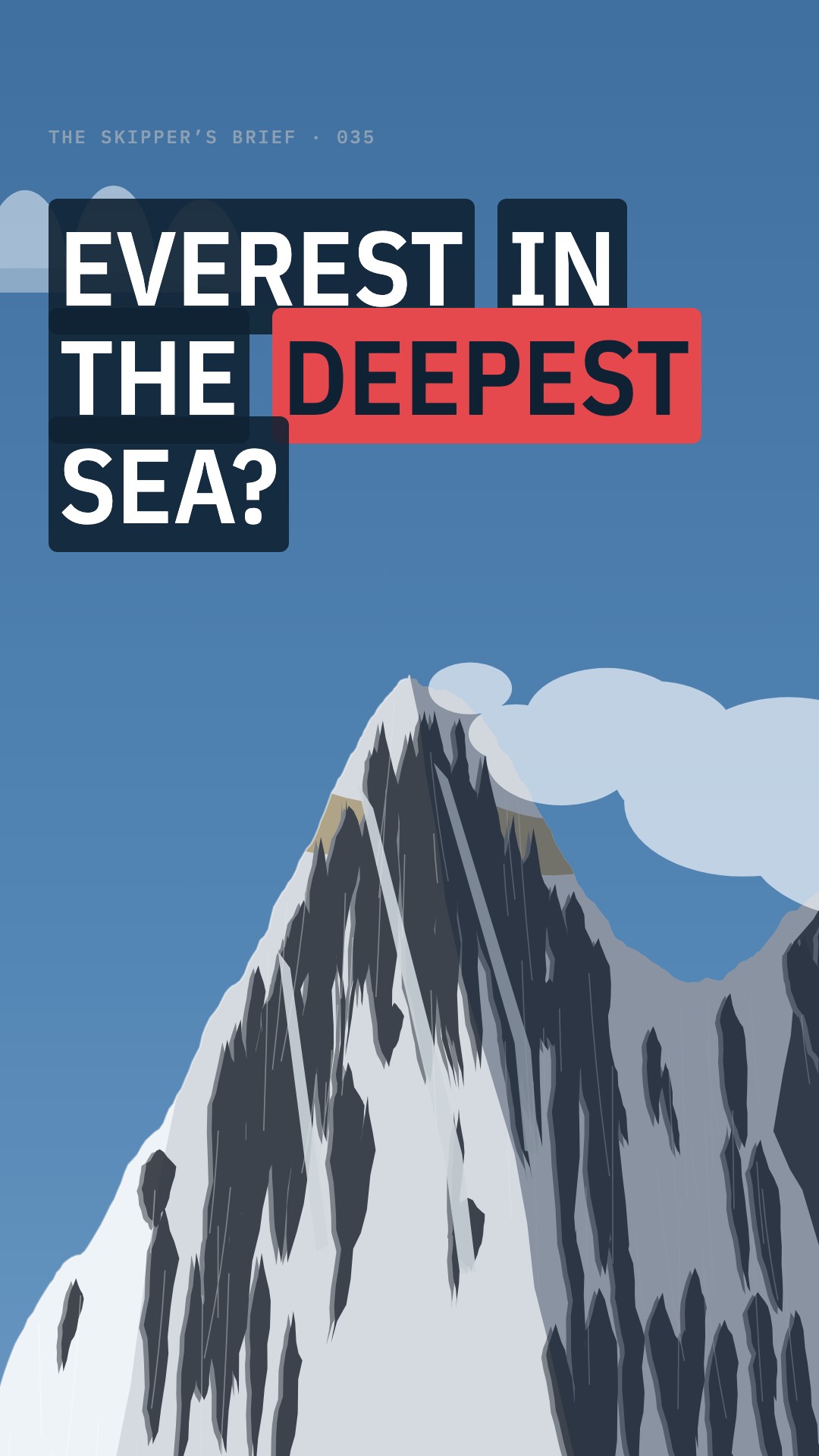
Would Mount Everest fit in the deepest part of the ocean?
Stories
The Challenger Deep is about 10,935 m deep, so Everest (8,849 m) would sit on its floor with more than 2 km of water over the summit.
Transcript
Would Mount Everest fit in the deepest part of the ocean?
The Challenger Deep is almost 11 kilometres down.
Drop in Everest: all 8,849 metres of it. Its summit would still be over 2 kilometres under water.
In 1960, Jacques Piccard and Don Walsh rode the Trieste to the bottom. Getting down took almost five hours.
Down there: over 1,000 times the pressure at the surface.
How do we know? Like your echo sounder: time a ping to the bottom and back.
Sound travels about 1,500 metres a second. Over the Deep, the echo takes almost 15 seconds.
Want to learn more interesting facts like this? Follow the page.
Sources
- NOAA National Ocean Service: How deep is the ocean? ("Challenger Deep is approximately 10,935 meters (35,876 feet) deep", southern end of the Mariana Trench, southwest of Guam)
- Greenaway, Sullivan, Umfress, Beittel & Wagner (2021), Revised depth of the Challenger Deep from submersible transects, Deep Sea Research Part I 178: 103644 (deepest observed depth 10,935 m, ±6 m at 95% confidence, below mean sea level; NOAA Institutional Repository). Other surveys differ: 10,925 m (Vescovo dives, 2019), 10,994 m (USNS Sumner, 2010), 11,034 m (Vityaz, 1957), per Guinness World Records
- Associated Press (8 December 2020): China, Nepal say Everest a bit higher than past measurements (new official height 8,848.86 m, 29,031.7 ft, from the 2019 Nepal and 2020 China surveys)
- US Office of Naval Research (2020): Lucky day: Navy celebrates 60th anniversary of deepest ocean dive (Lt Don Walsh and Jacques Piccard, 23 January 1960; a nearly five-hour descent; 20 minutes on the bottom; a crew sphere slung under a large float; a cracked outer plexiglass panel)
- EARTH Magazine (American Geosciences Institute), Benchmarks: January 23, 1960: Humans reach the deepest point on Earth (descent of four hours and 48 minutes; float tanks of lighter-than-water gasoline; 20 minutes on the seafloor; at 11,000 m, water pressure more than 1,000 times what it is at the surface)
- NOAA JetStream, Learning lesson: A pressing engagement (pressure rises about one atmosphere for every 10 m of water; under the nearly seven miles of water in the Mariana Trench it is about 1,080 atmospheres, or 16,000 pounds per square inch)
- DOSITS (University of Rhode Island): How is sound used to measure water depth? (an echosounder's transducer sends a sound pulse straight down and times its echo from the bottom; depth from the speed of sound, about 1,500 m/s)
- DOSITS (University of Rhode Island): How fast does sound travel? (about 1,500 m/s in seawater, varying a few percent with temperature, salinity and pressure). Over the Deep: 2 × 10,935 m ÷ 1,500 m/s ≈ 14.6 s, round trip