Brief #065 · DISTRESS
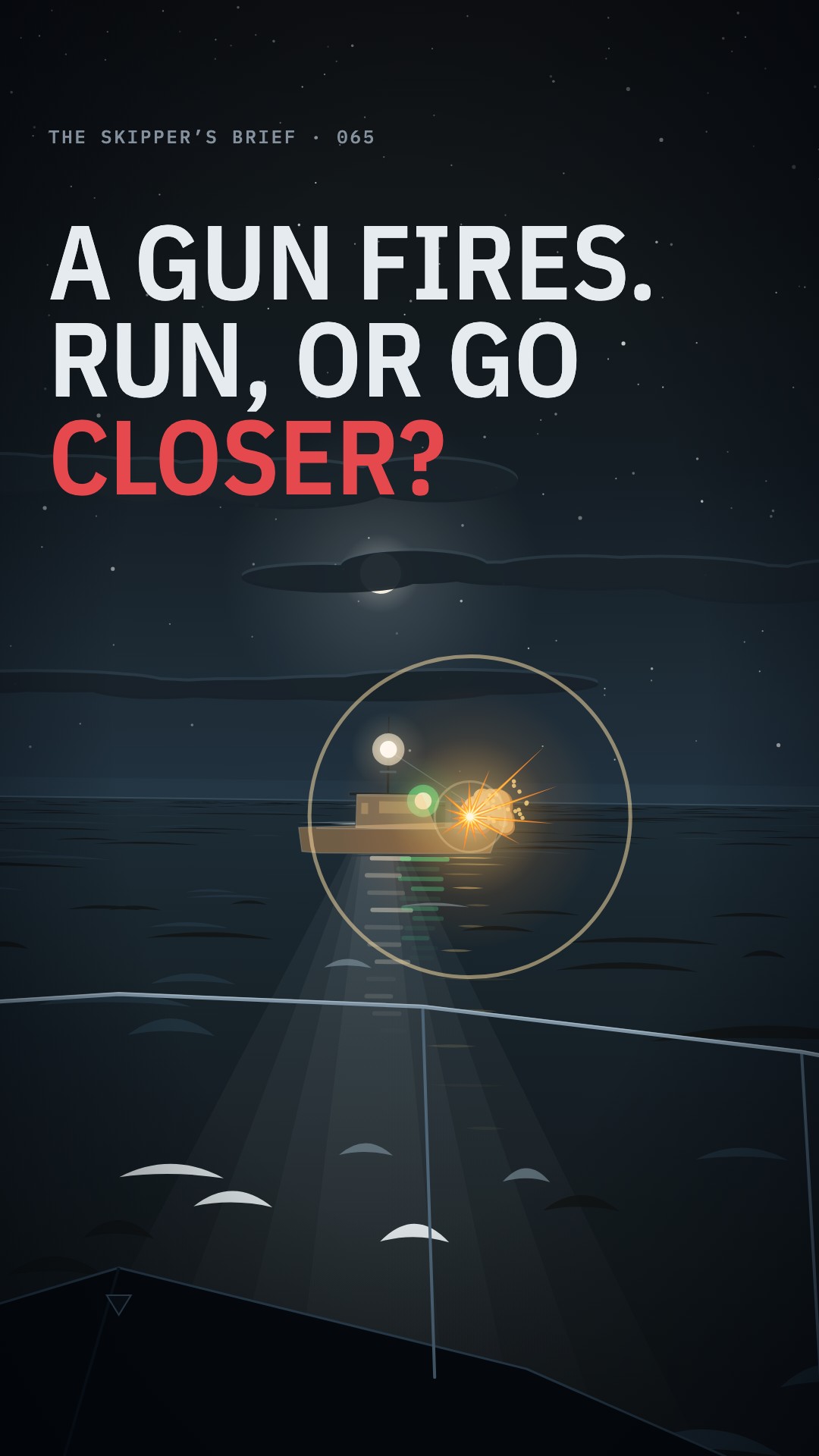
A boat near you fires a gun, once a minute. Run, or go closer?
Safety
A gun fired again and again, about once a minute, is one of the official distress signals in the international rules. So you go closer, if you safely can, and you tell the coastguard. Helping is a duty as well: the law of the sea requires a skipper to go to the help of people in distress, unless that puts their own boat in serious danger. Flames on a boat are on the same list, as from a burning barrel of tar or oil, so a glow on a boat at night may not be a barbecue.
International rules (COLREGs, SOLAS, UNCLOS). Inland waters and national law can have their own rules.
Transcript
A boat near you fires a gun. A minute later, it fires again. Do you run, or go closer?
It's a real question from the test at theskippersbrief.com.
She is in distress. Go closer, if you safely can.
A gun fired again and again, about once a minute, is an official distress signal.
Tell the coastguard where she is, and help as best you can.
The law of the sea requires it, unless it puts your own boat in serious danger.
And flames on a boat are on the same list, like a burning barrel of oil.
So look twice at that glow across the bay. It may not be a barbecue.
Try three free questions at theskippersbrief.com.
Sources
- COLREGs Rule 37, Distress signals: 'When a vessel is in distress and requires assistance she shall use or exhibit the signals described in Annex IV' (International text, Canada's Collision Regulations, Schedule 1)
- COLREGs Annex IV, Distress signals, section 1: '(a) a gun or other explosive signals fired at intervals of about a minute'; '(h) flames on the vessel (as from a burning tar barrel, oil barrel, etc.)'. The same list has red flares (i), orange smoke (j) and SOS (d). Section 2 prohibits using them except to indicate distress and need of assistance (International text, Canada's Collision Regulations, Schedule 1)
- UK Maritime and Coastguard Agency, 'SOLAS V for Pleasure Craft' (MCA/098, July 2014), Assistance to other craft: Regulations V/31, V/32 and V/33 require you 'to respond to any distress signal that you see or hear and help anyone or any boat in distress as best you can'
- SOLAS Chapter V Regulation 33.1, as reproduced by the RYA: the master of a ship at sea 'in a position to be able to provide assistance', on receiving information from any source that persons are in distress at sea, 'is bound to proceed with all speed to their assistance, if possible informing them or the search and rescue service that the ship is doing so'; a master 'unable or, in the special circumstances of the case, considers it unreasonable or unnecessary' to go logs the reason. RYA note: it 'applies to all vessels, including pleasure vessels'
- UN Convention on the Law of the Sea, Article 98(1), Duty to render assistance: 'Every State shall require the master of a ship flying its flag, in so far as he can do so without serious danger to the ship, the crew or the passengers: (a) to render assistance to any person found at sea in danger of being lost; (b) to proceed with all possible speed to the rescue of persons in distress, if informed of their need of assistance, in so far as such action may reasonably be expected of him'
- US law, 46 U.S. Code § 2304(a): 'A master or individual in charge of a vessel shall render assistance to any individual found at sea in danger of being lost, so far as the master or individual in charge can do so without serious danger to the master's or individual's vessel or individuals on board'
- UK government, 'GMDSS VHF DSC procedures for small boat users', on receiving or seeing a distress: 'You should use any available means to relay the distress message to an appropriate coast station'; the distress call template includes the position
- The Skipper's Brief, Lights and Signals course: 'Every course starts with 3 free questions, with no sign-up'. Its third free question: 'At night a boat keeps firing a gun, about once a minute. What is she telling you?' Answer: she is in distress; 'Go to help if you safely can, and tell the coastguard.' The Rules of the Road course's free question on flames from a barrel on deck has the same answer ('Treat it as distress')