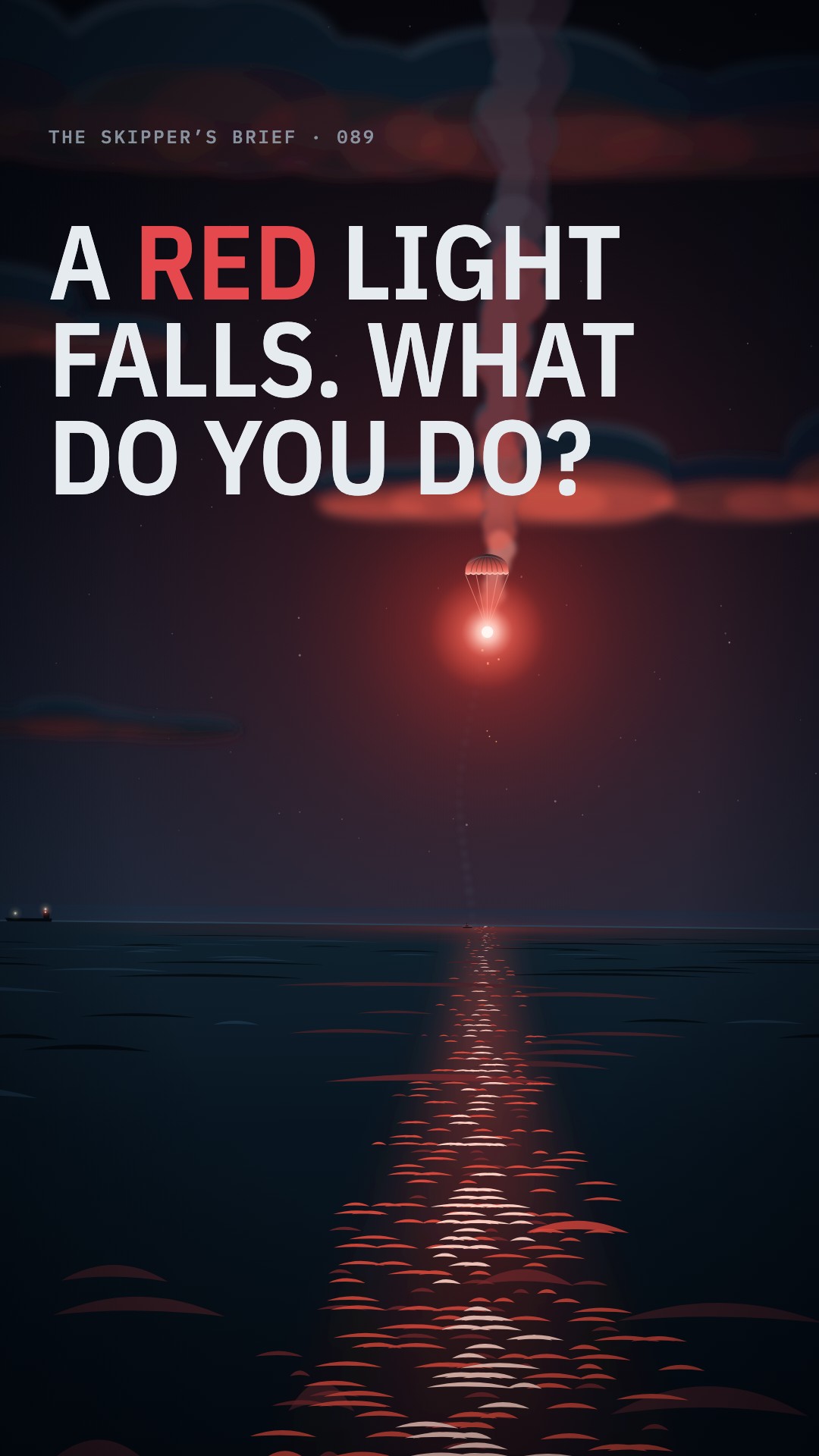
Brief #089 · DISTRESS
A red light falls slowly out at sea. What do you do?
Safety
A red light drifting slowly down out at sea is a red parachute flare, one of the distress signals in COLREG Annex IV: someone is in distress. Note the time and take its bearing with your hand-bearing compass, and be quick, as it burns for only about 40 seconds. Call the coastguard on VHF channel 16 and give them the time, the bearing and your position (if you can't reach them, a Mayday Relay passes the call on), then go and help if you safely can: answering a distress signal is a duty at sea. Not sure it was real? Report it anyway. And never fire one yourself except in distress.
International rules (COLREGs Annex IV, SOLAS V). The US Inland Rules list the same distress signals (33 CFR 87.01). How you reach the coastguard, and the law on helping, can differ in your own waters.
Transcript
A red light falls slowly out at sea. What do you do?
It's a real question from the test at theskippersbrief.com.
Someone is in distress. A red light falling slowly is a parachute flare.
Note the time, and take its bearing with your compass. It only burns for about forty seconds.
Call the coastguard on VHF channel 16. Give them the time, the bearing, and your position.
Then go and help, if you safely can. At sea, that's the law.
Not sure it's real? Report it anyway.
Easy to remember: clock, compass, call.
Take the free test at theskippersbrief.com.
Sources
- COLREGs Annex IV, Distress signals, section 1: among the signals that indicate distress and need of assistance, (i) 'a rocket parachute flare or a hand-flare showing a red light' and (c) 'rockets or shells, throwing red stars fired one at a time at short intervals'. Section 2: 'The use or exhibition of any of the foregoing signals, except for the purpose of indicating distress and need of assistance' 'is prohibited', as is the use of other signals that may be confused with them. Rule 37: 'When a vessel is in distress and requires assistance she shall use or exhibit the signals described in Annex IV.' (International text, Canada's Collision Regulations, Schedule 1)
- US Inland Rules, Annex IV, 33 CFR 87.01 Need of assistance: 'The following signals, used or exhibited either together or separately, indicate distress and need of assistance', among them (i) 'A rocket parachute flare or a hand flare showing a red light' (Cornell LII)
- RYA, Distress flares: a red parachute rocket projects 'a very bright flare to a height of about 300m' and 'burns for about 40 seconds while the flare drifts down on a parachute'; it is 'illegal to let them off in anything other than an emergency'
- Wikipedia, Flare: SOLAS sets standards for visual signals; 'aerial flares must burn for at least 40 seconds with a 30,000-candela average luminosity'; 'Red distress rockets and/or flares are now internationally recognized symbols that indicate a ship in distress'
- US 46 CFR 160.036-4, hand-held rocket-propelled parachute red flare distress signals: the parachute must 'open and properly suspend the pyrotechnic candle without fouling'; 'The rate of descent shall not exceed 4.5 m (15 ft.) per second'; 'The burning time shall be not less than 30 seconds'; 'The color of the burning signal must be vivid red' (Cornell LII)
- US Coast Guard, 'If you see a flare... now what?' (Yachts and Yachting, 4 March 2019): the questions rescuers will ask, among them 'What color was the flare?', 'What type of flare was it?' ('Meteor/star (falling rapidly)?', 'Parachute (falling slowly)?', 'Handheld (burning on surface)?'), 'What direction was the flare from you?', 'What is your position?' and 'Can you assist?'
- Soundings, 'Q&A: Flare sighting', the Coast Guard Auxiliary's guidelines if you spot an aerial flare: 'Estimate the direction of the flare from your location.' 'Estimate its distance.' 'Record the time of each sighting.' 'Have your location ready and contact the Coast Guard.'
- BoatUS Foundation, Flares & Distress Signals, 'What if you see a Visual Distress Signal given off by another vessel?': 'should you see a distress signal, immediate and positive action should be taken'; 'Notify the nearest Coast Guard station or State authority by radio'; 'Channel 16 on VHF marine radio (156.8 MHz)' is a recognized distress channel; 'If you can assist the stricken vessel without endangering yourself, you should.'
- UK government (MCA), 'GMDSS VHF DSC procedures for small boat users': keep 'a listening watch on Channel 16'; on a distress you receive, 'You should use any available means to relay the distress message to an appropriate coast station'
- Wikipedia, Mayday: 'a mayday call can be sent on behalf of one vessel by another; this is known as a mayday relay' (for the post text)
- UK Maritime and Coastguard Agency, 'SOLAS V for Pleasure Craft' (MCA/098, July 2014), Assistance to other craft: Regulations V/31, V/32 and V/33 require you 'to respond to any distress signal that you see or hear and help anyone or any boat in distress as best you can'; Misuse of distress signals: 'Regulation V/35 prohibits misuse of any distress signals'
- SOLAS Chapter V Regulation 33.1, as reproduced by the RYA: the master of a ship at sea 'in a position to be able to provide assistance', on receiving information from any source that persons are in distress at sea, 'is bound to proceed with all speed to their assistance, if possible informing them or the search and rescue service that the ship is doing so'; a master 'unable or, in the special circumstances of the case, considers it unreasonable or unnecessary' to go logs the reason. RYA note: it 'applies to all vessels, including pleasure vessels'
- US law, 46 U.S. Code § 2304(a): 'A master or individual in charge of a vessel shall render assistance to any individual found at sea in danger of being lost, so far as the master or individual in charge can do so without serious danger to the master's or individual's vessel or individuals on board'
- US Coast Guard, 'Coast Guard educates public to properly identify flare' (DVIDS, 14 December 2013, Coast Guard Station Bodega Bay): 'If you see something that looks like a flare, report it because that could be someone's life in danger'; 'If in doubt, it's always best to call the Coast Guard'; a red flare on the ocean is 'similar to a 911 call on shore'
- HM Coastguard, 'Flares are not fireworks' (3 November 2020): flares 'are an internationally recognised distress signal'; fireworks 'can easily be mistaken as an emergency situation at or near the coast', 'we can't always tell the difference'; 'if you think someone could be in trouble at the coast, always call 999 and ask for the Coastguard'
- The Skipper's Brief, Rules of the Road course (checked 2026-11-14): every course starts with 3 free questions, with no sign-up. Module 'Distress and attention signals' (Rule 37 and Annex IV), question 'At night you see this out to sea, falling slowly. What do you do?', over a red flare drifting down under a parachute. Options: carry on, it's someone's fireworks; note its bearing, call the coastguard, help (right); wait for her to call you by radio; keep clear, she is warning you off. Its explanation: a red parachute flare is a distress signal; note the time and its bearing, call the coastguard on VHF channel 16, and go to help if you safely can