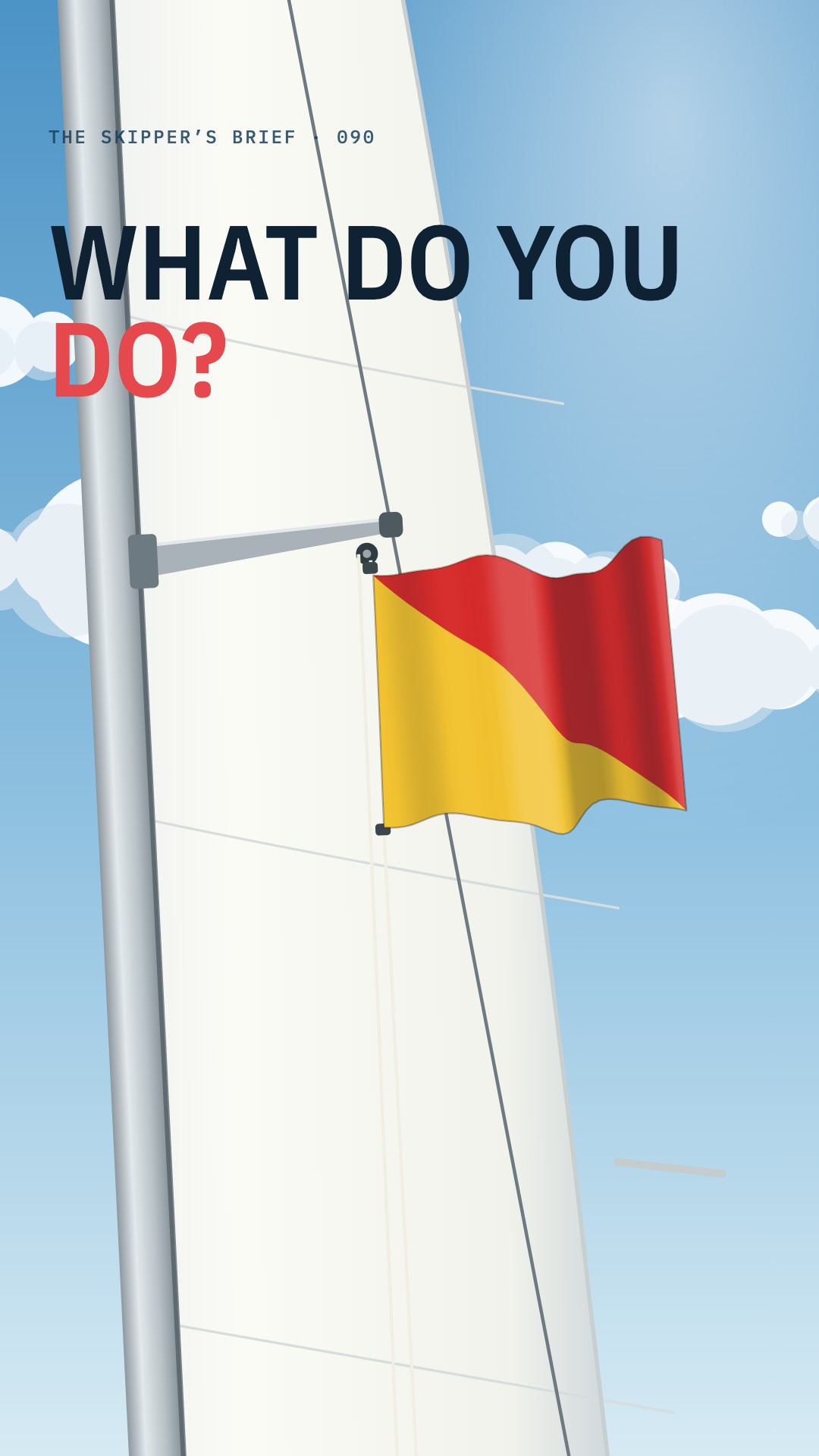
Brief #090 · FLAG O
The boat ahead just hoisted a red and yellow flag. What do you do?
Safety
Flag O of the International Code of Signals, split corner to corner (red in the upper half at the fly, yellow at the hoist), means "Man overboard". When the boat ahead hoists it, someone from her is in the water. Slow right down and keep a sharp lookout: in any sort of sea a head in the water can drop out of sight about a hundred metres off. Keep clear of her as she turns back to pick them up, stand by to help, and call the coastguard if she hasn't. Many boats fly the same flag on their man-overboard pole (danbuoy). One way to remember it: O for overboard.
Flag O is in the International Code of Signals, used worldwide, the US included. The lookout and safe-speed rules are the COLREGs' (the US Inland Rules say the same); the duty to help comes from the law of the sea and national law. Inland waters can have their own rules.
Transcript
The boat ahead just hoisted a red and yellow flag. What do you do?
It's a real question from the test at theskippersbrief.com.
Slow right down, and look for someone in the water.
That's flag O: man overboard. Someone from that boat is in the sea.
And a person in the water is tiny: just a head among the waves. A hundred metres off, it can vanish.
She'll turn back to pick them up. Keep clear of her, and stand by to help.
If she hasn't called the coastguard, you can.
On many boats, the same flag flies on the man-overboard pole.
One way to remember it: O for overboard.
Take the free test at theskippersbrief.com.
Sources
- International Code of Signals (NGA Pub. 102, United States edition, 1969, revised 2020; a US government work, 'no copyright claimed'), single-letter signals, which 'May be made by any method of signaling': 'O Man overboard.' Two-letter signal GW: 'Man overboard. Please take action to pick him up (position to be indicated if necessary).' Its alphabet flags plate (inside front cover) shows Oscar divided corner to corner, from the top of the hoist to the bottom of the fly: red in the upper half at the fly, yellow in the lower half at the hoist. The memory line 'O for overboard' is our own, not the Code's
- Wikipedia, International maritime signal flags: Oscar, 'Per bend gules and or' (divided diagonally, red and yellow), meaning 'Man overboard' and 'often attached to the man overboard pole on boats'
- Wikipedia, Man overboard: 'Signal flag Oscar indicates "man overboard"'; the equipment thrown to a casualty 'may include a horseshoe buoy or lifebuoy, a danbuoy or man overboard pole'; 'At least one person should do nothing other than stand and point at the casualty maintaining continuous visual contact'; to recover them the boat stops or sails away on a reach, then 'is either tacked or jibed back towards the casualty'
- Yachting Monthly, 'MOB myths busted, part 1' (Noel Dilly, 2017): 'In any sort of sea the MOB's head will disappear long before the boat is ready to turn. One hundred metres or so and it's gone'; 'someone is delegated to keep the victim in sight, pointing at them if possible'; the first response is to 'push the GPS MOB button, deploy the horseshoe and danbuoy, then send a Mayday'; 'Many danbuoys have very small flags'
- COLREGs Rule 5, Look-out: 'Every vessel shall at all times maintain a proper look-out by sight and hearing as well as by all available means appropriate in the prevailing circumstances and conditions so as to make a full appraisal of the situation and of the risk of collision.' (International text, Canada's Collision Regulations, Schedule 1)
- COLREGs Rule 6, Safe speed: 'Every vessel shall at all times proceed at a safe speed so that she can take proper and effective action to avoid collision and be stopped within a distance appropriate to the prevailing circumstances and conditions.' (International text, Canada's Collision Regulations, Schedule 1)
- COLREGs Rule 8(e), Action to avoid collision: 'If necessary to avoid collision or allow more time to assess the situation, a vessel shall slacken her speed or take all way off by stopping or reversing her means of propulsion.' (International text, Canada's Collision Regulations, Schedule 1)
- COLREGs Rule 2, Responsibility: (a) nothing in the Rules excuses 'the neglect of any precaution which may be required by the ordinary practice of seamen, or by the special circumstances of the case'; (b) 'due regard shall be had to all dangers of navigation and collision and to any special circumstances'. Why you keep out of the way of a boat turning back for someone in the water (International text, Canada's Collision Regulations, Schedule 1)
- UN Convention on the Law of the Sea, Article 98(1), Duty to render assistance: 'Every State shall require the master of a ship flying its flag, in so far as he can do so without serious danger to the ship, the crew or the passengers: (a) to render assistance to any person found at sea in danger of being lost'
- UK Maritime and Coastguard Agency, 'SOLAS V for Pleasure Craft' (MCA/098, July 2014), Assistance to other craft: Regulations V/31, V/32 and V/33 require you 'to respond to any distress signal that you see or hear and help anyone or any boat in distress as best you can'
- US law, 46 U.S. Code § 2304(a): 'A master or individual in charge of a vessel shall render assistance to any individual found at sea in danger of being lost, so far as the master or individual in charge can do so without serious danger to the master's or individual's vessel or individuals on board'
- UK government, 'GMDSS VHF DSC procedures for small boat users': a distress call and message go out on Channel 16, and on seeing or receiving a distress 'You should use any available means to relay the distress message to an appropriate coast station'
- The Skipper's Brief, Rules of the Road course, module 'Distress and attention signals' (paid part; every course starts with 3 free questions, with no sign-up). Question flag-o-close-ahead: 'A boat close ahead of you suddenly hoists this flag. What do you do?' Options: Keep well clear: she has divers down / Pass close: she needs a tow / Stand off: she is about to anchor / Slow down and look for someone in the water (right). Its explanation: flag O means man overboard; slow right down, keep a sharp lookout, stand by to help with the search, and tell the coastguard if she hasn't