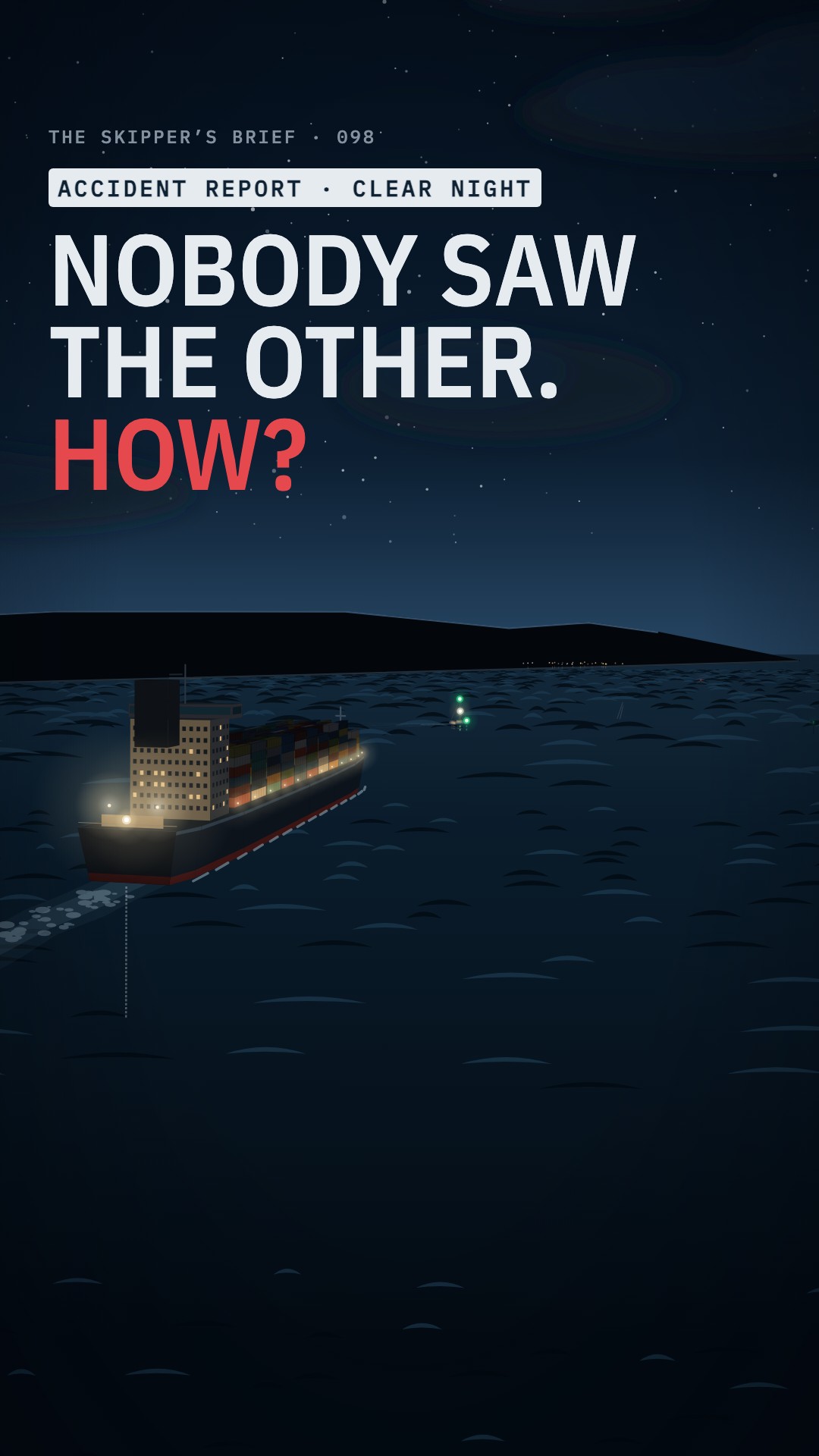
Brief #098 · ACCIDENT REPORT
A ship hits a yacht on a clear night. Nobody saw the other. How?
Safety
At about 04:19 on 6 July 2014, in clear visibility on a dark night, the 185 m container ship Kota Wajar collided with the 13.4 m yacht Blazing Keel in the shipping channel off Cowan Cowan Point, Moreton Bay, Queensland. The Australian Transport Safety Bureau found that no one on either vessel saw or otherwise detected the other before the collision. The yacht's anchor chain had started to pay out in a rising westerly, so her skipper and his wife motored for their marina across the bay in the dark, without radar (it had not worked for about 18 months), keeping watch from inside the cabin. On the ship, under pilotage, the procedures required a dedicated lookout, but none was posted, and radar was not used effectively: the yacht's echo was on the radar from 04:00. At 04:13 the yacht crossed the channel; the couple looked and saw no ships, though the ship was 1.6 miles away on their beam. The ship's bow struck the yacht's starboard side; the couple were not injured and the yacht kept her watertight integrity, but no one on the ship knew. The lesson: never assume a ship has seen you. Keep a proper lookout, all round and from outside (COLREG Rule 5); avoid shipping channels where you can, and cross only when clear, at right angles, behind a ship; make yourself easier to detect with a radar reflector or AIS.
One investigated collision, as found by the ATSB (investigation 311-MO-2014-006), without blame beyond its findings. The lookout rule is international (COLREGs Rule 5); the advice on crossing channels is Queensland's, for its shipping channels.
Transcript
A clear night. A ship hits a yacht. Nobody on either saw the other. How?
A couple at anchor. The wind rises, and their anchor chain starts slipping.
They motor home across the bay, without radar, watching from the cabin.
Down the channel comes a container ship, no lookout posted. The yacht shows on her radar. Nobody notices.
Then they reach the shipping channel.
From the cabin they see no ship, and cross. The ship is 1.6 miles off, on their beam.
The ship's bow hits the yacht. No one is hurt, and the yacht stays afloat. The ship sails on, unaware.
Investigators found neither vessel kept a proper lookout.
Never assume a ship has seen you. Look all round, from outside. Cross channels at right angles, when clear. And be seen.
Take the free test at theskippersbrief.com.
Sources
- Australian Transport Safety Bureau, investigation 311-MO-2014-006, final report (30 July 2015), safety summary: at about 0419 on 6 July 2014, 'in clear visibility', the container ship Kota Wajar collided with the yacht Blazing Keel in Moreton Bay, Queensland; the ship was southbound in the shipping channel, the yacht crossing it in a southwest direction. The yacht suffered extensive damage 'but its watertight integrity was maintained'; the two people on board were not injured. 'No one on board either Kota Wajar or Blazing Keel saw or otherwise detected the other vessel before the collision'. Free to read; the report is licensed CC BY 3.0 AU
- ATSB final report 311-MO-2014-006, The occurrence: the 185 m container ship and the 13.4 m (44 ft) steel cutter, her skipper (and owner) and his wife on board, anchored off Moreton Island to dive; it was a dark night (the moon had set before midnight) with good visibility. Around 0315 the yacht's anchor chain started to pay out in 15-knot westerly gusts, and at about 0330 the skipper weighed anchor to return to Newport Marina under power, with his navigation lights on. At 0413 he decided to cross the channel near M7 beacon. At 0419½ the port side of the ship's bulbous bow struck the yacht's starboard side; she bumped along the hull for about 30 seconds. 'No one on board Kota Wajar saw or heard the collision', and the ship continued along the channel as planned
- ATSB final report 311-MO-2014-006, Kota Wajar's lookout: under pilotage at night, her bridge team was the pilot, the chief mate (officer of the watch), the helmsman and the fourth mate, but 'no one was assigned the duties of a dedicated visual lookout', although her procedures required one. 'By 0400, about 20 minutes before the collision, Blazing Keel's radar echo was consistently appearing on the x-band radar's display', about 30 degrees on the port bow at 4.5 miles; none of the mates or the pilot saw it 'or, if they did, paid any attention to it'. Background shore lights, the bright lights of a dredger, and four course changes in 22 minutes were among the factors
- ATSB final report 311-MO-2014-006, Blazing Keel's lookout: the yacht's radar 'had not been operational for about 18 months' and she had no AIS; the skipper and his wife 'kept a lookout from the yacht's cabin from where it was not possible to keep an all-round lookout'. 'By 0413, when it was 1.6 miles and abeam, the skipper decided to cross the shipping channel near M7 beacon'; he said he and his wife 'looked but saw no ships in the channel'. The ship's lights should have been clearly visible from the yacht by 0410. Her lights: all of them were on, including the tricolour permitted for sailing vessels, so as a power-driven vessel she showed lights 'not in accordance with the rules and confusing'
- ATSB final report 311-MO-2014-006, Findings, contributing factors: 'A proper lookout, in accordance with the international regulations for preventing collisions at sea (COLREGS), was not maintained on board Kota Wajar. A dedicated visual lookout was not posted and radar was not appropriately used.' 'A proper lookout, in accordance with the COLREGS, was not maintained on board Blazing Keel. The yacht was navigating at night without radar and the lookout kept by sight was ineffective.' The findings are 'not ... apportioning blame or liability'
- ATSB final report 311-MO-2014-006: the yacht 'was not fitted with an AIS unit or a radar reflector to improve detectability (both optional for the yacht)'; 'While there is no substitute for a proper lookout, small vessels can improve their detectability with aids such as AIS transceivers and radar reflectors'. Other finding: fitting an AIS transceiver would have improved her detectability and let her crew detect ships at long range
- COLREGs Rule 5, Look-out: 'Every vessel shall at all times maintain a proper look-out by sight and hearing as well as by all available means appropriate in the prevailing circumstances and conditions so as to make a full appraisal of the situation and of the risk of collision.' (International text, Canada's Collision Regulations, Schedule 1)
- Maritime Safety Queensland, Safe boating in ship navigation areas (fact sheet): 'Maintain a constant and proper lookout at all times, using all means available'; 'Avoid travelling in a designated shipping channel'; 'Always cross a shipping channel at 90 degrees behind a ship and only when it is clear and safe to travel. Never cross in front of a large ship.' Also: a small boat 'can be unseen from the helm of a ship'