Brief #077 · A · B · C
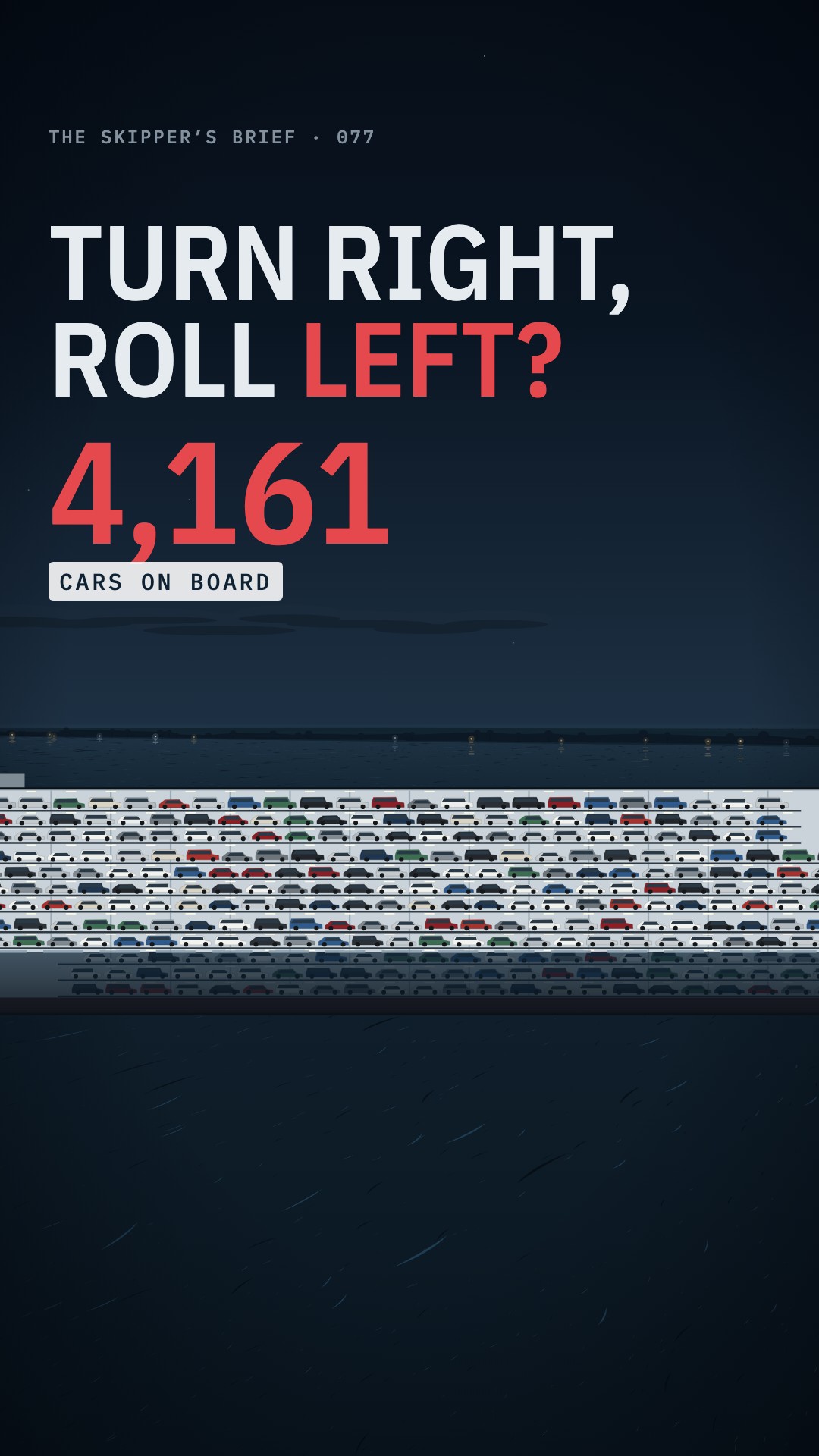
4,161 cars. One right turn. And she rolled over to the left. Why?
Safety
Answer: C. In a turn the water pushes sideways on the hull low down, while the ship's mass, carried round the turn, is centred higher up at her centre of gravity; together they heel her away from the turn, so a right turn leans her to the left. The Golden Ray didn't have the stability to resist it: the chief officer's error entering ballast quantities into the stability program meant she sailed with a GM of about 1.76 m (5.8 ft) against the 2.54 m (8.3 ft) required, and in a 68° right turn she reached a heel of 60° to the left in less than a minute (NTSB MAR-21/03). It wasn't her cargo: the NTSB found no sign that the 4,161 vehicles shifted before she began to heel; they were thrown about only once she was going over. And it wasn't the wind: 4 knots, which the NTSB found not significant.
One accident, as the NTSB investigated it: St. Simons Sound, Georgia, USA, 8 September 2019.
Transcript
4,161 cars. One right turn. She rolled over to the left. Why?
The Golden Ray. Four crew were trapped inside her for nearly 40 hours.
Is it her cars? Did they slide and tip her over?
Is it the wind? Did a sudden gust blow her over?
Or is it the turn? Do turning ships lean outward?
A, B or C? Tell me in the comments, and why you think so. Follow, so you don’t miss the answer.
Sources
- NTSB Marine Accident Report MAR-21/03, Capsizing of Roll-on/Roll-off Vehicle Carrier Golden Ray (2021): she capsized about 0137 on 8 September 2019 in St. Simons Sound, Georgia, during a starboard turn; '4,161 vehicles on board' (p. 20); 23 crew and 1 pilot, 4 engineering crew trapped 'for nearly 40 hours'; the 68° starboard turn at widener 11, a heel of '60° to port in less than a minute' (p. 33); GM about 1.76 m (5.8 ft) against a minimum of 2.54 m (8.3 ft) (pp. 22–23); excluded as causes (pp. 31–32): the weather, 'winds were light at 4 knots', and a cargo shift, 'Prior to the heeling event, there was no indication from the vessel's crew or VDR that cargo shifted'; in a turn the water's force heels a vessel 'in the opposite direction of the turn' (p. 33); probable cause: the chief officer's error entering ballast quantities into the stability calculation program (p. 40)
- NTSB news release, 14 September 2021: 'Inaccurate stability calculations caused the capsizing of vehicle carrier Golden Ray'; all 23 crew and the pilot were rescued, 'including four engineering crew who were trapped in the vessel for nearly 40 hours'; more than 4,100 vehicles lost
- Wikipedia, Golden Ray: the 200 m vehicle carrier, built 2017, that capsized in St. Simons Sound, Georgia, on 8 September 2019; all crew were rescued
- Triantafyllou and Hover, Maneuvering and Control of Surface and Underwater Vehicles, MIT OpenCourseWare 2.154, lecture notes 7.3.3 'Heel Angle': 'the fluid forces act below the waterline, but the center of gravity is near the waterline or above'; in a steady turn the vessel rolls 'out of the turn'