Brief #062 · LICENCES
Which country lets you drive a boat with no licence?
Safety
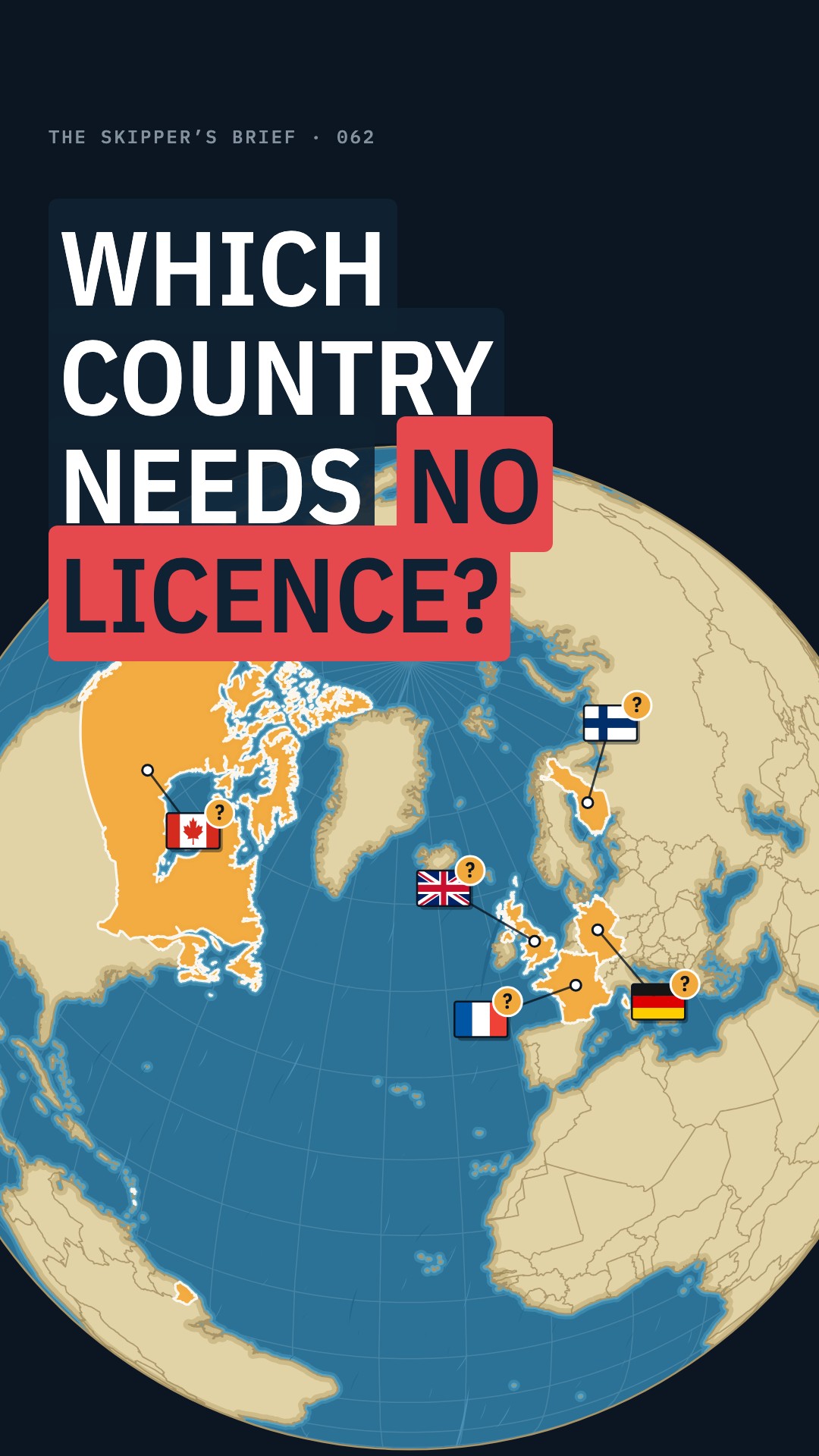
Boat licences differ a lot from country to country (private leisure motorboats, as of 2026): Germany asks for one above 15 PS (11.03 kW), France above 6 hp (4.5 kW), Canada for any boat with a motor; the UK asks for none, and nor does Finland, which only has an age limit (15 for a registered motorboat). But no test doesn't mean no rules: at sea the same collision rules apply to every vessel, from a kayak to a supertanker, in 164 countries. The test: two motorboats crossing; the one with the other on her starboard side gives way ("if to starboard red appear, it's your duty to keep clear"). Then all three courses.
Private leisure motorboats; national licence rules as of 2026 (they change, and regions and inland waters can add their own). Collision rules: the international COLREGs; harbours, rivers and inland waters can have their own (e.g. CEVNI, the US Inland Rules).
Transcript
Which country lets you drive a boat with no licence at all?
Germany: over 15 horsepower, you need a licence.
France: over six.
Canada: any motor at all.
The UK: none, for a private boat.
Finland: none either, just an age limit.
But no test doesn't mean no rules.
At sea, one set of rules covers every boat, from a kayak to a supertanker.
That's what my courses teach, whatever your country.
Two motorboats crossing. Who gives way?
You do: she's on your right. If to starboard red appear, it's your duty to keep clear.
What's the rule where you are?
Try three free questions at theskippersbrief.com.
Sources
- ELWIS (Germany's Federal Waterways and Shipping Administration), Sportbootführerscheine (Stand: 3 December 2025): a sport boat licence is required for recreational boats with a drive of more than 11.03 kW (15 PS) with a combustion engine, or more than 7.5 kW with an electric motor (since 1 January 2023); the inland licence for boats under 20 m, the sea licence with no length limit; private use
- French Ministry of the Sea, Le permis plaisance (updated 17 April 2026): 'Le permis est obligatoire pour piloter un bateau de plaisance à moteur lorsque la puissance de l'appareil propulsif est supérieure à 4,5 kilowatts (6 chevaux)'
- Canada, Competency of Operators of Pleasure Craft Regulations (SOR/99-53), current to 2026-09-30: s. 2(1) they apply to 'pleasure craft that are fitted with a motor and that are operated for recreational purposes in Canadian waters, other than the waters of the Northwest Territories and Nunavut'; s. 3(1) no person shall operate a pleasure craft unless competent and with proof of competency on board (a Pleasure Craft Operator Card or an equivalent); s. 3(2) non-residents in Canada for less than 45 consecutive days are exempt
- Transport Canada, Pleasure Craft Operator Card (PCOC) FAQ (modified 2026-05-12): 'Everyone who operates a power-driven boat needs proof of competency'; the regulations 'only apply to pleasure craft fitted with a motor'
- RYA (the UK's national body for boating, which issues the ICC for the UK Government), The value of training: 'you don't legally need a licence to skipper a vessel in UK waters'; a VHF radio needs an operator's licence
- GOV.UK, Boatmasters' licence: 'You do not need a boatmasters' licence if you're in charge of a pleasure vessel, including hire boats used as pleasure vessels'
- RYA, About the UK ICC: the International Certificate of Competence is 'issued on behalf of the UK Government under the authorisation of the UK Maritime and Coastguard Agency' and is 'intended to provide evidence of competence when requested by officials in foreign countries'
- Finland, Water Traffic Act (Vesiliikennelaki 782/2019, consolidated, amended to 2025): s. 6 a registrable motor-driven watercraft may be operated only by a person who has turned 15; registration is required for a craft with an engine of at least 15 kW, or with a motor or sail and a hull of at least 5.5 m; s. 41 only the master of a 'huvialus' (a leisure vessel over 24 m and under 500 GT, s. 3) must be 18 and hold the International Certificate for Operators of Pleasure Craft; no other licence for leisure boats
- COLREGs Rule 1(a) and (b), Application: 'These Rules shall apply to all vessels upon the high seas and in all waters connected therewith navigable by seagoing vessels'; an appropriate authority may make special rules for roadsteads, harbours, rivers, lakes or inland waterways (International text, Canada's Collision Regulations, Schedule 1)
- COLREGs Rule 3(a), General definitions: 'The word vessel includes every description of water craft, including non-displacement craft, WIG craft and seaplanes, used or capable of being used as a means of transportation on water'
- COLREGs Rule 15, Crossing situation: 'When two power-driven vessels are crossing so as to involve risk of collision, the vessel which has the other on her own starboard side shall keep out of the way and shall, if the circumstances of the case admit, avoid crossing ahead of the other vessel'
- COLREGs Rule 16, Action by give-way vessel: every vessel directed to keep out of the way of another shall, so far as possible, take early and substantial action to keep well clear
- COLREGs Rule 21(b), Sidelights: a green light on the starboard side and a red light on the port side, each showing an unbroken light over an arc of 112.5 degrees, from right ahead to 22.5 degrees abaft the beam on its side (so a vessel crossing from your starboard side shows you her red light)
- IMO, Status of Treaties (2025 edition, lists the Hong Kong Convention in force from 26 June 2025): COLREG 1972, in force since 15 July 1977, 164 Contracting States, 98.91 % of world tonnage
- The Skipper's Brief courses (live 2026-10-29): Rules of the Road, Lights and Signals and Buoyage, all three together; every course starts with 3 free questions, no sign-up. Rules of the Road covers who the rules apply to (Rules 1-3: 'from a kayak or jet ski to a tanker') and crossing (Rules 13-17); the modules were built on fourteen boating tests compared (US state exams, RYA, ICC, CEVNI, Canada's PCOC, four Australian states, Germany's SBF See)