Brief #075 · A · B · C
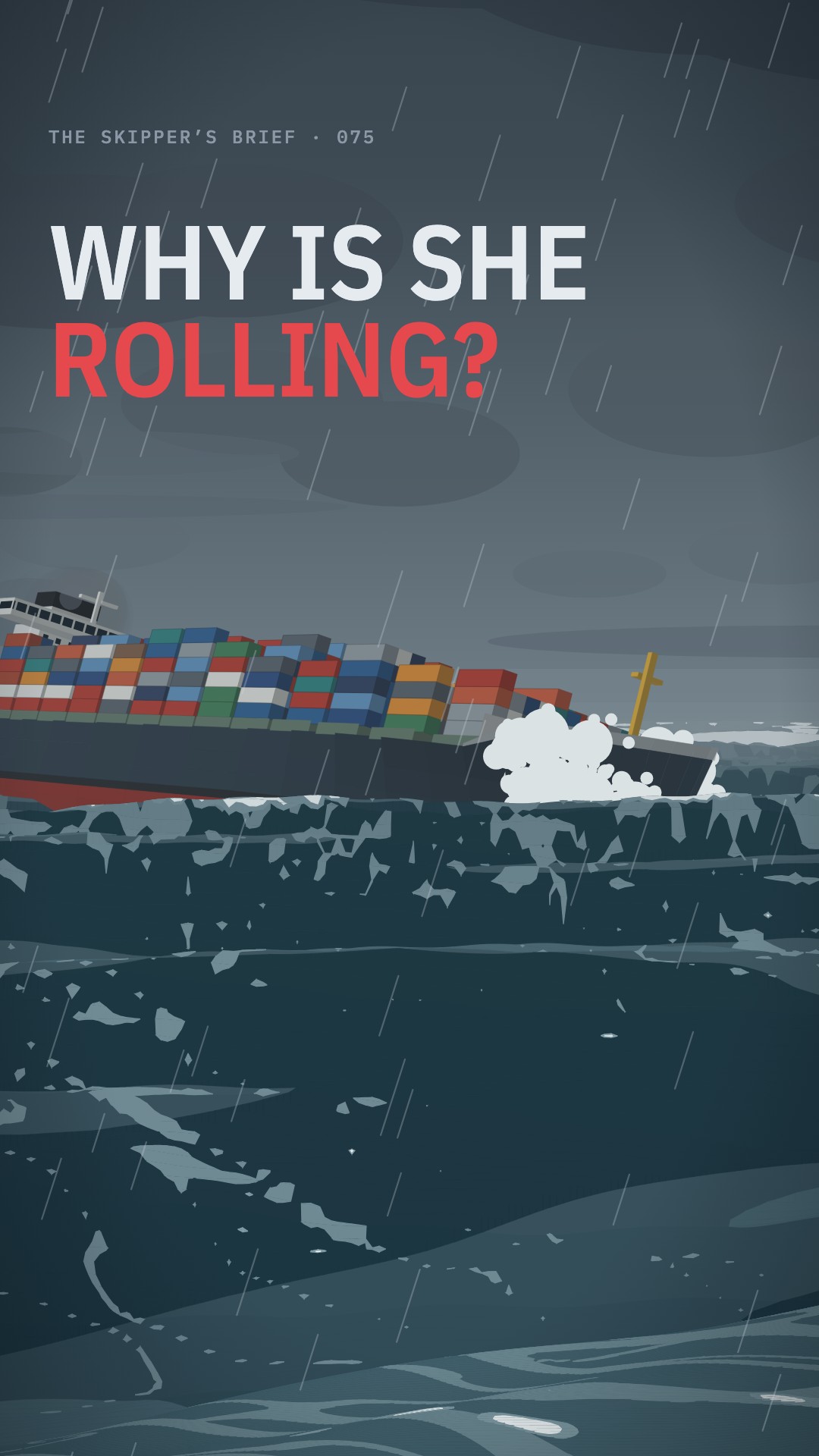
She's heading into the waves. So why is she rolling side to side?
Boat handling
Answer: B. When the waves are about as long as the ship and she heads into them, her stability keeps changing: with a crest under her middle and troughs at bow and stern, her flared bow and flat stern lose waterline width and she is less stable; with a trough under her middle she is stiffer again. Two waves pass her in every roll, so each roll lands on a weak moment and swings further than the last: in October 1998 the APL China rolled 35 to 40 degrees heading into a North Pacific storm, and a model of her class in the same seas rolled about 37 degrees (40 with the wind). Not a swell on her side: the seas came from ahead and off her bow, and in beam seas ships of her class rarely rolled past 15 degrees. Not her cargo either: the rolling broke the lashings, and hundreds of containers went over the side as a result.
Big ships with a fine, flared bow and a wide, flat stern, above all large container ships, in head or near-head seas about one ship length long.
Transcript
This ship is heading straight into the waves. So why is she rolling 40 degrees, side to side?
In 1998, a ship like her lost hundreds of containers this way.
Is it a big swell, hitting her from the side?
Are the waves changing how stable she is?
Or is her cargo on deck sliding about?
A, B or C? Tell me in the comments, and why you think so. Follow, so you don’t miss the answer.
Sources
- Steamship Mutual, 'Parametric Rolling – Container Lashing Systems' (free article): in late October 1998 a laden post-Panamax (C11 class) container ship in a severe Pacific storm 'rolled to 35° to 40° and as a result several hundred containers were lost over the side and several hundred more were severely damaged'. Its conditions for this rolling: 'The ship is in head or near head seas'; 'The natural period of roll is equal to about twice the wave encounter period.'; 'The wave length is of the order of the ship length.'; the wave height exceeds a critical level; 'The roll damping is low.'
- France, Levadou, Treakle, Paulling, Michel and Moore, 'An Investigation of Head-Sea Parametric Rolling and its Influence on Container Lashing Systems' (SNAME Annual Meeting 2001; free PDF from Steamship Mutual). The 1998 case: a laden C11 class ship eastbound from Kaohsiung to Seattle in a violent north Pacific storm, steering into the seas (from forward of the beam to dead ahead); 'Port and starboard rolls as great as 35 deg to 40 deg were reported'; of almost 1,300 deck containers a third went overboard and another third were damaged. The mechanism: stability rises 'when a wave trough is near amidships' and falls 'when a crest is in this position'; with the crest amidships the V-shaped bow and the flat stern lose waterline width; 'two waves pass the ship during one roll cycle'. In beam seas the class's rolls 'rarely exceed 15 deg', and the model tests saw no such rolling in beam seas. A model in the storm's seas rolled 36.8 deg (40.1 with wind), and the analyses 'confirmed the expected failure of container stacks' under those motions
- Wärtsilä Encyclopedia of Ship Technology, 'Parametric roll resonance': the righting arm shrinks as a wave crest passes and grows again in the trough; 'The reduction of righting arm GZ at wave crest causes a larger heel under the action of wind and sea.' If the roll to the other side coincides with the next crest, the roll grows. 'Large containerships are prone to parametric rolling' because of the different shapes of their fore and aft bodies
- Old Salt Blog (Rick Spilman, 8 December 2020), naming the 1998 ship: 'In October 1998, the Post-Panamax container ship APL China began to roll violently by 30 to 40 degrees in a severe storm in the Pacific.' It gives 406 containers lost and 1,000 damaged; published counts differ, so the reel says 'hundreds'