Brief #101 · KNOT OF THE WEEK
The one knot every sailor should know: the bowline
Boat handling
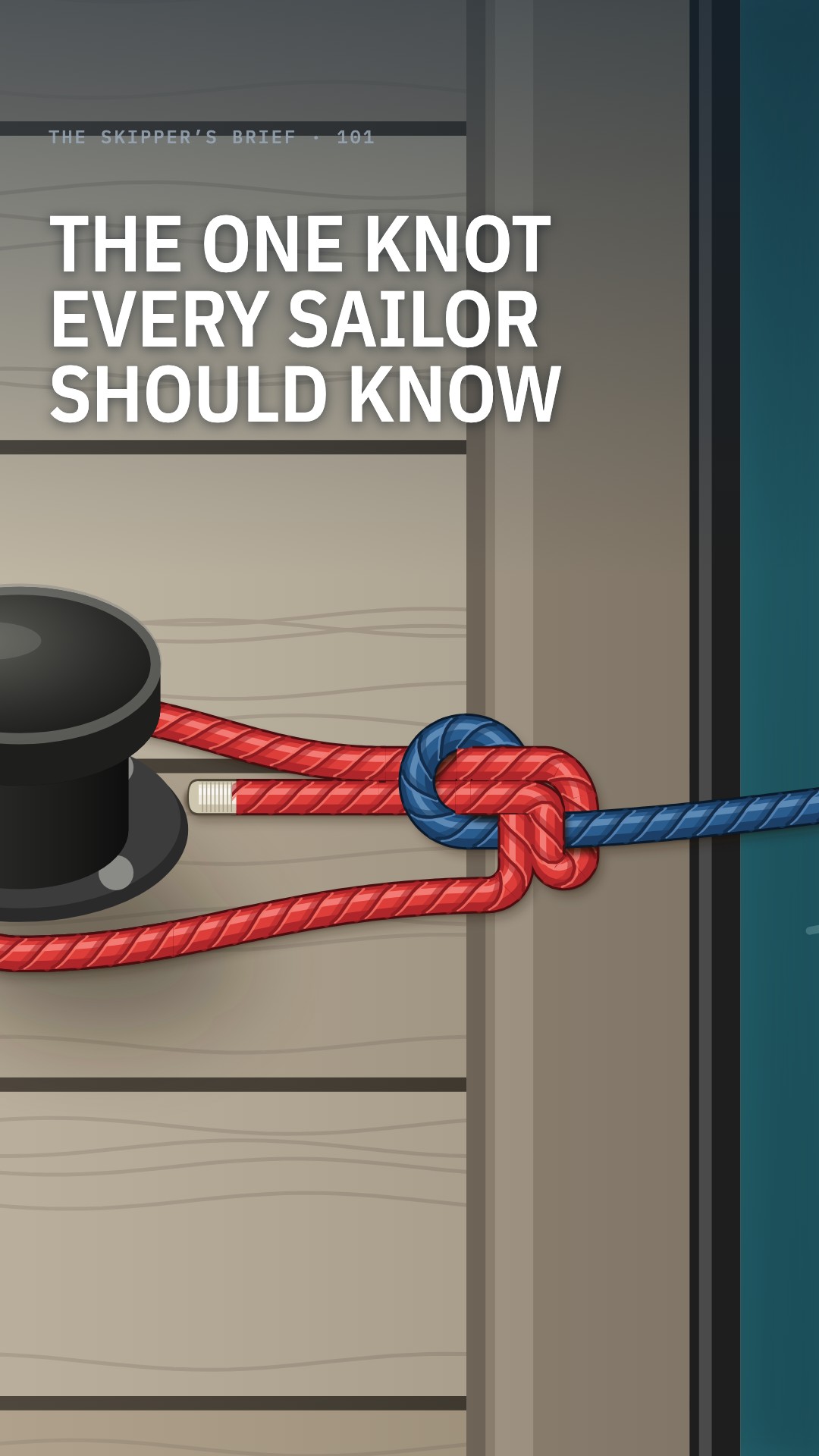
The bowline makes a fixed loop at the end of a line that holds under load and still unties easily afterwards. Tied the common way: make a small overhand loop in the standing part (the working end lying over the standing part), pass the end up through it from underneath, round the back of the standing part and back down through the loop, then hold the end and the eye together and pull the standing part to set it; many boaters learn it as the rabbit that comes out of the hole, runs round the tree and goes back down the hole. The tail should finish inside the eye, with a good length to spare. Make that first loop the other way round and the same moves give no bowline at all. It is used for a loop over a bollard or post, a sheet on a sail's clew and as a rescue loop, but it can work loose when it isn't under load.
Transcript
The one knot every sailor should know: the bowline. It holds a heavy load, and still unties easily.
One: make a small loop, with the working end on top.
Two: the rabbit comes up out of the hole. Three: round the back of the tree. Four: and back down the hole.
Hold the end and the loop, and pull the standing part.
Drop it over a bollard, or tie a sheet to a sail.
Left slack, it can shake loose.
So check it: the tail inside the loop, and plenty of it.
Classic mistake: the first loop the wrong way round. Load it, and it slips apart.
Follow the page for next week's knot.
Sources
- Wikipedia, Bowline: a knot 'used to form a fixed loop at the end of a rope', with 'the virtues of being both easy to tie and untie; most notably, it is easy to untie after being subjected to a load'; 'sometimes referred to as king of the knots'; commonly used in sailing small craft 'to fasten a halyard to the head of a sail or to tie a jib sheet to a clew of a jib', and 'well known as a rescue knot'; its 'main deficiencies are a tendency to work loose when not under load (or under cyclic loading), to slip when pulled sideways', and its bight can capsize, so secure variations or 'an overhand knot backup' are used where it matters; in the Birmingham bowline 'the "rabbit" makes two trips out of the hole and around the tree'; thought to be first mentioned in John Smith's A Sea Grammar (1627) as the 'Boling knot'
- Forbes Pettigrew, A Few Good Knots (2013, CC BY-NC-ND 3.0, on the Internet Archive), pp. 8 and 18: an overhand loop is one where the 'Working End lies over the Standing Part'; the bowline: 'Form an Overhand Loop in the Standing Part of the rope, pass the Working End up through the loop, under the Standing Part, around and down through the loop'; swapping the overhand loop for an underhand one needs different instructions, the substitution 'in many cases simply resulting in another knot or no knot at all'; the most common form (ABoK #1010) is right-hand with an overhand loop, while the left-hand form 'places the Tail on the outside of the Loop'
- Discover Boating (NMMA), How to tie a bowline knot: make a small loop ('or hole – according to the saying'), feed the working end 'through the underside of the loop', wrap it round the main part of the rope and feed it back through the loop; many boaters were taught it with the saying 'the rabbit comes out of the hole, around the tree, and back into the hole', the working end being the rabbit and the standing end the tree; pull to tighten; used for tying a boat to a dock and to tie a jib sheet to a clew
- Royal Museums Greenwich, How to tie a bowline knot: 'a strong and secure general purpose knot, which doesn't jam under load and is easy to tie and untie'; a go-to knot for securing a line round something such as a pole; the knot should be well dressed
- Sailboat Cruising, How to tie a bowline: set it with 'a sharp tug on the standing part and the loop'; used for 'attaching sheets to a clew' and mooring to a piling; 'if the headsail is allowed to flog the bowline can shake itself loose'
- The Bear Essentials, How to tie the bowline knot: correct when it has 'a clean U-shaped collar with the tail inside the eye'; 'leave a tail of at least 10–12 rope diameters'; it can work loose when the load is removed, cycled or pulled sideways across the eye